
TL;DR
When sales teams start driving content direction, marketing quietly becomes a reactive content factory. It feels customer-centric on the surface, but it's not. Sales sees the last 10-20% of the buyer journey. Marketing sees the full picture — data, patterns, lifecycle, positioning. Real strategy needs sales input without sales ownership. Here's why the distinction matters more than most companies realize.
I've been in rooms where content decisions were made based on one thing:
A sales conversation that happened yesterday.
Not market data. Not customer segments. Not product direction.
Just what someone heard on a call.
And suddenly, that became a blog post idea. A campaign. Sometimes even messaging direction.
At first, it feels logical. Even customer-centric.
But step back, and you realize something uncomfortable:
We're not building a content strategy. We're reacting to noise.
The Moment Marketing Becomes a Content Factory
This is how it usually unfolds.
Sales teams start believing:
- "We talk to customers every day"
- "We know what they care about"
- "Marketing should just amplify this"
And marketing?
It gets reduced to execution.
- Turn this objection into a blog
- Turn this call into a post
- Publish this exactly as discussed
No abstraction. No filtering. No strategy.
Just output.
At that point, marketing isn't a function anymore. It's a content factory.
And here's the part nobody says out loud: a content factory that's busy all the time, but building nothing.
The Biggest Misconception: Sales Sees the Whole Market
Sales has something incredibly valuable: direct conversations with prospects.
But here's what gets missed consistently:
Sales doesn't see the market. It sees a slice of it.
And not just any slice — the last stage.
They're talking to people who are already aware, already evaluating, already close to making a decision.
That's not the full buyer journey. That's the final 10-20% of it.
Forrester research puts this in sharp relief — B2B buyers complete 57-70% of their purchase journey before they ever engage with a sales rep. Gartner takes it further: buyers spend only 17% of their total purchase journey actually meeting with potential suppliers.
So when content is driven purely by sales input, what happens?
We over-index on:
- Objections
- Comparisons
- Feature justification
And completely miss:
- Problem awareness
- Category education
- Early-stage trust building
We show up too late. And we wonder why pipeline takes longer to generate.
What Sales Never Sees (But Marketing Lives In)
This is where the disconnect becomes genuinely dangerous.
Because marketing isn't guessing. It's operating on a completely different layer of reality.
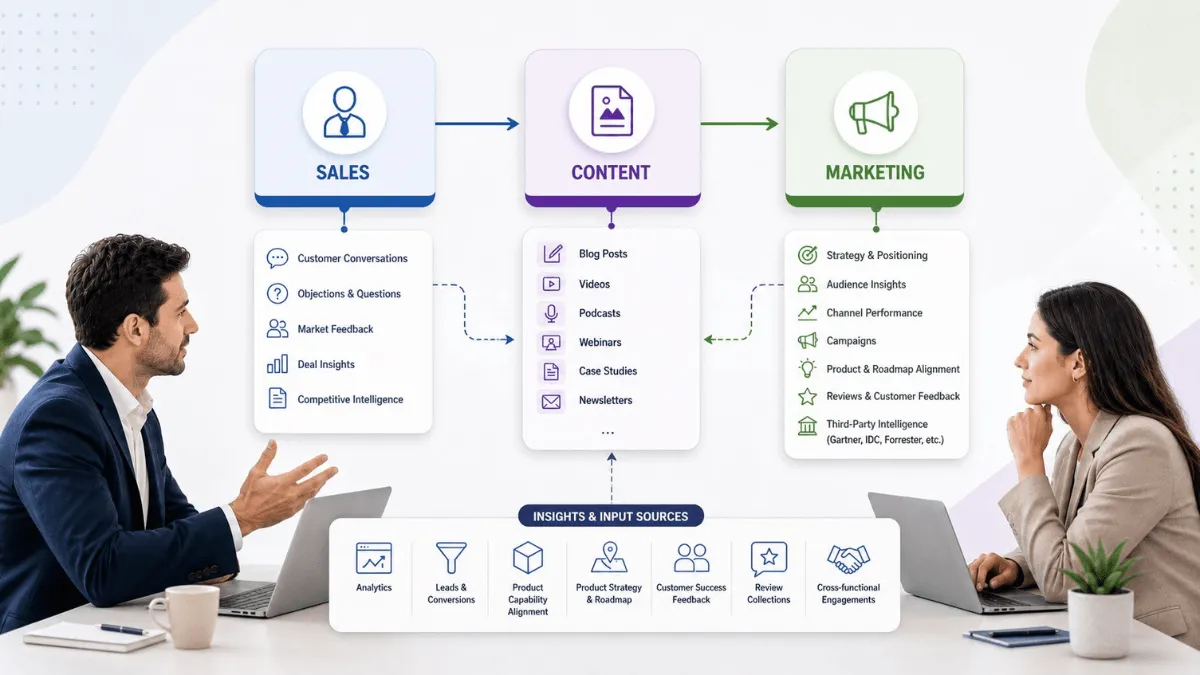
Marketing sees:
First-party data
- Analytics behavior
- Traffic sources
- Conversion paths
Lead intelligence
- What actually turns into pipeline
- What stalls and why
Product alignment
- What the product does today
- Where it's headed tomorrow
Customer success feedback
- Why customers stay
- Why they churn
Cross-channel performance
- What drives awareness vs. intent
Lifecycle influence
- From first touch to closed deal to retention
And beyond internal data:
- Analyst perspectives from Gartner, IDC, Forrester
- Market trends
- Competitive positioning shifts
In other words: marketing sees patterns. Sales sees moments.
Both matter. But they are not interchangeable.
The mistake is treating them like they are.
The 95-5 Problem Nobody Talks About
LinkedIn's B2B Institute research surfaced something that should change how we think about content: at any given time, 95% of your potential buyers are not in-market.
They're not ready to buy. They're not talking to sales. They're not evaluating vendors.
But they're still consuming content.
They're forming opinions. Building mental shortlists. Deciding who sounds credible before they ever raise their hand.
That's the audience sales never reaches.
And if our content is entirely sales-informed, we're ignoring 95% of the people who will eventually matter.
That's not a content problem. That's a growth problem.
The Dangerous Shortcut: "Just Post What Sales Says"
I've seen this happen more than once.
Sales teams push for:
- Posting conversations as-is
- Turning calls into blogs
- Publishing raw takes
It feels authentic. Fast. Real.
But here's the problem:
- It doesn't scale: One conversation is not market truth. It's one data point.
- It lacks the abstraction buyers need: Sales talks in specifics. Marketing has to communicate in patterns. They're different skills, different frames.
- It breaks positioning: Messaging becomes inconsistent, reactive, and fragmented across touchpoints.
- And worst of all: It slowly erodes how our product is understood — externally and internally.
When Sales Starts Judging Content (Without Seeing the System)
Another pattern I've seen, and it's a common one:
Sales teams evaluating content like this:
- "This post won't bring customers"
- "This isn't what prospects are asking"
- "This won't convert"
But that judgment comes from one narrow lens: direct conversations.
What it ignores:
- The role of content in awareness creation
- The compounding effect of repeated exposure over time
- The reality that most B2B buyers never engage with sales early in their journey
The Demand Gen Report found that 47% of B2B buyers consume three to five pieces of content before they even engage with a sales rep.
Not every piece of content is meant to convert.
Some are meant to:
- Educate the market
- Frame the problem before the solution
- Build credibility with people who won't be ready for 6 months
- Shape perception before a competitor does
If we judge everything by "will this close a deal this quarter?", we kill everything that makes deals possible in the first place.
That's not pessimism. That's how compounding content actually works.
The Real Risk: Messaging Gets Distorted
This is where it stops being a marketing problem and becomes a business problem.
When sales-led thinking dominates content:
- Messaging becomes inconsistent across channels
- Product capabilities get misrepresented in public-facing material
- Positioning drifts without anyone noticing
- The wrong audience gets attracted, creating downstream problems in sales cycles and retention
And here's the hardest truth:
Sales teams often believe they understand the product's messaging — even when there are real gaps in that understanding.
That gap shows up as:
- Overpromising on capabilities
- Misaligned expectations post-sale
- Poor-fit leads clogging the pipeline
- Longer, messier sales cycles
And ultimately: lost revenue that traces back to a content and messaging problem nobody diagnosed correctly.
HubSpot's research shows that companies with tightly aligned sales and marketing generate 208% more revenue than those operating in silos. That number isn't just about collaboration. It's about who owns what.
This Isn't About Sales vs. Marketing
Sales is not the enemy. Let's be clear about that.
Sales input is critical. They bring:
- Real objections we'd never surface from data alone
- The actual language buyers use
- Friction points that expose product gaps or messaging blind spots
But here's the line that matters:
Sales should inform content. Not drive it.
Because:
- Sales closes deals
- Marketing creates the conditions for those deals to exist
If we reverse that?
We don't get alignment. We get chaos that looks like collaboration.
What Actually Needs to Change
This isn't about process tweaks or better standups.
It's about ownership being clear and defended.
Marketing has to own:
- Audience definition
- Messaging architecture
- Narrative and positioning
- Content direction and editorial judgment
Sales should:
- Feed insights regularly
- Challenge assumptions with real examples
- Validate what's resonating and what isn't
But not dictate execution.
The shift is simple to say, hard to hold in practice:
Sales feeds the system. Marketing decides what gets built.
The Bottom Line
If our content is driven by the latest sales call, the loudest internal voice, or the most recent objection — we're not building a strategy.
We're reacting.
And over time, that reaction becomes something genuinely dangerous:
Noise that looks like activity, but builds nothing.
Real content strategy doesn't just respond to what sales heard yesterday.
It compounds over time — shaping how a market thinks, building trust before buyers are ready, and creating the conditions that make sales conversations easier, shorter, and more qualified.
That's the difference between a content factory and a content strategy.
One keeps us busy. The other builds the business.
FAQs
Q: Isn't sales input the most direct form of customer feedback? Why shouldn't it drive content?
Sales input is valuable — but it's a filtered signal, not a complete one. Sales interacts with buyers who are already aware and evaluating. That's maybe 10-20% of your total addressable audience at any point. Marketing needs to speak to the other 80%, too. Use sales input as one input among many, not the primary editorial compass.
Q: How do we get sales teams to buy into this without creating friction?
Start by making the data visible. Show them what content actually drives pipeline — not just what sounds relevant. When sales teams see that early-stage educational content is influencing deals they eventually close, the conversation shifts. It becomes less about opinion and more about evidence.
Q: What does good sales-marketing collaboration actually look like?
Regular insight-sharing sessions where sales briefs marketing on objections, language, and friction — but marketing retains editorial judgment on what to build from those insights. A shared content calendar with visibility into intent. And a clear RACI that defines: sales informs, marketing decides, both measure together.
Q: How do we know if our content has already become "noise"?
A few signals: your content topics change based on who spoke up last in a meeting, your blog reads like a feature list or objection handler, your messaging is inconsistent across the website vs. sales decks vs. social posts, and your content drives traffic but not pipeline. If two or more of those are true, you've likely crossed into reactive territory.
Q: Is this problem unique to B2B?
It's more acute in B2B because the buyer journey is longer, the buying committee is larger, and the role of content in the pre-sales phase is disproportionately important. But the underlying issue — letting one internal function override another without the data to back it — shows up across industries and company sizes.
Get the monthly briefing
One high-signal edition a month on B2B growth, AI search, and agentic marketing. No noise, unsubscribe anytime.