The Most Dangerous Marketer Isn’t the Inexperienced One - It’s the reactive one
For a long time, I thought being a good marketer meant being responsive.
Quick replies.
Fast turnarounds.
Jumping into every request.
Saying yes to “just one small thing.”
My calendar was full.
My Slack never quiet.
My to-do list always growing.
From the outside, it looked like productivity.
From the inside, it felt like progress.
But over time, I noticed something uncomfortable:
The marketers who advanced fastest weren’t the busiest.
They weren’t the ones replying instantly or juggling ten requests.
They were the ones protecting time to think.
At first, I assumed they just had lighter workloads.
Later, I realized they were making deliberate choices.
They prioritized leverage over activity.
Because when I looked honestly, the projects that truly moved the needle — positioning clarity, customer insight, narrative strategy — were always the ones I postponed.
Not because they weren’t important.
Because they required focus.
And focus is expensive in modern marketing.
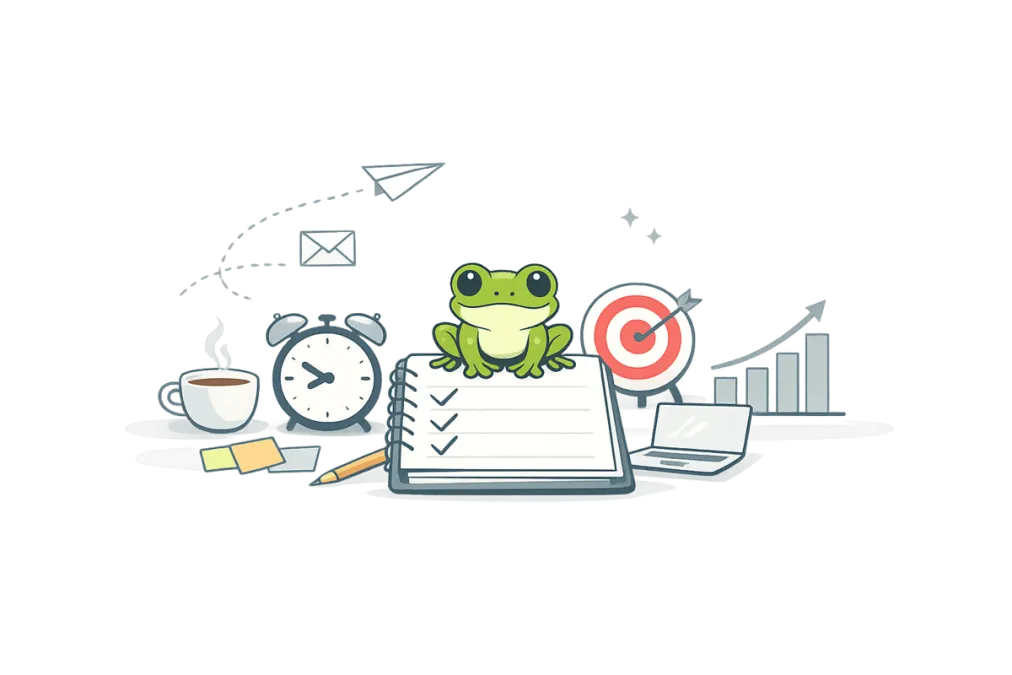
A simple idea from Eat That Frog landed differently for me:
If you don’t do your most important work first, it rarely gets done well.
In marketing, that’s not just a productivity tip.
It’s a career strategy.
The Real Frog Isn’t a Task
The book teaches doing important tasks first.
And I do follow that principle.
But over time, I realized something deeper:
For marketers, the most important work is rarely a “task.”
It’s strategy.
It’s thinking.
It’s pattern recognition.
It’s understanding what’s shifting in the market.
It’s connecting signals before they become trends.
That kind of work doesn’t live on a checklist.
I started noticing how easily marketers — myself included — get consumed by tasks defined by others:
Campaign requests
Asset creation
Internal asks
Reporting cycles
All valid.
All necessary.
But tasks are not strategy.
If all your time is spent executing, when do you step back and see what’s really happening?
When do you question direction?
When do you anticipate change?
When do you prepare for what’s next?
That’s where focus stops being a productivity hack and becomes a competitive advantage.
The Busyness Illusion in Marketing
Modern marketing quietly rewards busyness.
Being active looks valuable.
Being available looks collaborative.
Being overloaded looks important.
But busyness can be a form of avoidance.
Because deep thinking is harder than quick execution.
It has no instant feedback.
No visible completion.
No quick validation.
Yet that’s where real leverage lives.
A single sharp insight can outperform months of campaigns.
A clear narrative can simplify dozens of downstream assets.
A well-defined ICP can focus entire GTM motions.
High-leverage thinking reduces chaos before it begins.
How This Connected My Other Realizations
Earlier in my journey, I had two major shifts.
One was realizing marketing must be built into the product itself — not layered on later. That changed how I think about remarkability.
Another was recognizing how easily companies get trapped competing in crowded spaces. That reshaped how I think about markets and positioning.
But I eventually saw the missing link:
Neither insight matters if you don’t create time to think.
Remarkability requires reflection.
Market creation requires perspective.
Both require stepping back from execution mode.
That’s where Eat That Frog became more than a productivity lesson.
It became a self-leadership lesson.
Because you can’t build remarkable products or shape better markets if all your time is spent reacting.
My Practical Framework for Moving from Busy to Impactful
I don’t follow a rigid productivity system.
But I use a simple lens to protect high-impact work.
Not rules — just checkpoints.
1) The Leverage Filter
Does this create long-term leverage or short-term output?
Leverage work includes:
- Positioning clarity
- Customer insight
- Strategic narratives
- ICP refinement
If my week is full of output but empty on leverage, that’s a warning sign.
2) The Real Frog Question
What am I postponing because it requires deep thinking?
That’s usually the real frog.
Not the hardest task — the most cognitively demanding one.
3) The Focus Block Rule
My best thinking gets my best hours.
Not leftover time.
Not between meetings.
Not after Slack drains my attention.
4) The Reactive vs Strategic Check
At the end of the week, I ask:
Did I shape direction, or only respond to it?
Both matter.
Only one compounds.
5) The Six-Month Test
Will this still matter in six months?
If not, it rarely deserves my best energy.
I don’t apply these perfectly.
But they keep me from drifting into permanent busyness.
Because busyness is easy to justify.
Impact requires intention.
My Ongoing Practice
Some weeks are reactive.
That’s reality.
But now I notice it faster.
And correct course sooner.
I’ve learned that protecting thinking time isn’t selfish.
It’s part of the job.
Because in marketing, clarity is a force multiplier.
And clarity needs space.
Closing Reflection
Eat That Frog didn’t turn me into a productivity machine.
It made me more aware of where my real value lies.
Marketing isn’t just about output.
It’s about judgment.
And judgment improves when your best mental energy goes to your most meaningful work.
The marketers who grow fastest aren’t the busiest.
They’re the ones who consistently do the work others postpone.
Not because it’s easy.
Because it matters.
TL;DR
Eat That Frog reshaped how I define productivity as a marketer.
Key shifts:
- Busyness ≠ effectiveness
- The real frog is strategic thinking
- Tasks are necessary but not strategy
- Focus is a competitive advantage
- High-impact work feels uncomfortable
- Senior marketers manage attention, not just tasks
Bottom line:
Your impact is shaped less by how much you do and more by whether you protect time for the work that compounds.
Frequently Asked Questions
Q: Isn’t marketing naturally reactive?
Partly. Marketing supports multiple teams. Some reactivity is inevitable.
The issue is when reactive work consumes all your best energy and leaves no space for strategy.
Q: How do you protect focus in a fast-moving team?
Transparency helps. I communicate when I’m doing deep work and unavailable for quick requests.
People respect it when they see the results.
Q: What if leadership values speed over strategy?
Tie strategy to outcomes.
Show how clarity improves conversions, alignment, and efficiency.
Q: How do I identify my real frog?
Usually:
- The work you keep postponing
- The work that requires deep thinking
- The work with long-term impact
Discomfort is often the signal.
Q: Does this mean saying no more often?
Yes — thoughtfully.
Focus isn’t about doing less.
It’s about doing what matters.
Get the monthly briefing
One high-signal edition a month on B2B growth, AI search, and agentic marketing. No noise, unsubscribe anytime.