
For two decades, paid search was built on control.
Marketers engineered campaigns around match types, negatives, and tightly segmented ad groups. Precision at the keyword level was the competitive edge.
That architecture is no longer the growth engine inside Google Ads.
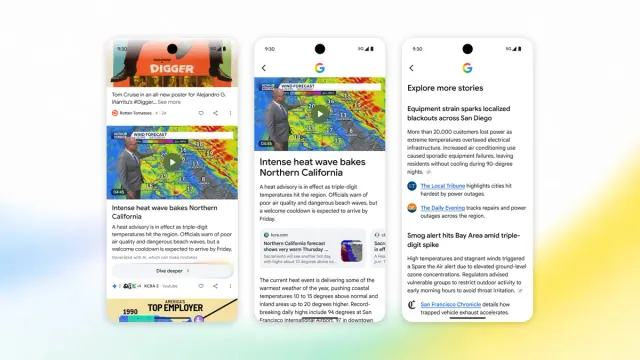
With the expansion of AI Overviews — and ads within them — Google is shifting from keyword-triggered auctions to intent-driven eligibility. As confirmed in Google’s own announcement on ads in AI Overviews and Lens-powered experiences, the search page itself is being restructured.
This is not a feature update. It’s a change in how auctions are decided.
The Auction Now Starts With Intent

AI Overviews synthesize answers at the top of search results for a growing share of queries. According to Google Ads Help documentation, ads can appear within and around these AI-generated summaries when relevant.
The sequence has changed:
- Google interprets user intent and context.
- The system evaluates real-time signals — device, location, behavioral history, predicted conversion likelihood.
- Ads are selected to support that inferred intent.
The auction is no longer reacting only to the literal query. It is responding to a probabilistic model of what the user is trying to achieve.
Industry reporting has confirmed the expansion of these placements beyond limited testing, signaling this is structural — not experimental.
Informational Queries Are Now Commercial Inventory
Traditional paid search separated traffic into informational and transactional buckets.
That distinction is weakening.
A query like “Why is my pool green?” historically sat in the informational category. Today, Google’s systems can infer the commercial implications of that problem state. If resolving the issue requires chemicals or services, ads can appear — even without explicit buying language.
This expands monetizable inventory upstream in the decision journey.
Advertisers who only target bottom-funnel transactional keywords risk missing high-probability intent earlier in the cycle.
Keywords Are Becoming Guardrails
Keyword match types still exist. But their role is shifting.
Exact and phrase match now function primarily to:
- Protect branded terms
- Contain irrelevant traffic
- Allocate budget across priority segments
Growth is increasingly driven by broad match paired with Smart Bidding, which Google formally recommends for reaching incremental queries.
Broad match allows the system to interpret context rather than rely strictly on literal text. When combined with automated bidding strategies, it enables participation in auctions that tightly constrained match types would exclude.
Control moves from query sculpting to goal definition.
Performance Max Is the Automation Infrastructure
Performance Max campaigns represent the clearest expression of this shift.
Instead of targeting individual keywords, Performance Max ingests:
- Creative assets
- Audience signals
- Product feeds
- Conversion data
It then distributes ads across Search, YouTube, Display, Discover, Gmail, and Maps based on predicted performance.
As AI Overviews expand, eligibility increasingly favors advertisers running automation-heavy campaign types. Search-only, manually engineered structures limit exposure to emerging AI-integrated placements.
Automation is no longer optional infrastructure.
Landing Pages Influence Matching
In an intent-driven system, landing pages become part of the targeting signal.
Performance Max uses page content to discover converting queries and generate ad combinations. Pages that clearly articulate the problem and solution align better with AI reasoning systems.
Thin promotional pages are disadvantaged. Contextual clarity improves both matching and conversion performance.
A Strategic Reset for Advertisers
The evolution of Google Ads reflects three structural changes:
- Intent prediction is superseding strict keyword matching.
- Automation is replacing manual campaign engineering.
- Commercial signals are surfacing earlier in the search journey.
Adapting requires:
- Clean, accurate conversion tracking
- Strategic use of broad match with Smart Bidding
- Deployment of Performance Max to access cross-channel inventory
- Landing pages aligned with user problem states
Keywords remain part of the system.
But they are no longer the primary growth lever.
In an AI-mediated search environment, visibility is determined less by the exact term a user types — and more by how well your campaigns align with Google’s interpretation of intent.
That is the new operating reality for advertisers.
Get the monthly briefing
One high-signal edition a month on B2B growth, AI search, and agentic marketing. No noise, unsubscribe anytime.