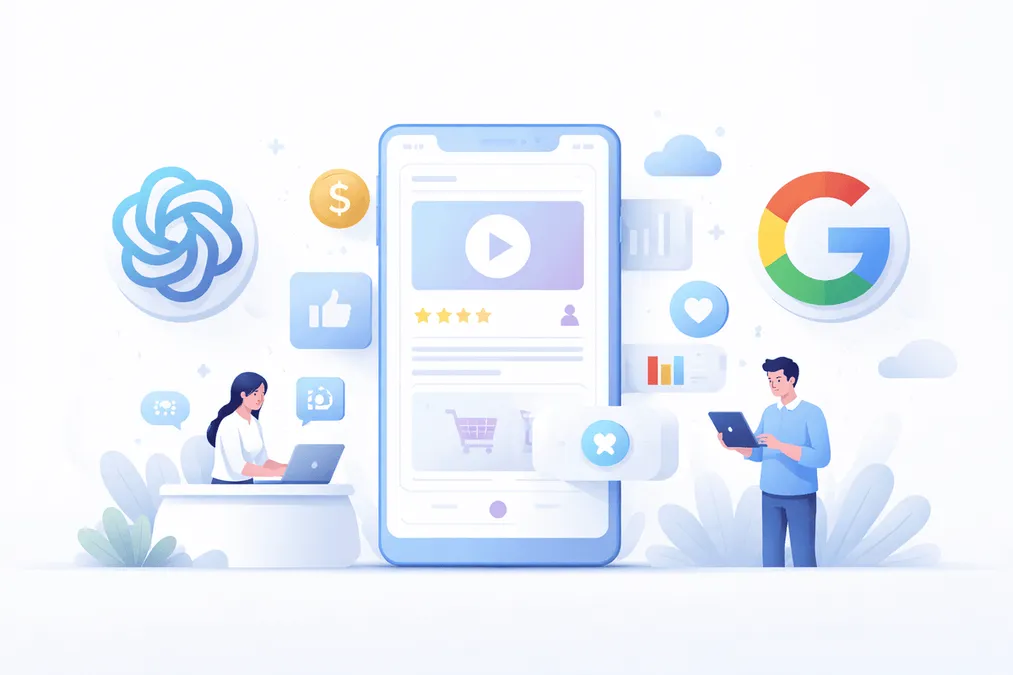
As AI becomes the front door to discovery, two giants are redrawing the rules of digital advertising — and they’re heading in very different directions.
On one side: conversation-first monetization.
On the other: commerce-first automation at planetary scale.
The battleground is no longer the search results page. It’s the answer itself.
OpenAI’s Bet: Ads That Feel Like Answers
Inside a recent company discussion, OpenAI executive Assad Awan outlined how advertising could appear within ChatGPT — and the approach is deliberate.
No banners.
No pop-ups.
No flashing sidebars.
Instead, ads would appear as clearly labeled sponsored responses, integrated directly into a conversation.
If a user asks for the best accounting software or running shoes, a sponsored recommendation could appear within the answer — written in the same tone, format, and structure as the assistant’s organic response.
OpenAI’s guardrails are explicit:
- Clear labeling — Users must know what is sponsored.
- Contextual relevance — Ads tied only to the active query.
- No private conversation targeting — Personal chats won’t fuel ad profiling.
This is a radical shift in ad mechanics.
In traditional search, brands fight for pixel position.
In conversational AI, they compete for credibility inside an answer.
The optimization question changes:
How do you create sponsored content that feels genuinely helpful — not manipulative — inside an AI-generated response?
If OpenAI succeeds, sponsored placements won’t feel like ads. They’ll feel like expert suggestions — with disclosure.
That’s not a media buy problem.
That’s a trust design problem.
Google’s Bet: AI Everywhere, Commerce First

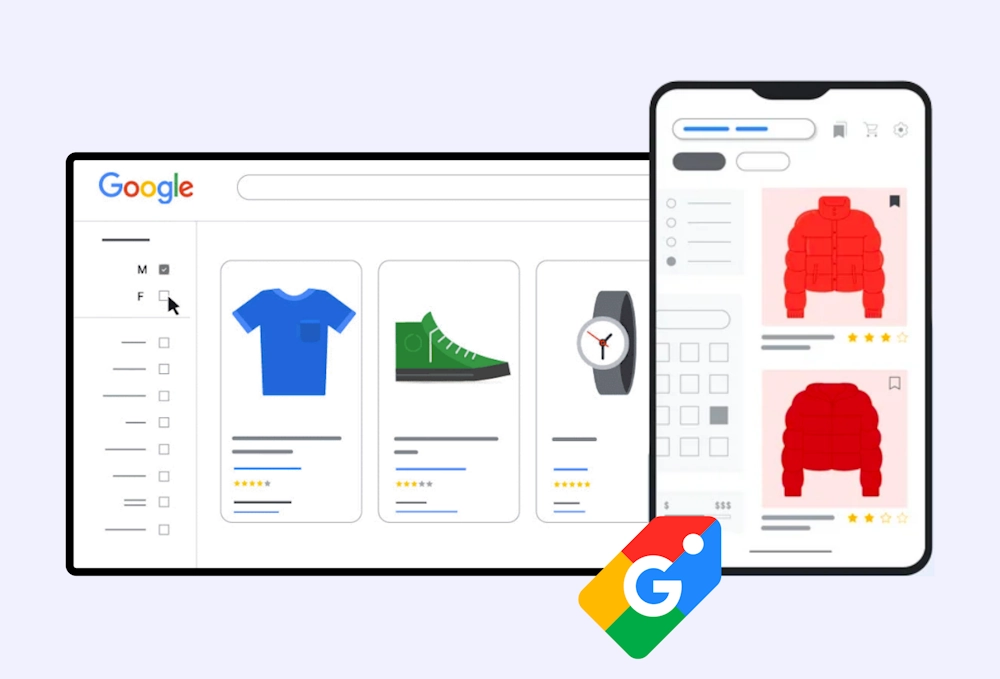
While OpenAI builds native ad experiences inside chat, Google is reinforcing its empire.
In her annual ads and commerce letter, Vidhya Srinivasan outlined Google’s 2026 roadmap: AI integrated across Search, YouTube, Shopping, and campaign automation.
The message is clear:
AI is not the new product.
AI is the new operating system of Google’s ad stack.
Here’s what that means:
- Performance Max evolves toward autonomy.
Performance Max increasingly decides where budget flows — across search, display, YouTube, and shopping — with minimal human steering. - AI Overviews reshape search real estate.
AI Overviews summarize information directly in results, blending organic insights with commercial discovery. - Commerce tightens its grip.
Merchant feeds, structured product data, and shoppable video become central to visibility.
Google’s strategy doesn’t reinvent advertising.
It supercharges it with AI optimization.
Instead of conversational ads competing for trust, Google’s ecosystem competes for transactional completion.
If OpenAI is building the AI concierge,
Google is building the AI mall.
The Structural Difference
The contrast isn’t cosmetic. It’s economic.
| OpenAI | |
|---|---|
| Monetizing a conversation | Optimizing an ecosystem |
| Ads embedded in dialogue | Ads embedded in infrastructure |
| Competes on trust | Competes on performance |
| Sponsored recommendations | Autonomous campaign allocation |
OpenAI must protect neutrality while monetizing attention.
Google must protect advertiser ROI while reducing clicks through AI summaries.
Both face risk.
- OpenAI’s challenge: If ads feel biased, credibility collapses.
- Google’s challenge: As zero-click searches grow, how do brands measure impact when fewer users leave Google’s surface?
What This Means for Marketers
This is not a cosmetic platform update.
This is a shift from:
- Ranking for keywords
to - Being referenced inside AI systems.
From:
- Buying impressions
to - Earning inclusion inside machine-generated answers.
To stay visible in AI-mediated discovery, brands must rethink foundations:
1. Structured Data Is Now Survival
Merchant feeds, schema markup, clean product catalogs — AI systems rely on machine-readable clarity.
2. Authority Beats Volume
AI models summarize consensus. Thin content disappears. Credible, referenced, high-signal material wins.
3. Conversational Intent Matters
Queries are becoming longer, contextual, and decision-driven. Brands must optimize for questions, not just keywords.
4. Creative Must Feel Native
In a chat environment, tone matters as much as targeting. Ads must read like insight — not interruption.
The Bigger Shift: Discovery Without Pages
We are entering an era where discovery doesn’t necessarily end in a click.
- AI Overviews reduce search page friction.
- Conversational interfaces compress evaluation cycles.
- Product recommendations may occur before a website visit.
The homepage is no longer the first impression.
The AI answer is.
And whoever earns inclusion in that answer — organically or sponsored — owns the moment.
The Strategic Reality
This isn’t OpenAI versus Google.
It’s two visions of how advertising survives in a world where AI mediates information:
- One builds monetization into dialogue.
- The other embeds intelligence into infrastructure.
For marketers, the takeaway is simple:
Visibility in the AI era won’t be bought with louder ads. It will be earned through structure, authority, and trust.
Because when AI becomes the interface,
ads don’t interrupt discovery.
They become part of it.
Get the monthly briefing
One high-signal edition a month on B2B growth, AI search, and agentic marketing. No noise, unsubscribe anytime.