For four years, our SaaS company lived in the high-ACV enterprise world. Twelve-month sales cycles. Six-figure deals. Complex implementations that required dedicated project managers and months of hand-holding. Our sales-led motion worked—we had happy enterprise customers and predictable revenue growth.
But we hit the scaling wall every SLG company eventually faces. Our sales team could only handle so many complex deals simultaneously. Our marketing qualified leads were expensive to generate and took forever to convert. We were leaving money on the table with prospects who needed our core functionality but couldn't justify our enterprise complexity or pricing.
So we built a second product version—same core value proposition, streamlined for simpler use cases. Self-onboard. Usage-based pricing. Minimal sales touch required. The deals we used to lose because they weren't ready for high-contract, complex workflow management started converting. Our average sales cycle dropped from twelve months to four weeks. Sometimes faster.
Here's what surprised me: those "simple" PLG customers didn't stay simple. They grew. They added users. They eventually needed the enterprise features we were already building. What started as a PLG acquisition motion became a hybrid expansion engine.
Pure-play GTM models are dead. Hybrid is not an option—it's the competitive moat.
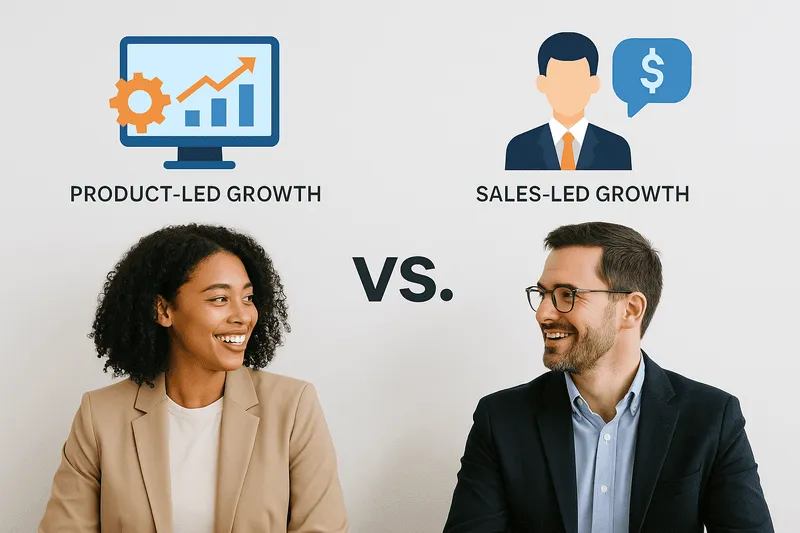
The PLG vs SLG Divide: Why Everyone's Picking Sides
The SaaS world has divided itself into warring camps. In one corner: Product-Led Growth evangelists preaching the gospel of self-serve, viral adoption, and product-market fit as the ultimate growth driver. In the other: Sales-Led Growth traditionalists defending relationship-driven deals, consultative selling, and high-touch customer success.
PLG Champions Say: "The product should sell itself. Remove friction. Let users discover value organically. Scale through viral mechanics."
SLG Advocates Counter: "Complex problems need human solutions. Relationships drive retention. Enterprise deals require consultative expertise."
Both camps are right about their strengths. Both are wrong about their completeness.
Why Pure Models Fail: The Math Doesn't Lie
PLG Hits the Expansion Wall
Product-led companies excel at efficient acquisition but struggle with sustainable expansion. The numbers tell the story:
- Conversion plateau: Most PLG companies see freemium-to-paid conversion rates stagnate around 2-4%
- Expansion challenges: Self-serve customers resist paying for advanced features without human guidance
- Enterprise complexity: Moving upmarket requires sales motions that pure PLG companies aren't built for
The PLG limitation: Products can demonstrate value, but they can't negotiate enterprise contracts or navigate procurement processes.
SLG Scales Revenue, Not Efficiency
Sales-led models build predictable revenue but create inevitable bottlenecks. Human-driven cycles create velocity ceilings, CAC bloat, and friction for modern buyers who expect self-serve options.
- Capacity constraints: Even the best sales teams can only handle finite deal volume
- Rising costs: Sales talent is expensive and getting more expensive
- Buyer mismatch: Forcing sales interactions on buyers who prefer self-service creates friction and lost deals
The SLG limitation: Humans don't scale like software. Period.
Hybrid GTM: The New Playbook
The breakthrough isn't choosing PLG or SLG—it's orchestrating both into a unified growth engine.
PLG is the spark, SLG is the fuel—hybrid is the fire.
Hybrid GTM recognizes that different customer segments, deal sizes, and buying stages require different motions. The magic happens when you can seamlessly move prospects and customers between self-serve and sales-assisted experiences based on their specific needs and signals.
The Hybrid GTM Flywheel
Product Trial → Usage Signals → Sales Trigger → Expansion → Product Adoption → Repeat
This isn't just about having both motions—it's about using data to orchestrate when and how each motion activates. Product usage patterns become sales intelligence. Sales insights inform product development. Marketing orchestrates the entire experience.
Core Hybrid Principles
Signal-Based Activation: Use product behavior to trigger sales interventions at optimal moments, not arbitrary timelines.
Unified Customer Journey: Eliminate friction between self-serve and sales-assisted experiences. Customers should feel like they're dealing with one company, not separate organizations.
Data as the Bridge: Product analytics inform sales strategy. Sales insights guide product roadmap. Marketing orchestrates both.
Case Studies: Hybrid GTM in Action
Zoom: PLG Foundation + Enterprise Sales Layer
Zoom built viral adoption through free video conferencing that delivered immediate value. But their $100B+ valuation came from layering enterprise sales on top of product adoption.
Their Hybrid Approach: Free product creates enterprise opportunities → specialized sales teams drive large-scale deployments → product usage data guides renewal and expansion strategies.
The Result: Zoom can acquire customers at PLG efficiency while expanding them at enterprise scale.
Snowflake: Enterprise Sales + Product-Driven Expansion
Snowflake started with complex data warehouse migrations requiring extensive consultation. But they've increasingly used product trials and usage-based pricing to drive adoption within existing accounts.
Their Hybrid Approach: Sales-led initial deals → product usage drives organic expansion → consumption data guides strategic account management.
The Result: Industry-leading net revenue retention (158%+) by combining relationship-driven deals with product-driven growth.
Notion: Viral Growth + Strategic Enterprise Layer
Notion grew through viral adoption among knowledge workers but recognized that enterprise deals required different motions. They developed enterprise sales while maintaining their product-led core.
Their Hybrid Approach: Product drives individual adoption → team growth triggers enterprise conversations → sales focuses on organizational transformation and compliance.
The Result: Rapid user growth with increasing average deal sizes as they expand into enterprise accounts.
Implementation Frameworks by Company Stage
Early-Stage ($0-5M ARR): PLG Foundation
Focus: Build product adoption engine and understand user behavior
- Start with generous free tier or trial
- Optimize for time-to-value and activation
- Track usage patterns that indicate expansion readiness
- Add inside sales only for clear expansion signals
Key Metric: Product-qualified leads (PQLs) generated per month
Growth-Stage ($5-25M ARR): True Hybrid
Focus: Orchestrate PLG and SLG motions with unified data
- Segment GTM by customer size: PLG for SMB, hybrid for mid-market
- Build product usage triggers that activate sales sequences
- Create specialized product-led sales roles
- Implement revenue operations that bridges product and sales data
Key Metric: Expansion revenue ratio by acquisition channel
Scale-Stage ($25M+ ARR): Sophisticated Orchestration
Focus: Advanced hybrid motions with predictive intelligence
- Multiple product tiers serving different market segments
- AI-powered lead scoring combining behavioral and firmographic data
- Account-based marketing amplified by product adoption signals
- Strategic sales focus on enterprise transformation while product drives usage expansion
Key Metric: Net Revenue Retention by customer acquisition source
The Future of GTM Leadership
Beyond CMO and CRO: The Growth Architect
Every SaaS leader needs to stop asking "PLG or SLG?" and start asking "When and how do we blend both?"
The future belongs to Growth Architects—leaders who can orchestrate product, marketing, and sales into unified revenue engines. These leaders understand:
- Product analytics as sales intelligence: Usage patterns predict expansion better than traditional scoring
- Marketing as revenue orchestration: Moving beyond demand generation to full-funnel optimization
- Sales as product amplification: Using human expertise to accelerate product value realization
The Hybrid GTM Stack
Successful hybrid organizations invest in:
- Customer Data Platforms that unify product and sales touchpoints
- Product Analytics that generate actionable sales signals
- Sales Automation that responds to behavioral triggers, not just demographic data
- Revenue Operations that optimize across the entire customer lifecycle
Breaking Down the Silos
The biggest obstacle to hybrid GTM isn't technical—it's organizational. Traditional companies optimize product and sales teams separately, creating competing incentives and fragmented customer experiences.
Hybrid organizations restructure around shared outcomes:
- Product teams measured on expansion-ready accounts generated
- Marketing teams own full-funnel conversion, not just lead volume
- Sales teams focus on high-value activities while product handles qualification
The Competitive Reality
Companies clinging to pure PLG or pure SLG models are fighting tomorrow's war with yesterday's weapons. While they debate philosophy, hybrid companies are capturing market share by serving customers however they prefer to buy.
The window for hybrid GTM transformation is closing fast. First-movers are already building competitive moats through superior data integration, customer experience, and capital efficiency.
Conclusion: The Hybrid Imperative
In SaaS, growth models aren't religions—they're systems. The next decade belongs to leaders who build hybrid GTM engines that scale with every type of buyer, in every market, at every stage.
The companies that master this integration will dominate their markets. Those that cling to pure-play models will find themselves outmaneuvered by more sophisticated competitors who can serve customers however they prefer to buy.
The only question is whether you'll adapt fast enough to join them.
TLDR: The Hybrid GTM Advantage
The Problem: Pure PLG companies hit expansion walls. Pure SLG companies can't scale efficiently. Both models leave money on the table.
The Solution: Hybrid GTM combines PLG's acquisition efficiency with SLG's expansion power. Use product usage data to trigger sales interventions at optimal moments.
The Framework: Land with PLG (low CAC, fast adoption), expand with SLG (higher ACV, deeper relationships). Bridge both with unified data and revenue orchestration.
The Bottom Line: Companies using hybrid GTM models show 40%+ higher expansion rates and 25% lower overall CAC compared to pure-play alternatives.
Frequently Asked Questions
Q: How do we avoid channel conflict between product and sales teams?
A: Create shared revenue metrics and unified customer success definitions. Product teams should be measured on expansion-ready accounts generated, not just feature adoption. Sales teams should be measured on product usage acceleration within their accounts, not just deal closure.
Q: What's the minimum company size needed for hybrid GTM?
A: You can start hybrid motions at $2M+ ARR. Below that, focus on PLG foundation-building. Above $10M ARR, hybrid becomes essential for sustained growth.
Q: How do we price for hybrid models?
A: Use usage-based pricing with clear upgrade paths. Start with generous free tiers to drive adoption, then create natural expansion moments tied to team size, data volume, or advanced features. Avoid arbitrary user limits that break the product experience.
Q: What's the biggest implementation mistake companies make?
A: Treating PLG and SLG as separate functions instead of integrated systems. Your product team needs to understand enterprise sales cycles. Your sales team needs to read product analytics. Your marketing team needs to orchestrate both.
Q: How long does hybrid GTM implementation take?
A: Plan 6-12 months for basic hybrid capabilities, 18-24 months for sophisticated orchestration. Start with data integration and trigger frameworks before building complex automation.
Q: What about customer experience consistency?
A: Map every customer touchpoint across product and sales interactions. Create unified brand standards and ensure your sales team understands your product's self-serve experience. Customers should feel like they're dealing with one company, not separate product and sales organizations.
Q: How do we measure hybrid GTM success?
A: Track Product-Qualified Leads (PQLs) to sales conversion, expansion revenue by customer acquisition channel, hybrid customer LTV vs pure PLG/SLG cohorts, and time from first product touch to enterprise deal closure.
The transformation from binary thinking to hybrid orchestration represents the next evolution of SaaS growth strategy. Leaders who embrace this complexity will build the dominant companies of the next decade.

Written by Sudheer Kiran
Full Stack Growth Marketing Professional & Fractional CMOHey, I'm Sudheer. I've spent nearly two decades working in growth marketing—mostly with B2B SaaS companies, agencies, and startups. I help businesses find smart, scalable ways to grow through digital transformation, brand strategy, and marketing that actually converts.