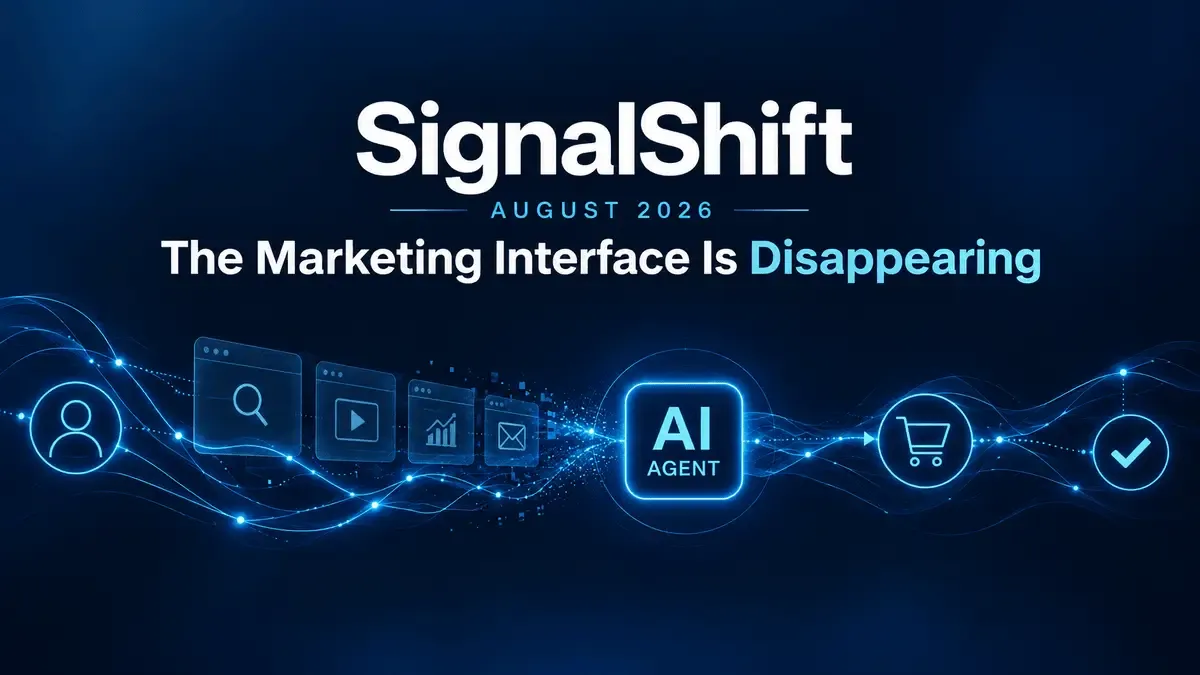
Last month I made the case that the interface between brands and buyers was changing shape — that an intelligent system was starting to sit between the customer and the company, and that marketing's job was shifting from winning attention to influencing the decisions that system makes.
I stand by that. But a thesis like that only earns its keep if the next month shows it showing up somewhere concrete. So this issue isn't going to re-argue that AI is mediating the customer journey. July settled that. August is about what happens once you accept it's true — because the moment you do, a much less glamorous set of questions shows up on your desk: Who operates the martech stack when an agent can run it directly? What does it cost to retrofit an organization built for human-operated channels? Which skills get scarce, and which get cheap? And who pays for all of it when marketing budgets aren't growing?
That's the shift I watched play out in August's actual announcements. Google expanded AI-generated visibility reporting inside Search Console — a measurement admission, really, that the old click-based proof of influence isn't enough anymore. Microsoft pushed AI deeper into search advertising and shopping, changing what a "campaign" even is to operate. Salesforce turned its enterprise applications into capabilities that outside AI agents can operate directly — the martech stack itself becoming agent-native. OpenAI crossed a $1 billion annualized ad run rate in under 200 days, turning a chat interface into a functioning media business. And creators started showing up inside brands' AI-search playbooks, because the evidence AI systems trust now lives outside the company's own website. Google laid out the reasoning behind its new AI visibility controls if you want the source.
None of these, read alone, is a new philosophical claim. Each one is a company quietly rebuilding its product around a premise July already established.
Which is exactly why I think August is the more useful issue for anyone actually running a marketing organization.
If you want the number that captures the tension every CMO I talk to is quietly wrestling with, it's this one: Gartner's 2026 CMO Spend Survey found marketing budgets sitting flat at 7.8% of company revenue, while CMOs are now putting 15.3% of that budget toward AI. Only 30% think their organization is actually mature enough to scale it. I've seen this movie before — new capability, old budget envelope — and it never ends with "we'll just add headcount."
The mediated interface isn't a thesis anymore. It's a set of operating decisions marketing leaders now have to make.
Last month's question was existential: who's making decisions between the buyer's intent and your revenue? This month's questions are operational: Who runs your stack once an agent can run it for you? What gets automated, what gets protected, and who decides? Where does the budget for all of this actually come from, given that marketing spend isn't expanding to match the ambition? And which of your people are you keeping for their judgment, versus their ability to operate software that's about to need a lot less operating? That's why August matters to me — not because it proves the mediation thesis again, but because it's the month the bill for that thesis started arriving.Executive Dashboard
| August Shift | What Changed | Why It Matters |
|---|---|---|
| Agentic marketing | Enterprise platforms are exposing capabilities directly to AI agents | Marketers will increasingly supervise systems rather than operate them |
| AI-mediated discovery | Search and shopping increasingly happen inside AI interfaces | Brands must optimize for recommendation, not merely ranking |
| Conversational advertising | ChatGPT Ads reached $1B annualized revenue run rate | AI assistants are becoming an advertising environment |
| Zero-click influence | Google is adding generative-AI visibility reporting | Traffic is becoming an incomplete measure of marketing influence |
| Machine-readable brands | AI shopping systems depend on structured, current information | Product and brand data becomes part of distribution |
| Distributed authority | AI systems draw from creators, publishers and third-party sources | Brand perception becomes less controllable from owned channels |
| Capability-based martech | Platforms are becoming interoperable through agents and MCP | The application may disappear behind an agent layer |
| Constrained transformation | AI investment is rising while marketing budgets remain tight | Transformation increasingly has to fund itself |
Signal 01: The Marketing Stack Is Becoming Agent-Operated
Last month I focused on the customer-facing half of this shift — agents sitting between buyers and brands. August is the other half: agents sitting between marketers and their own software. For years, our martech stack got more powerful by getting more complicated. I lived this personally — I learned Google Ads, then Analytics, then Salesforce, then HubSpot, then a rotating cast of CDPs, attribution tools, content systems and data warehouses that all promised to be "the one platform" and never quite were. The bargain was always simple: more software meant more capability, as long as you were willing to learn how to drive it. That bargain is starting to break. Microsoft's AI Max for Search now uses AI to expand search-term matching, generate additional creative, and pick the landing page on its own. Google already lets you build and optimize campaigns inside Google Ads through conversation. And Salesforce's August Headless 360 expansion takes this a lot further — it lets authorized AI agents discover and use capabilities across Salesforce's clouds through open standards like MCP, without a human ever opening the app. Microsoft's own writeup on AI Max spells this out clearly. None of this matters because these products "have AI features." Every product has AI features now; that's table stakes. What matters is that the interface to the software is becoming the agent itself.Why We're Calling This a Signal
The first generation of martech was application-centric. You opened Salesforce. You opened your analytics dashboard. You clicked through a campaign builder. The next generation is capability-centric, and that's a genuinely different thing. A marketer doesn't necessarily need to open Salesforce to update a record, open a dashboard to catch an anomaly, or manually assemble every piece of a campaign. Increasingly, you can just specify the outcome and let the software figure out which systems to touch. That quietly redefines what "martech expertise" even means — something I think a lot of ops leaders haven't fully sat with yet.What This Means
The valuable skill is moving up a level. Less: "Do you know how to operate this platform?" More: "Do you know what the system should accomplish, what it's allowed to do, and how to judge whether the result is any good?" We're going to need fewer people whose main value is repetitive platform operation, and a lot more people who can define objectives, set constraints, build governance, and hold the line on quality.Organizational Impact
The marketing ops team stops looking like a platform-administration function and starts looking like an AI orchestration function. That ripples through:- marketing operations
- campaign management
- analytics
- CRM administration
- agency work
- QA
- reporting
- workflow design
What CMOs Should Do Next
Don't start by asking which marketing jobs AI can eliminate — that's the wrong first question, and it tends to make people defensive rather than useful. Start by mapping the actual decisions and workflows sitting inside your marketing org. Sort them: which ones genuinely require judgment, and which ones are really just navigating software? That second bucket is exactly where agentic automation is going to show up first. I'd bet on it happening faster than most roadmaps assume.Closing Thought
The martech stack isn't disappearing. The marketer's relationship with it is.Signal 02: "Machine-Readable Positioning" Just Became a Job, Not a Concept
I flagged last month that the buyer was increasingly a machine, and that agents evaluate on different logic than humans — price, specs, reviews, evidence, not homepage polish. August is where that stopped being an observation and started requiring an actual owner, a budget line and a deliverable. AI shopping is what's forcing the issue. Microsoft says AI-referred visitors convert 42% better than non-AI traffic. It also reports that AI and AI agents influenced roughly 20% of global retail sales during last year's holiday season, and that 72% of consumers now expect AI-assisted shopping experiences from retailers within the next year. Microsoft's shopping research walks through the numbers in more detail. The customer still matters, obviously. But increasingly, a machine decides which products even make it in front of that customer to begin with.Why We're Calling This a Signal
AI shopping systems don't evaluate brands the way people do. I think this is the part a lot of brand teams are underestimating. They don't reward a gorgeous homepage just because it looks good. They need structured, current information — product attributes, availability, pricing, reviews, specs, and other signals they can actually parse and compare. Microsoft is blunt about the downside here: incomplete or outdated product data can cause a product to vanish from recommendations entirely. Not rank lower. Disappear.What This Means
Marketing now genuinely has two audiences. The first is the person who eventually makes the decision. The second is the system deciding which options that person even sees. That's the discipline now needing a real owner: machine-readable positioning. Not a mindset shift anymore — an actual line item someone has to run.Organizational Impact
Product marketing, ecommerce, SEO, data ops and brand teams can't keep treating structured information as back-office plumbing. It's distribution infrastructure now, whether we planned for that or not.What CMOs Should Do Next
Go audit the information an AI system would actually need to recommend your company accurately. I mean sit down and do this, not delegate it and forget about it. Ask yourself:- Is our product information structured?
- Is it current?
- Are our claims independently corroborated anywhere?
- Can an AI actually tell us apart from our competitors?
- What's the piece of missing or bad information that would get us excluded entirely?
Closing Thought
Your next customer may never see your marketing. They may see the answer your marketing helped the machine construct.Signal 03: The Click Is Losing Its Monopoly on Marketing Measurement
Last month I argued search was shifting from ranking to recommendation. Fine as a thesis — but a thesis doesn't show up on your reporting dashboard. This is the number that does. For decades, the click was marketing's most convenient proof that something worked. Someone searched. Someone clicked. Someone visited. Someone converted. That chain was never perfect, but at least it was measurable — and honestly, most of our reporting decks were built entirely on that assumption. AI search is breaking the chain. An August study examining Google AI Overviews found that clicks through to cited sources happened in only about 1% of AI Overview visits, with more browsing sessions simply ending after the AI gave its answer. The paper is worth a look if you're skeptical of that number, as I was. Google's response is to add dedicated generative-AI visibility insights to Search Console — and it says AI Overviews now reach more than 2.5 billion monthly users, with AI Mode past a billion of its own.Why We're Calling This a Signal
Marketing is moving into environments where influence can happen without a visit ever occurring. Someone can encounter your company inside an AI-generated answer, absorb the recommendation, and never click through to the source that actually informed it. Traditional attribution will log that as nothing happened. The customer, meanwhile, walked away with an opinion of you.What This Means
Measurement needs another layer sitting on top of what we already track. Not just: Did they click? But: Were we present in the decision? Practically, that means tracking:- AI visibility
- citations
- recommendation frequency
- branded search
- direct traffic
- assisted pipeline
- consideration
- revenue
Organizational Impact
SEO teams can't stay solely accountable for rankings anymore. Analytics teams can't treat sessions as the whole picture. And brand teams need to stop waving off AI visibility as "an SEO problem" — I've heard that exact line in more than one leadership meeting this year.What CMOs Should Do Next
Start building an AI influence layer into your measurement stack. Don't rip out your traffic metrics. Just stop treating them as the only currency that counts.Closing Thought
The click used to prove that marketing mattered. In AI-mediated journeys, the absence of a click may simply mean the marketing worked earlier than we could see.Signal 04: ChatGPT Has Become a Real Media Market
For a while, the debate was whether AI assistants would replace search. August gave us a more interesting development than that argument: AI assistants are becoming advertising platforms in their own right. OpenAI expanded ChatGPT Ads into 31 European markets in August. Then, on August 31, it announced ChatGPT Ads had hit a $1 billion annualized revenue run rate — in under 200 days from launch — with tens of thousands of advertisers already on the platform and self-serve access rolling out across India, Europe, the Middle East and North Africa. OpenAI's own announcement on the European expansion has the details. That's not an experiment anymore. That's a media business, full stop.Why We're Calling This a Signal
Search advertising intercepts a query. Social advertising intercepts attention. Conversational advertising potentially intercepts decision-making while it's actually happening. A user in a search box types: "CRM software." The same user in ChatGPT might explain their company, their budget, their existing tech stack, and their constraints — unprompted. That's a fundamentally richer environment to advertise into.What This Means
Media planning is shifting from: Where is my audience? to: Where is my audience actually making decisions? ChatGPT, Gemini, Copilot and the rest could become a genuinely new class of high-intent media — not just another placement to A/B test.Organizational Impact
Paid media teams will need to stop thinking in just search, social, display and video, and start understanding conversational environments as media environments in their own right.What CMOs Should Do Next
Don't treat ChatGPT Ads as just another performance channel to bolt onto your media mix. Study the economics of advertising into a space where the user is explicitly telling you what they need. I don't think the bigger opportunity here is cheaper acquisition. I think it's higher-context intent — and that changes what "good creative" even looks like in this channel.Closing Thought
The next generation of advertising may not interrupt a customer's journey. It may show up inside the conversation where the decision is actually being formed.Signal 05: Your Brand Is Increasingly Defined Outside Your Website
The old brand playbook was built entirely around control. Own the website. Publish the message. Buy the distribution. Optimize the search rankings. Manage the narrative. AI search quietly undermines every one of those assumptions. Digiday reported in August that brands are starting to fold creators into their AI-search strategies specifically because large language models pull from social platforms, blogs, news sites and other places well outside a company's control. Digiday's reporting on this shift is a good read if creator strategy sits on your desk. LinkedIn is making a parallel case in B2B: buyers increasingly meet brands through AI-generated recommendations, and credibility gets built through customers, partners and industry voices rather than the company's own claims. LinkedIn lays this out in its B2B research.Why We're Calling This a Signal
An AI model isn't simply reading your website. It's synthesizing the entire internet's opinion of you. That means your brand's external information footprint increasingly decides what machines believe about you — and most of us have spent zero budget managing that footprint deliberately.What This Means
PR, creator marketing, customer advocacy, reviews, analyst relations, community presence and thought leadership are converging into one system: the distributed authority layer of the brand.Organizational Impact
The old lines between SEO, PR, influencer marketing, content, brand and thought leadership start to feel artificial. They're all just feeding evidence into the same machine-driven recommendation engine now.What CMOs Should Do Next
Stop asking only: "What are we publishing?" Start asking: "What would an AI find if it went and investigated us without ever talking to our marketing team?" That's a genuinely harder question to answer honestly. It's also the more useful one.Closing Thought
Your brand is becoming something the internet says about you — not simply something your company publishes about itself.Signal 06: Creator Marketing Is Becoming Media Infrastructure
Creators started out as an alternative to media. Then they became an advertising channel we bought placements from. Now something more interesting is happening — they're becoming inputs into AI discovery itself. Digiday reported that brands are already asking creators for AI visibility as part of campaign briefs, while creators are experimenting with their own strategies to show up more often in AI-generated recommendations.Why We're Calling This a Signal
Creators used to optimize purely for human-facing algorithms — Instagram's feed, YouTube's recommendations, TikTok's For You page. Now there's a second algorithmic layer they're optimizing for: AI systems deciding what information to retrieve and recommend.What This Means
Creator marketing is shifting from: "Can this creator reach our audience?" to: "Can this creator become part of the evidence ecosystem around our category?" That's a genuinely different value proposition, and it means your creator briefs probably need to change.Organizational Impact
Influencer marketing starts overlapping heavily with SEO, PR, brand authority, product discovery, reputation management and AI visibility work.What CMOs Should Do Next
Stop evaluating creators purely on reach and engagement numbers. Start asking whether their content creates durable market evidence — something that gets discovered long after the original post scrolls out of anyone's feed.Closing Thought
The most valuable creator may no longer be the one who reaches the most people today. It may be the one whose opinion keeps getting retrieved tomorrow.Signal 07: Retail Media Is Escaping the Retail Website
Retail media started with a simple pitch: a retailer knows what you buy, so advertisers should get to reach you where you shop. That model is expanding well past its original footprint. Retailers are increasingly pushing their commerce data out into CTV, social and other off-site environments. The strategic asset was never really the ad inventory on the retailer's own website — it's the purchase data sitting underneath it.Why We're Calling This a Signal
As traditional digital advertising loses some of its deterministic signal, transaction data is becoming more valuable, not less. Retailers have something most publishers simply don't: proof of purchase.What This Means
Retail media is turning into a broader commerce-media infrastructure play, not just a sponsored-products line item. The retailer increasingly controls audience data, purchase signals, measurement, attribution and media inventory — all at once.Organizational Impact
Consumer marketing teams will need to manage retail media alongside traditional paid media, not treat it as a separate ecommerce specialty tucked in a corner.What CMOs Should Do Next
Judge retail media networks on more than reach and ROAS. Look at the quality of their first-party purchase signals and how far they can extend those signals beyond their own site.Closing Thought
Retail media's long-term value may not be the ad it sells you. It may be the transaction data it knows happened afterward.Signal 08: The Corporate Website Is Becoming an API for the AI Layer
The website used to be the final destination. Search sent people there. Advertising sent people there. Email sent people there. Content marketing sent people there. AI increasingly doesn't need to bother. Microsoft's shopping guidance makes the underlying shift explicit: agents lean heavily on structured information rather than the visual experience a human sees. Google is simultaneously handing website owners more controls and visibility into how their content shows up inside generative Search.Why We're Calling This a Signal
The website is turning into less of a storefront and more of a knowledge repository that machines consume.What This Means
The question is no longer just: "Is our website optimized for conversion?" It's also: "Is our website understandable to machines?" That makes product data, structured content, FAQs, documentation, claims, pricing, availability and entity information part of the distribution layer — not just supporting content.Organizational Impact
Web, SEO, content, product marketing and data teams get pulled tighter together, whether org charts reflect that yet or not.What CMOs Should Do Next
Treat the website as two things at once: a human experience layer, and a machine-readable knowledge layer. The second one is becoming strategically important faster than most roadmaps I've seen give it credit for.Closing Thought
The future website may have fewer visitors but more influence.Signal 09: Martech Is Beginning to Dissolve Into a Capability Layer
Software companies used to compete to own the application. Salesforce wanted the CRM. Adobe wanted the content workflow. HubSpot wanted the marketing platform. Google wanted the advertising interface. Agents don't care which application owns the function. They care whether they can reach the capability. Salesforce's August Headless 360 announcement is a particularly clean example of this. The company is turning its own applications into reusable enterprise capabilities that authorized AI agents can discover and use through open standards, MCP included. Salesforce's press release is worth reading in full if you run ops.Why We're Calling This a Signal
The organizing unit of enterprise software is shifting from application to capability.What This Means
A future marketing agent might never "use Salesforce" in any way a human would recognize. It might just retrieve customer information, create a campaign, update a CRM record, analyze performance or trigger a workflow — without the marketer thinking for a second about which application actually did the work.Organizational Impact
Vendor boundaries matter less. Integration architecture matters more. And governance matters dramatically more than either of those.What CMOs Should Do Next
When you're evaluating martech spend, add two questions to your checklist: Can this system be operated by agents? and Can its capabilities be used by agents outside its own interface? I think those two questions will decide which platforms survive the next five years and which ones quietly get orphaned.Closing Thought
The martech application may survive underneath the workflow while disappearing completely from the marketer's day-to-day experience.Signal 10: Search Advertising Is Losing the Keyword as Its Fundamental Unit
The keyword used to be the basic unit of search marketing. You chose one. Wrote an ad around it. Picked a landing page. Set a bid. The machine executed your plan. That architecture is steadily getting inverted. Microsoft's AI Max now expands search-term matching well beyond your keyword list, generates additional messaging on its own, and can dynamically pick the landing page. Microsoft frames it explicitly as a way to capture both conventional search behavior and AI-driven search journeys in one motion. Google is heading in the same direction with its own AI Max and automated campaign tools.Why We're Calling This a Signal
The marketer is moving from specifying execution to specifying constraints.What This Means
Campaign management increasingly looks like: define the objective, provide the assets, set the economics, define your exclusions, establish guardrails, evaluate the outcomes. The machine handles more of everything in between.Organizational Impact
Search specialists will need to get comfortable managing systems rather than managing campaigns — which, if I'm honest, is a much bigger identity shift for a lot of PPC folks than it sounds.What CMOs Should Do Next
Spend less time optimizing individual campaign mechanics. Spend more time on high-quality creative inputs, first-party data, conversion signals, business objectives, experimentation and governance.Closing Thought
Search advertising is becoming less about choosing the right keyword and more about teaching the machine what a valuable customer actually looks like.Signal 11: B2B Marketing Is Moving From Attention Generation to Confidence Engineering
AI is making information cheap. Buyers can ask ChatGPT, Gemini or Copilot to explain a category, compare vendors, summarize reviews and build a shortlist — all before a rep ever hears from them. The problem is that better information doesn't automatically create confidence. I'd argue it often does the opposite. LinkedIn's August B2B research frames this directly around credibility and trust, and its broader Buyability framework argues AI is shifting B2B growth away from visibility and toward being trusted, remembered and defensible inside the buying group. LinkedIn's research hub has the full body of work if you want to dig in.Why We're Calling This a Signal
For decades, B2B marketing was essentially an information business — whitepapers, webinars, case studies, product pages, buying guides. The assumption was always that more information moved buyers forward. AI has quietly wiped out that scarcity.What This Means
When information becomes abundant, the scarce resource becomes confidence. Can the buyer defend this decision internally? Can procurement validate the vendor? Can the executive sponsor justify the spend? Can the buying committee actually agree?Organizational Impact
B2B marketing becomes less about producing more content and more about producing evidence.What CMOs Should Do Next
Put your investment behind customer proof, independent validation, original research, credible experts, strong references, transparent product evidence and a genuinely distinctive point of view.Closing Thought
AI can answer the buyer's questions. Marketing increasingly has to answer the harder one: "Why should I trust this decision?"Signal 12: AI Transformation Is Going to Have to Pay for Itself
There's a contradiction sitting under almost every AI marketing strategy I've reviewed this year. CMOs are being told to transform. Budgets aren't transforming at the same speed. That Gartner survey I mentioned earlier bears repeating here: marketing budgets are effectively flat at 7.8% of company revenue, while CMOs are allocating 15.3% of that budget to AI initiatives — and only 30% of organizations call themselves mature or fully ready on AI.Why We're Calling This a Signal
AI isn't arriving during a period of unlimited marketing expansion. It's arriving during a period of resource constraint. That changes the actual question on the table. Not: "How much should we invest in AI?" But: "Where can AI create enough operating leverage to fund the next stage of transformation?"What This Means
The first real AI business case in marketing may end up being cost displacement — not because efficiency is the end goal, but because efficiency is what buys you the capital to fund the higher-value work.Organizational Impact
CMOs will increasingly have to decide which work simply disappears, not just which AI tools get added on top of everything that already exists.What CMOs Should Do Next
Build your AI investment portfolio around three buckets: Automate — the repetitive operational work. Augment — the decisions where a human still has to be in the room. Reallocate — the savings you redirect toward strategy, creativity and customer insight.Closing Thought
The CMOs who win the AI transition may not be the ones with the biggest AI budgets. They may be the ones who create budget through AI.Signal 13: AI Is Reintroducing the Aggregator Problem
The internet keeps recreating the same tension, over and over. Google aggregated information. Amazon aggregated commerce. Facebook aggregated audiences. App stores aggregated software. Every one of those intermediaries made discovery easier while simultaneously gaining real power over the businesses that depended on them. I've watched several categories live through this cycle already. AI assistants are starting to recreate the same dynamic. Microsoft describes a near future where an assistant understands a shopper's requirements, compares alternatives and returns a shortlist — potentially before the shopper ever visits a retailer's website.Why We're Calling This a Signal
The strategic issue here isn't traffic. It's relationship ownership. If the assistant controls discovery, comparison and eventually the transaction, the brand may end up owning the product but not the customer relationship.What This Means
The fight between brands and AI platforms will increasingly come down to identity, data, attribution, recommendations, transaction and loyalty.Organizational Impact
Customer acquisition strategy becomes inseparable from platform strategy — you genuinely can't plan one without the other anymore.What CMOs Should Do Next
Don't optimize exclusively for AI referral traffic. Build real reasons for customers to form a direct relationship with your brand once they've been referred — loyalty programs, accounts, communities, first-party data, customer service, proprietary experiences.Closing Thought
The most valuable click in an AI economy may be the one that creates a relationship the intermediary cannot own.Signal 14: The Scarce Marketing Skill Is Moving From Production to Judgment
Every month, another piece of marketing production gets easier to automate. Search campaigns can be generated. Reports can be summarized. Creative can be adapted. Keywords can be expanded. Landing pages can be selected. Customer data can be queried on demand. Salesforce is exposing enterprise capabilities directly to agents. Google and Microsoft keep automating more of campaign construction and optimization. Put together, this creates a consequence that's easy to miss: production becomes cheap.Why We're Calling This a Signal
When execution becomes abundant, judgment becomes more valuable — not less. That's just basic scarcity economics, applied to marketing talent. The differentiating questions become: What should we do? Why? For whom? What evidence should we actually trust? What should the machine not be allowed to do? What does "good" even mean here?What This Means
Marketing talent moves upstream — from making to deciding.Organizational Impact
The strongest marketers I know are already starting to look less like platform operators and more like strategists, editors, system designers, experiment designers, customer psychologists and business operators.What CMOs Should Do Next
Don't measure AI productivity purely by hours saved. Measure whether your organization is actually getting better at making decisions.Closing Thought
AI makes execution cheaper. That makes judgment more expensive.Signal 15: The New Marketing Funnel Is Not a Funnel
For decades, we drew the customer journey as a funnel: awareness, consideration, conversion, retention. The model assumed a fairly predictable march through channels we could see and measure. AI is making that model very hard to defend with a straight face. LinkedIn's B2B research describes buying groups increasingly using LLMs before they ever speak with sales, with brands getting surfaced, compared and evaluated through AI-generated recommendations long before buyers reach a company's website. The buyer isn't really moving through a funnel anymore. The buyer is asking questions.Why We're Calling This a Signal
The new journey looks less like: Ad → Website → Content → Demo → Sales and more like: Question → AI answer → recommendation → external evidence → comparison → conversation → decision That journey can start anywhere. It can loop back on itself. It can skip your website entirely and never look back.What This Means
Marketing's job shifts from controlling a journey to being discoverable and credible at the moments where decisions actually get made.Organizational Impact
This blurs the neat lines between brand, demand generation, SEO, content, PR, social, product marketing, customer advocacy and sales enablement — probably faster than most org charts can keep up with.What CMOs Should Do Next
Stop organizing every investment around funnel stages. Start organizing around decision moments. Where does the buyer ask a question? Where does an AI construct the shortlist? Where does trust actually get validated? Where does the buying committee disagree? Where does the decision become defensible to the CFO? Those are the moments marketing needs to own now.Closing Thought
The funnel was designed for a world where marketers could see the journey. The next marketing organization will be designed for a world where much of the journey happens outside its view.August in 90 Seconds
Fifteen signals, one structural story: last month's thesis just showed up in the budget, the org chart and the martech stack. AI agents are becoming the interface through which marketers operate advertising, CRM, analytics and enterprise software — Salesforce's Headless 360 is the clearest example of applications turning into reusable capabilities for agents. At the same time, AI assistants are becoming the interface through which customers discover, compare and evaluate products. Microsoft says AI-referred visitors convert 42% better than non-AI traffic, and 72% of consumers now expect AI-assisted shopping within the next year. Then there's the measurement problem. Google is exposing AI visibility as its own distinct form of search performance, while the research on AI Overviews I referenced earlier suggests AI-generated answers can dramatically shrink the click-through we've always used to prove marketing worked. And OpenAI has shown that conversational AI isn't just replacing a search interface — it's become a media business in its own right, hitting that $1 billion annualized ad run rate in under 200 days. Put it all together and the pattern is unmistakable: The marketer is increasingly separated from the software by an agent. The customer is increasingly separated from the brand by an agent. And the space in between is exactly where the next round of marketing competition is going to play out.The SignalShift Perspective
Being Understood by AI Systems Is Last Month's Problem. Being Able to Operate Alongside Them Is This Month's.
It's tempting to read all of this as just another technology cycle. Every platform bolts on an AI assistant. Every agency sells an AI service. Every marketer picks up another AI tool. Then the market moves on to the next thing, like it always does. I think that read misses the actual structural change happening underneath — and I think last month's read, while directionally right, only got half of it. I argued the win condition was becoming positioning: making your brand understandable and credible to the systems mediating discovery. That's still true. But August is where a second, less discussed win condition showed up alongside it — operational readiness. It's not enough to be recommended by the machine if your organization can't actually operate at the speed, cost structure and governance model that agentic execution demands. Put differently: AI increasingly decides what marketing gets seen, what marketing gets executed, and what marketing gets measured — and this month's signals are mostly about the "executed" and "measured" half, which I gave short shrift to in July. That creates three new strategic layers I'd want every CMO thinking about.1. The machine operating layer
Agents will increasingly operate marketing infrastructure directly. The competitive question becomes: How effectively can your organization direct machines?2. The machine discovery layer
AI assistants increasingly decide which brands, products and ideas enter a customer's consideration set in the first place. The question becomes: What does the machine know about you?3. The machine measurement layer
AI-generated answers can create real influence without any conventional traffic to show for it. The question becomes: How do you measure influence when the customer doesn't need to click at all? These three layers aren't independent — they compound. A company with weak data will be hard for agents to operate. A company with weak external authority will be hard for AI systems to recommend. A company with weak measurement won't even know whether either transformation is working. That's exactly why the right response can't be "roll out another AI tool." It has to be a different marketing operating model altogether.What CMOs Should Reconsider
1. The Website
Not just a destination. A knowledge layer for machines.2. SEO
Not just rankings. Presence inside machine-generated consideration.3. Brand
Not just what the company says. What the external information ecosystem says about the company.4. Paid Media
Not just buying audiences. Buying decision moments.5. Martech
Not just applications. Capabilities that humans and agents can orchestrate.6. Analytics
Not just traffic and conversion. Evidence of influence across machine-mediated journeys.7. Marketing Talent
Not just production capacity. Judgment, systems thinking and governance.8. Organization
Not another AI center of excellence. A marketing system designed to operate alongside agents.Signal Ledger
|
Signal |
Structural Shift |
Time Horizon |
CMO Implication |
|---|---|---|---|
| Marketing Stack Becomes Agent-Operated | Application → Agent | 3–5 years | Redesign workflows |
| Two Audiences | Human → Human + Machine | 2–4 years | Build machine-readable positioning |
| Click Loses Monopoly | Traffic → Influence | 2–5 years | Redesign measurement |
| ChatGPT Becomes Media | Search → Conversation | 2–4 years | Expand media strategy |
| Brand Defined Externally | Owned → Distributed authority | 3–5 years | Integrate PR/creator/SEO |
| Creator Infrastructure | Creator → Media infrastructure | 2–4 years | Rethink creator economics |
| Retail Media Expands | Retail ads → Commerce data infrastructure | 3–5 years | Reassess media mix |
| Website Becomes API | Destination → Knowledge layer | 3–5 years | Rebuild web architecture |
| Martech Capability Layer | Applications → Capabilities | 3–5 years | Prioritize interoperability |
| Keyword Loses Importance | Keywords → Business objectives | 2–4 years | Change search management |
| Confidence Engineering | Information → Evidence | 3–5 years | Invest in credibility |
| AI Must Pay for Itself | AI spend → AI-funded transformation | 2–4 years | Tie AI to resource reallocation |
| Aggregator Returns | Direct relationship → AI intermediary | 3–5 years | Protect first-party relationships |
| Judgment Becomes Scarce | Production → Decision quality | 3–5 years | Redesign talent model |
| Funnel Breaks | Funnel → Decision ecosystem | 3–5 years | Organize around decision moments |
Signals We're Watching
1. AI agents becoming autonomous media buyers
The interesting question isn't whether agents can manage campaigns. It's whether brands will eventually hand them authority over real chunks of media budget.2. AI assistants moving from recommendation to transaction
Recommendation is only step one. The much bigger structural shift happens when an assistant can recommend, negotiate, purchase and manage the post-purchase experience end to end.3. Conversational advertising becoming personalized
Today's ChatGPT Ads are deliberately kept separate from the answer experience. The question worth watching is how advertising evolves once the environment understands a user's context, not just their query. OpenAI's August milestone makes this one worth keeping an eye on.4. AI visibility becoming an executive KPI
Google adding generative-AI visibility reporting feels like an early signal here. The next question is whether CMOs eventually see AI visibility sitting right next to reach, pipeline and revenue on the standard executive dashboard.5. Brands building machine-readable knowledge systems
I suspect the winning organizations will eventually maintain something like a formal "AI knowledge layer" — a single authoritative source for product, customer, company, pricing, compliance and positioning information.6. Creator content becoming part of GEO strategy
If AI systems keep leaning on third-party evidence, creator marketing may become part of a much broader brand-discovery architecture rather than an isolated social tactic sitting in its own budget line.7. The first major marketing organization designed around agents
The technology is arriving before the org chart is ready for it. The question I'll be watching heading into 2027 is which company actually redesigns marketing around this new reality, instead of just bolting more AI tools onto the structure they already have.The August Takeaway
The biggest mistake here would be reading August as just another month of AI product announcements — or worse, as a rerun of last month's argument with new logos attached. It isn't. July told you the interface was being mediated. August is the month that stopped being a thesis and started being a set of decisions on someone's desk: whose stack gets rebuilt, whose budget funds it, whose skills survive it. Marketers may no longer need to operate every application. Customers may no longer need to visit every website. Searchers may no longer need to click every result. Buyers may no longer need to research every vendor on their own. That part, I already told you. What's new this month is that none of it makes marketing less important — it makes the org chart, the budget model and the talent bench that support it far more consequential than they used to be. The next generation of marketing organizations will end up competing on three things: What their machines can do. What other machines know about them. And whether humans still trust the outcome. That's the real SignalShift from August 2026 — and I suspect we'll be revisiting it more than once before the year is out. SignalShift™
Get the monthly briefing
One high-signal edition a month on B2B growth, AI search, and agentic marketing. No noise, unsubscribe anytime.