Marketing is entering a strange new phase: the customer isn't always the one doing the marketing journey anymore.
AI is beginning to search, compare, interpret, recommend, and increasingly act on a buyer's behalf. What once required a customer to visit a website, read a product page, compare vendors, and make a decision can increasingly happen through an intelligent intermediary.
The implications are bigger than another wave of AI-powered marketing tools. The interface between brands and buyers is changing.
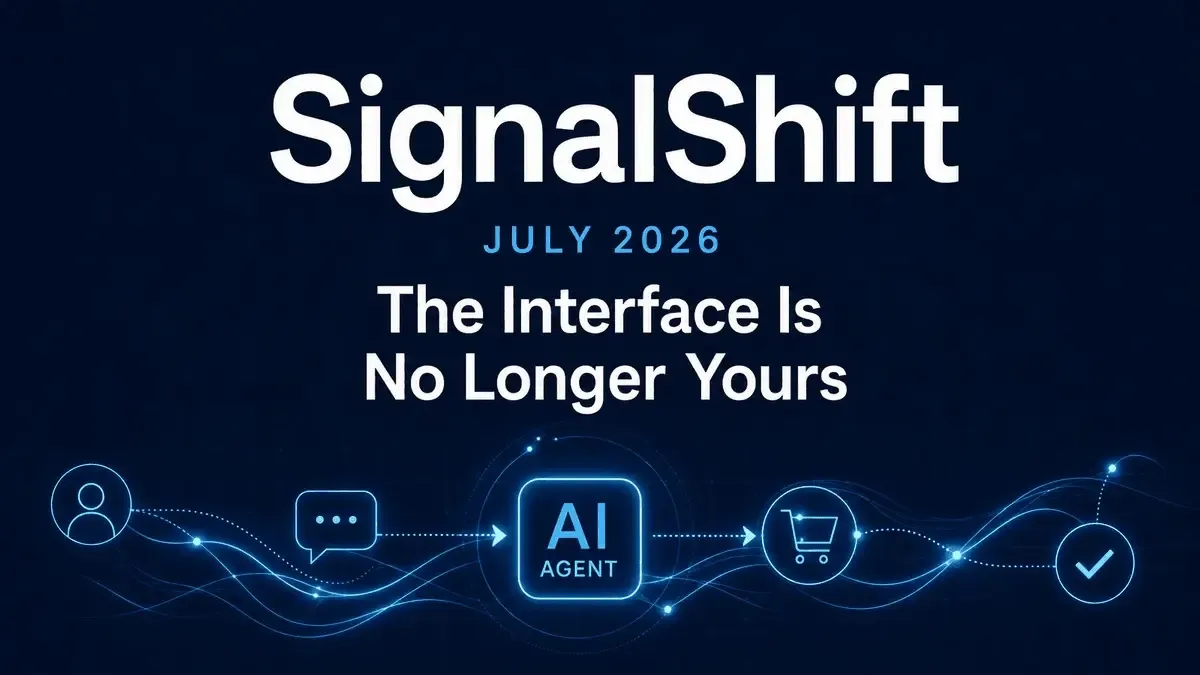
I've spent over 15 years watching search evolve — from ten blue links, to featured snippets, to voice search, to the first wave of "answer engines." And if there's one thing that experience has taught me, it's this: the hard part was never keeping up with the news. The hard part is spotting when a handful of unrelated developments are quietly pointing at the same structural shift. That's the whole premise of SignalShift. Not a news roundup. Not another "AI is changing everything" newsletter. Every month, I'm trying to answer one question:What changed this month that should influence how marketing organizations operate over the next three to five years?Last month's briefing argued that marketing had entered its Intelligence Era — AI was making execution cheaper while making strategic thinking more valuable than ever. July pushes that argument one step further, and honestly, it's the shift I've been quietly bracing for since the first agentic commerce demos started showing up in my feed. The intelligence isn't staying inside the marketing org anymore. It's moving into the customer journey itself. Here's what I mean. Google's Q2 2026 earnings update confirmed that AI Mode has now crossed 1 billion monthly active users, and that AI-powered Search experiences are sending billions of clicks to websites every week. At the same time, Google is weaving conversational, AI-generated guidance directly into its advertising and shopping surfaces. Salesforce didn't sit still either. Its July Agentforce Commerce release shipped Shopper Agent, Buyer Agent, and Merchant Agent — connecting AI-driven discovery directly to catalogs, inventory, orders, and checkout across its commerce stack. And then Visa dropped the one that made me sit up: it confirmed that AI agents are now completing live purchases with participating merchants across Europe — browsing products, selecting items, and initiating transactions on a consumer's behalf, inside defined controls. Read any one of these in isolation, and it's just another AI product launch. Read them together, and something bigger comes into focus. The interface between a company and its customer is changing shape. For two decades, marketing built its whole playbook around owned and rented surfaces — the website, the search results page, the social feed, the inbox, the ad unit, the checkout flow. The customer showed up and interacted with those surfaces directly. That's the model most of us grew up on. That model is cracking. Increasingly, there's an intelligent system sitting between the customer and the company. The buyer asks. The assistant searches, interprets, compares alternatives, weighs the evidence, and recommends. And more and more, it doesn't stop at recommending — it acts. That changes the job. The question used to be simple:
How do we get customers to interact with our brand?Now it's this:
How do we make our brand understandable, credible, and recommendable to the intelligence systems increasingly sitting in the middle of that interaction?That's the central shift I'm calling out this month. Below are six Strategic Shifts I think fall out of it — and what I'd actually be doing about each one if I were sitting in your seat right now.
Executive Dashboard
| Signal | Confidence | Executive Priority | Primary Functions Impacted |
|---|---|---|---|
| 01. The Interface Is No Longer Yours | ★★★★★ | Immediate | Brand, SEO, Product Marketing, Digital |
| 02. The Buyer Is Becoming a Machine | ★★★★★ | Immediate | Product Marketing, Commerce, Demand Generation |
| 03. Discovery Is Becoming Recommendation | ★★★★★ | Immediate | SEO, Content, PR, Brand |
| 04. Marketing Execution Is Becoming Agentic | ★★★★☆ | Next 6–12 Months | Demand Gen, Paid Media, Marketing Operations |
| 05. Content Has Become Cheap. Credibility Has Not. | ★★★★★ | Immediate | Content, Brand, PR, Thought Leadership |
| 06. Data Quality Is Becoming a Revenue Capability | ★★★★☆ | Strategic Priority | Marketing Ops, RevOps, Product, Data |
Executive Takeaways
Three threads run through everything below:- AI is moving from behind the marketer to between the marketer and the customer.
- The customer journey is becoming increasingly mediated by intelligent systems.
- Competitive advantage is shifting from owning attention to influencing decisions.
Signal 01: The Interface Is No Longer Yours
For most of my career, digital marketing ran on one basic assumption: the company owned the destination. The website was the destination. The app was the destination. The store was the destination. Search and advertising were just the on-ramps that got people there. Even social platforms, for all their control over distribution, still ultimately sent people somewhere else to convert. That architecture is coming apart. AI assistants are fast becoming the place where people ask their questions, weigh their options, and decide what to do next — and here's the part that should actually get your attention: AI isn't just answering questions anymore. It's starting to act. Salesforce's July Agentforce Commerce release made Shopper Agent, Buyer Agent, and Merchant Agent generally available, with native integration into ChatGPT and planned connections to Google Search — including AI Mode — and Gemini. Salesforce is positioning these agents to carry the customer journey all the way from discovery through checkout and service, in its own words. Visa's announcement was, to me, even more consequential. In July, it confirmed live agentic commerce transactions running across Europe, where AI agents browsed products, made selections, and initiated purchases on a cardholder's behalf, within consumer-defined limits. That's not a pilot anymore. That's payment rails treating agent-initiated purchases as a normal transaction type. The interface isn't going away. It's being abstracted.Why I'm Calling This a Signal
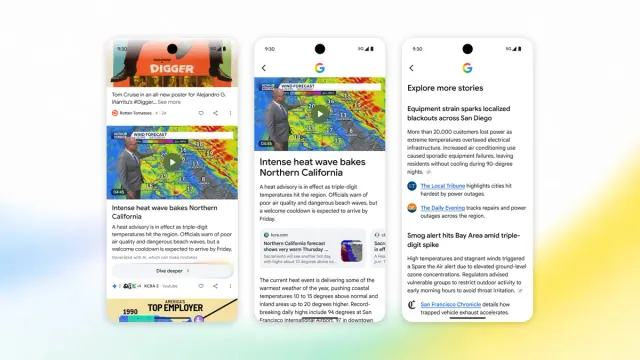
I don't like calling something a "signal" off the back of one press release, so here's the convergence that makes this one real for me:- Platform Signal: Google says AI Mode has crossed 1 billion monthly active users and is driving incremental Search queries, with AI-powered Search now sending billions of clicks to websites every week (blog.google).
- Commerce Signal: Salesforce is wiring AI agents straight into product discovery, inventory, orders, checkout, and service (Salesforce).
- Payments Signal: Visa's live European transactions show agentic commerce has moved past controlled experiments and into real payment infrastructure (Visa).
- Search Signal: Google is already folding AI-generated product guidance, conversational discovery, and AI-powered shopping ads directly into Search results (blog.google).
What This Actually Means
Marketing has always optimized the interface. The homepage. The landing page. The product page. The checkout flow. The ad. The email. That's been the job for as long as I've been doing this. But when an AI system sits between the buyer and those surfaces, the job shifts. You're no longer just optimizing what a human sees — you're optimizing what the system understands about your company. That pulls a whole new set of things into the marketing remit: product information, pricing, reviews, customer evidence, documentation, structured data, brand positioning, third-party validation, availability, integrations, policies. All of it is now part of the experience, whether marketing has claimed ownership of it or not. Your website still matters. But it's becoming one source of truth inside a much bigger information ecosystem — not the whole ecosystem.Organizational Impact
- Digital Marketing — Website work shifts from pure human UX toward human-plus-machine discoverability.
- SEO — Technical optimization is now table stakes. The bigger question is whether AI systems can accurately represent the company at all.
- Product Marketing — Positioning has to hold up consistently across the website, docs, reviews, sales decks, and every third-party source an AI might pull from.
- Brand — Brand equity now depends partly on whether intelligent systems actually understand what your brand stands for.
What I'd Do Next If I Were You
Start with three honest questions:- If a buyer never once visited our website, would an AI system have enough information to explain why we're different?
- Where is AI currently getting its information about our company — and is any of it wrong?
- What happens the moment an AI system puts us head-to-head against our competitors?
- Map your brand's AI discovery footprint.
- Audit every source AI systems are pulling from to describe your company.
- Build one genuine single source of truth for product positioning and claims.
- Tighten up your product documentation and structured data.
- Start tracking AI visibility right alongside your organic search dashboard.
Closing Thought
For two decades, marketing competed to own the destination. The next era is going to compete to influence the intelligence that chooses the destination for the customer.Signal 02: The Buyer Is Becoming a Machine
The buyer used to be human, full stop. Even for something as considered as software, insurance, travel, or enterprise equipment, there was a person on the other end who read, compared, weighed, and clicked. Marketing was built entirely around human cognition — attention, emotion, persuasion, friction, trust. That's the discipline I trained in. Now there's a second participant showing up in the buying journey: the agent. An agent doesn't browse the way we browse. It doesn't care whether your homepage is beautiful. It's not moved by the same persuasion tricks that have worked on humans for decades. It evaluates on a different logic entirely — price, availability, specifications, compatibility, reviews, evidence, constraints. And increasingly, it can just go ahead and complete the transaction itself.Why I'm Calling This a Signal
- Commerce Signal: Salesforce reports that AI influenced 20% of global online sales during the 2025 holiday season — roughly $262 billion — and that retailers running their own shopper agents grew sales 59% faster than those that didn't (Salesforce).
- Payments Signal: Visa has moved agentic commerce into live European transactions, with agents browsing, selecting, and purchasing on a consumer's behalf (Visa).
- Behavioral Signal: A July 2026 CI&T study found that 68% of surveyed UK and Ireland consumers had already used an AI agent while shopping, and 86% had either used one or were open to it.
- Research Signal: Harvard Business Review research found that classic e-commerce persuasion tactics — scarcity cues, countdown timers, strikethrough pricing, bundles, vouchers — don't reliably move AI shopping agents. Star ratings and price did (HBR).
What This Actually Means
We've spent decades getting really, really good at optimizing for human persuasion. Now we also have to optimize for machine evaluation — and those are not the same skill. Picture two products. Product A has gorgeous creative, punchy copy, and a slick website. Product B has clear specs, reliable pricing, strong reviews, structured product data, solid documentation, and consistent information wherever you look. A human might lean toward Product A. An agent will very likely pick Product B. That's a new discipline forming in real time: decision-readiness.Organizational Impact
- Product Marketing — Product information stops being "documentation" and starts being a commercial asset.
- Content — Everything you publish now needs to work for humans and be extractable by machines.
- Commerce — Catalog quality is now marketing infrastructure, not an ops afterthought.
- Brand — Every brand promise needs evidence an intelligent system can actually verify.
What I'd Do Next If I Were You
Run what I'd call an Agent Readiness Audit. Ask yourself honestly:If an AI agent had to compare us against our five toughest competitors without ever talking to our sales team, does it have enough reliable information to choose us?Then go audit: product specifications, pricing, reviews, availability, customer proof, FAQs, integrations, competitive differentiation, documentation, and structured data.
Closing Thought
Your next buyer might not read your marketing at all. Their agent might.Signal 03: Discovery Is Becoming Recommendation
Search used to be a retrieval problem, and a fairly simple one at that. You typed something in. Google handed you links. You picked one. That model built an entire industry around rankings and traffic — an industry I've made a career inside of. AI search adds a layer on top of retrieval that changes the game: recommendation. The question isn't just "can the customer find us" anymore. It's becoming:"Will the system recommend us?"LinkedIn's own analysis of 89,000 unique LinkedIn URLs cited across ChatGPT Search, Google AI Mode, and Perplexity found LinkedIn was the second-most-cited domain in AI search, showing up in 11% of AI responses on average. LinkedIn's guidance to marketers now is straightforward: answer specific customer questions, hold a clear point of view, keep your terminology consistent, and structure content so AI can actually parse it (LinkedIn). Google is arriving at the same place from a different direction. AI Mode already surfaces organic shopping recommendations, and its newer ad formats can place products directly inside AI-generated explanations, not just alongside them (blog.google).
Why I'm Calling This a Signal
- Platform Signal: Google is turning Search into an AI-mediated discovery and recommendation surface (blog.google).
- Content Signal: LinkedIn is explicitly treating its own content as an input into the broader AI search ecosystem (LinkedIn).
- Research Signal: A fast-growing body of AI-search research is treating generative-engine visibility as its own distinct problem — source selection, citation, and answer generation are now studied as a category.
- Behavioral Signal: More buyers are researching vendors and products through AI systems before they ever engage a company directly — something I see reflected in my own inbound patterns.
What This Actually Means
SEO isn't dying. It's getting bigger and messier. The SEO function of the future is going to need to fold together search optimization, digital PR, original research, customer reviews, expert content, product documentation, brand consistency, entity visibility, and AI visibility — under one roof. The goal isn't just to rank anymore. It's to become a trusted source inside the answer itself.Organizational Impact
- SEO — Moves from traffic acquisition toward AI-mediated discovery.
- PR — Third-party authority becomes a direct input into search visibility.
- Content — Original expertise starts outweighing generic topical coverage.
- Brand — A consistent identity helps AI systems correctly identify the entity behind the content.
What I'd Do Next If I Were You
Add AI visibility to your SEO dashboard, right next to your rankings. Track brand mentions, citations, recommendation frequency, competitor inclusion, source domains, category associations, AI-generated comparisons, and share of answer. And ask the question that actually matters:When our customers ask AI which companies they should consider, are we in the answer?
Closing Thought
The next SEO advantage isn't being the first link. It's being the reason the answer exists at all.Signal 04: Marketing Execution Is Becoming Agentic
Last month I argued AI was turning marketing into an intelligence function. July gives us the next data point: the intelligence is starting to act on its own. Salesforce launched an AI marketing team built to work alongside human marketers on pipeline generation, content creation, campaign execution, lead qualification, and customer experience — not as a tool you operate, but as something closer to a teammate (Salesforce). Google, meanwhile, is pushing advertising toward increasingly conversational, AI-powered workflows — ads that answer questions directly, AI-generated product explanations, agents embedded inside the advertising experience itself (blog.google). The distinction worth holding onto here is automation versus autonomy. Automation follows rules you write. Agents increasingly interpret an objective and decide the action themselves. That's a fundamentally different relationship to have with your tech stack.Why I'm Calling This a Signal
- Platform Signal: Salesforce is explicitly framing agents as collaborators capable of building pipeline, creating content, and running campaigns (Salesforce).
- Advertising Signal: Google is pushing campaign execution toward AI-powered targeting, creative generation, conversational discovery, and automated destination selection (blog.google).
- Organizational Signal: Marketing platforms across the board are shifting from "AI as a productivity tool" to "AI as an operating layer."
What This Actually Means
The marketing job is moving up a level. Campaign managers used to spend their days answering: which audience, which keyword, which creative, which bid, which placement, which variation. AI is increasingly capable of answering most of those on its own. What's left for the human marketer is bigger, not smaller: which market actually matters, which customer segment deserves priority, what business outcome we're chasing, what the brand should stand for, which opportunity is worth the investment, what guardrails the system should operate inside. Those aren't campaign decisions anymore. They're commercial decisions — and they belong at a more senior level than a lot of orgs currently place them.Organizational Impact
- Paid Media — Campaign operators increasingly become AI supervisors, not button-pushers.
- Demand Generation — Campaign management starts looking more like revenue orchestration.
- Marketing Operations — Shifts toward governance, data quality, experimentation, and system oversight.
- Marketing Leadership — Spends less time reviewing campaign mechanics and more time setting strategic inputs.
What I'd Do Next If I Were You
Stop asking, "How many marketing tasks can AI automate?" Start asking:"Which marketing decisions should humans keep for themselves?"Over the next 90 days: map your repetitive workflows, flag the ones ready for agentic execution, set clear human-approval thresholds, put real AI governance rules in writing, train your team on orchestration rather than just prompting, and start measuring AI by business outcomes — not by hours saved.
Closing Thought
Automation made marketers faster. Agents are going to force marketers to get a lot more strategic — whether they're ready or not.Signal 05: Content Has Become Cheap. Credibility Has Not.
Generative AI has completely rewritten the economics of content production. A single marketer can now churn out 100 headlines, 50 ad variations, 20 landing pages, 10 blog drafts, and a week's worth of social posts in a fraction of the time it used to take. I've felt this shift in my own daily writing practice. You'd think that would make content more valuable. Instead, it's making generic content worthless — and LinkedIn's response is the clearest tell. The platform says it's actively suppressing the reach of generic, repetitive content using a system trained to detect whether a post actually adds perspective, context, or expertise. In LinkedIn's own initial testing, it correctly flagged generic content 94% of the time (LinkedIn News). Notice the distinction LinkedIn is drawing: it's not punishing AI-assisted content. It's punishing content with no point of view. That's an important line, and one I'd encourage every content team to internalize before they either ban AI outright or lean on it without editing a single word.Why I'm Calling This a Signal
- Platform Signal: LinkedIn is actively cutting distribution for generic AI-generated content (LinkedIn News).
- Search Signal: Google is simultaneously adding transparency to AI-generated ads, with a new "How this ad was made" panel disclosing when generative AI was used (blog.google).
- Market Signal: As AI makes content production abundant, original research, real expertise, and proprietary evidence become relatively scarcer — and scarcity is what creates value.
- Behavioral Signal: AI systems increasingly synthesize across multiple sources, which makes strong external, third-party evidence more important to how a brand gets understood.
What This Actually Means
The content hierarchy is flipping. The old one was volume → visibility → traffic. The emerging one is expertise → evidence → authority → recommendation. The companies that win from here won't necessarily be the ones publishing the most. They'll be the ones with something actually worth saying: original research, real customer evidence, hard-won executive experience, proprietary data, genuine opinions, unique frameworks, implementation knowledge. The stuff you can't get by asking a model to "write a 1,500-word article on X."Organizational Impact
- Content Marketing — Shifts from content production toward knowledge production.
- Thought Leadership — Becomes a genuinely strategic function, not a vanity line item.
- PR — Third-party validation becomes part of your AI visibility strategy, not a separate workstream.
- Brand — A distinct human point of view becomes a real differentiator again.
What I'd Do Next If I Were You
Move part of your content budget from production to provenance. Ask:- What do we know that our competitors don't?
- What proprietary data do we actually have sitting around?
- What customer evidence could we be publishing but aren't?
- Which of our executives genuinely has a differentiated point of view?
- What could we research firsthand instead of just summarizing what's already out there?
Closing Thought
AI can make content abundant. It can't make your company interesting. Only you can do that.Signal 06: Data Quality Is Becoming a Revenue Capability
The first five shifts all point at the same underlying conclusion. If AI systems are increasingly involved in discovery, evaluation, recommendation, and execution, then the quality of the information feeding those systems becomes a commercial issue — not a technical one. This is where the conversation stops being about AI and starts being about data infrastructure. Salesforce's agentic commerce architecture makes the point well. Its commerce agents run against catalogs, inventory, orders, customer relationships, and business logic, and Salesforce is explicit about how much proprietary business data and context matter to whether these agentic experiences actually work (Salesforce). Google is making the identical point from the advertising side. Its AI-powered Shopping system leans on Merchant Center product data to understand context and match products to conversational shopper intent — and Google outright warns that messy or incomplete product data can keep customers from finding you inside AI-driven shopping experiences at all (blog.google). The implication reaches well past commerce: AI cannot make a good decision from bad information. No model, however capable, fixes that.Why I'm Calling This a Signal
- Platform Signal: Agentic systems increasingly depend on direct access to enterprise data, workflows, and business rules (Salesforce).
- Commerce Signal: AI agents need accurate catalogs, availability, pricing, customer context, and transaction data to act reliably at all (Salesforce).
- Search Signal: Google is expanding the role structured product data plays in conversational discovery and AI-powered shopping (blog.google).
- Organizational Signal: Marketing, sales, product, and customer data are increasingly being wired straight into AI systems, not just used for after-the-fact reporting.
What This Actually Means
Marketing data used to exist mainly to answer "what happened?" Then it evolved to answer "who's likely to buy?" The next question data has to answer is:"What should the system do next?"That's a real shift in what data is for. It's decision infrastructure now, not just a dashboard input. Bad data used to just mean a bad report. Now it can mean bad recommendations, bad targeting, bad personalization, bad AI answers, bad customer experiences, and bad automated decisions — all compounding, often invisibly, until something breaks downstream.
Organizational Impact
- Marketing Operations — Owns a lot more than integrations and reporting now.
- RevOps — Data quality becomes directly, measurably tied to revenue execution.
- Product Marketing — Product information becomes operational data, not a static doc.
- Marketing Leadership — Data governance becomes a strategic growth issue, not an IT concern.
What I'd Do Next If I Were You
Build what I'd call a Marketing Intelligence Layer, connecting: Customer → Account → Behavior → Intent → Content → Product → Outcome. Then assign real ownership for: data accuracy, product information, customer evidence, audience definitions, brand claims, AI-readable knowledge, source freshness, and measurement. If no one owns these today, that's your first fix.Closing Thought
In an agentic market, data quality isn't an operations problem. It's a growth capability — treat it like one.July in 90 Seconds
Marketing has spent two decades optimizing for human interaction: get the click, win the attention, drive the visit, convert the visitor. That was the whole game, and most of us got good at it. July shows the next layer taking shape. AI systems are becoming the intermediary between customers and brands — they answer questions, synthesize information, compare products, recommend vendors, evaluate options, and increasingly, they transact. Google says AI Mode has crossed 1 billion monthly active users, while Salesforce and Visa are already building the infrastructure for AI agents to participate directly in commerce. LinkedIn, meanwhile, is adapting its content ecosystem for AI discovery while actively suppressing generic AI-generated content. Same month, same underlying story, told from three different corners of the industry. The customer journey is settling into a new shape: Human Intent → AI Interpretation → Recommendation → Action That means marketing has to evolve from winning attention to influencing decisions. And that changes what actually matters day to day: content needs evidence behind it, brands need credibility, products need machine-readable information, websites need to function as knowledge sources, data needs to be clean enough for machines to act on, and marketing teams need to shift from operating campaigns to orchestrating intelligent systems. The biggest change this month isn't that AI can do more marketing tasks. It's that AI is increasingly doing the choosing.The SignalShift Perspective
Last month's thesis was that marketing had entered its Intelligence Era. This month reveals what happens once that intelligence leaves the marketing org and steps into the buying journey itself. Most teams I talk to are still framing AI purely as a productivity question. How many hours can we save? How many campaigns can we automate? How much content can we generate now? How much can one marketer do? Those are fair questions. They're just not the strategic one. The one that actually matters is:Who — or what — is increasingly making the decisions between a buyer's intent and a company's revenue?For most of digital marketing's history, the answer was simple: the customer. They searched, clicked, compared, chose, and bought. Now an intelligent system can participate at every one of those stages. That rewires the whole architecture. The old marketing system: Brand → Channel → Customer The emerging marketing system: Brand → Data → Intelligence Layer → Customer And eventually, something closer to: Customer → Agent → Market → Agent → Brand That last model is the one worth sitting with. Imagine a buyer telling their agent: "Find me the best CRM for a 200-person SaaS company that integrates with our existing stack, costs less than $X, has strong support, and can be implemented within 60 days." That buyer doesn't want ten thousand search results. They want a decision. The agent can do the research, eliminate unsuitable vendors, compare pricing, weigh reviews, inspect documentation, check integrations, build a shortlist — and eventually, complete the transaction. At that point, our traditional marketing metrics start losing their explanatory power. Impressions don't explain recommendation. Rankings don't explain selection. Traffic doesn't explain influence. Clicks don't necessarily explain conversion. What replaces all of it is something harder to measure but far more consequential: decision influence. That creates a new hierarchy of marketing value, and I think it's worth mapping out explicitly: Attention — Can people see you? Discovery — Can people find you? Understanding — Can intelligent systems accurately explain you? Credibility — Can they validate your claims? Recommendation — Will they include you in the shortlist? Action — Can they help the buyer actually transact with you? The marketing organizations that internalize this progression early are going to have a real edge. Because the future of marketing isn't just about getting better at communicating with people. It's about getting better at being understood by the systems that increasingly communicate on people's behalf.
Signal Ledger
| Structural Shift | Old Model | Emerging Model | Marketing Response |
|---|---|---|---|
| Interface | Website / app | AI-mediated experience | Build machine-readable brand intelligence |
| Buyer | Human decision-maker | Human + AI agent | Optimize for machine evaluation |
| Discovery | Ranking | Recommendation | Measure AI visibility and citation |
| Content | Production | Provenance + expertise | Invest in original knowledge |
| Campaigns | Human execution | Agentic orchestration | Redesign roles around strategy |
| Data | Reporting asset | Decision infrastructure | Treat data quality as revenue infrastructure |
| Brand | Awareness | Confidence | Build evidence and consistency |
| Commerce | Human clicks | Agentic transactions | Prepare product and transaction systems |
Signals We're Watching
A few things I don't have full conviction on yet, but I'm tracking closely.1. Will AI Agents Become a New Advertising Audience?
The next big question in advertising isn't just where ads show up anymore. It's whether ads will start getting designed for AI systems making decisions on behalf of humans, rather than for humans directly. Google is already testing this inside AI Mode, where AI can offer product guidance, explain why something fits a user's needs, and surface sponsored recommendations right alongside its own AI-generated answers (blog.google). The question I keep coming back to:Can advertising influence an agent without destroying the trust that makes the agent useful in the first place?
2. AI Search Without the Click
Search traffic has been marketing's default currency for decades. AI answers are quietly challenging that. If the AI cites your research, pulls in your expertise, recommends your company — and the customer never actually visits your site — what exactly is marketing supposed to measure? Google says AI-powered Search is currently sending billions of clicks to websites every week, but the more important long-term question is what happens as AI systems resolve more of the decision before the click ever happens (blog.google). The industry hasn't built that measurement layer yet. I don't think anyone has cracked it cleanly.3. The Rise of the Agent-Readable Brand
Traditional brand guidelines were written for humans — logo, colors, voice, messaging. I think the next generation needs another layer entirely: What should machines understand about us? Positioning. Category. Use cases. Customers. Competitive differentiation. Proof. Product capabilities. Limitations. Companies that formalize this knowledge early are going to have a real head start as AI systems keep growing as a discovery channel.4. Agentic Commerce Beyond Retail
Commerce agents are starting where you'd expect — retail. But I think the bigger opportunity is B2B. Picture an AI agent that can research vendors, validate requirements, compare solutions, build a shortlist, request pricing, schedule a demo, review security documentation, and kick off procurement — largely on its own. The B2B buying committee of the future might involve fewer humans doing manual research and more humans supervising agent-driven evaluation. That would fundamentally reshape how demand generation works.5. The Death of Generic Thought Leadership
LinkedIn's crackdown on generic AI content might be an early sign of a much bigger market correction. When anyone can publish instantly, publishing itself stops being valuable. Perspective becomes the scarce resource. I think the next real competitive advantage belongs to executives and companies willing to say something specific, original, defensible, and occasionally uncomfortable. Not more content. More conviction.6. Who Owns the Decision Layer?
This might be the single most important question of all. Google owns Search. OpenAI is building conversational discovery and commerce. Meta is building AI assistants that can increasingly research and act. Salesforce is building agentic marketing and commerce infrastructure. Visa is building the transaction rails for agents. This emerging market isn't just competing for users anymore. It's competing to become the intelligence layer through which people make decisions. I'd keep a close eye on this one. Whoever controls that layer ends up shaping what customers discover, what they consider, what they trust, and ultimately what they buy.The One Idea to Remember
Marketing is moving from owning the customer interface to influencing the intelligence that mediates it. That's the structural change July made visible to me. The website isn't dead. Search isn't dead. Advertising isn't dead. Content isn't dead. But every one of their roles is changing shape underneath us. The marketing organizations that win over the next three to five years won't simply be the ones creating the most content, generating the most leads, or automating the most campaigns. They'll be the ones that make their brands understandable to machines, credible to humans, and easy for intelligent systems to recommend and act upon. Because your next customer might never see your ad. They might never read your blog. They might never browse your website at all. They might simply ask:"Which company should I choose?"And increasingly, someone else's intelligence will answer for them. That's it for July. If a specific Signal above hit close to home for your org, I'd genuinely love to hear about it — reply or drop a comment. See you next month.
SignalShift™
Get the monthly briefing
One high-signal edition a month on B2B growth, AI search, and agentic marketing. No noise, unsubscribe anytime.