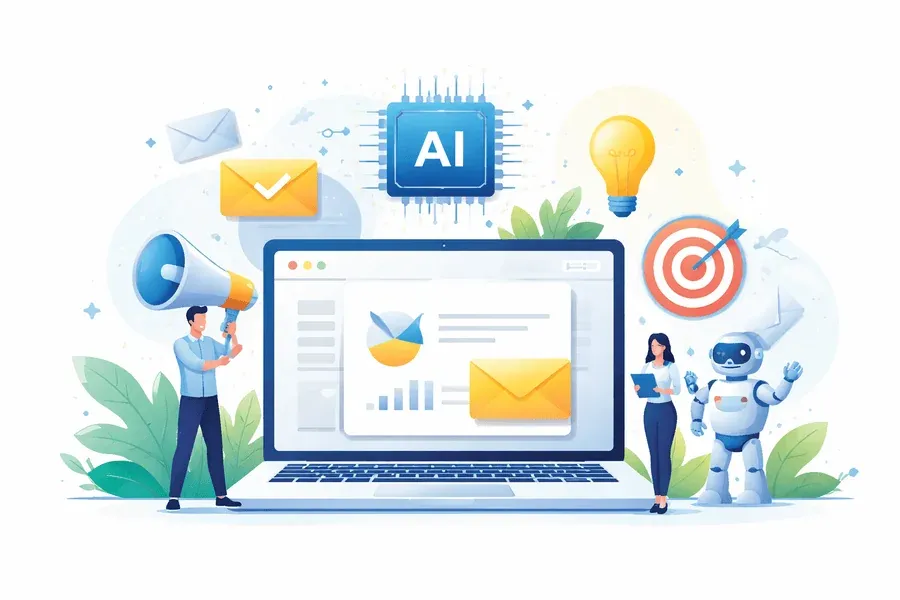
In my previous article, I spoke about how AI has quietly taken over our inboxes and how this shift is about to kill bad email marketing.
That piece was based on what I was personally experiencing with Gmail, Microsoft Outlook with Copilot, and Apple Mail. Subtle changes. Prioritisation shifts. AI-generated summaries. Smarter filtering.
Since publishing that, one question kept coming up in conversations with marketers:
“So how do we stay on top of this?”
That’s the right question.
Because once you accept that AI now decides who gets visibility, the goal is no longer just sending emails.
The goal becomes engineering inbox dominance.
Welcome to inbox engineering.
From email marketing to inbox engineering
Traditional email marketing was campaign-centric.
You built lists.
You designed templates.
You scheduled blasts.
You measured opens and clicks.
Inbox engineering is relationship-centric.
You design behaviour loops.
You shape engagement signals.
You train inbox algorithms.
You optimise for long-term visibility.
The shift is subtle, but profound.
Instead of asking, “How do I get this email opened?”
We now ask, “How do I consistently deserve attention?”
The new game: earning algorithmic trust
Modern inbox AI systems are constantly learning.
Every open.
Every scroll.
Every click.
Every delete.
Every ignore.
All of it feeds into a trust model.
This means every email you send is either:
- Increasing your future visibility
or - Quietly damaging it
Inbox engineering is about stacking the odds in your favour, campaign after campaign.
Let’s break down the playbook.
The Inbox Engineering Playbook
1. Segment by intent, not by identity
The biggest mistake most email programs still make is segmentation based on static attributes.
Job title.
Company size.
Industry.
Location.
These were proxies for intent.
Now we can work with actual intent signals.
Pages visited.
Time spent.
Content consumed.
Features explored.
Trials started.
Pricing visits.
Support tickets raised.
Intent-based segmentation lets you show up exactly when relevance peaks.
And relevance is the strongest signal inbox AI understands.
2. Design campaigns for engagement, not opens
Open rates used to be the primary goal.
In AI inboxes, opens are just the beginning.
What matters far more is:
- Scroll depth
- Click quality
- Time on site
- Post-click exploration
- Return engagement
Your campaign design should push users forward, not just grab attention.
This means:
One clear goal per email.
One primary action.
One narrative flow.
Confusion kills engagement.
Clarity amplifies it.
3. Write for AI summaries and human attention
AI now summarises your emails.
Which means your message may get reduced to one or two lines before the user even sees it.
This forces a shift in copywriting.
Every email must pass a simple test:
If this is summarised in one sentence, does it still feel valuable?
To do this well:
Lead with value.
State outcomes clearly.
Avoid vague intros.
Front-load relevance.
When humans and AI both understand your message instantly, your engagement rates climb naturally.
4. Build inbox reputation, not just sender reputation
Traditional deliverability focused on technical metrics.
Domain health.
IP reputation.
Spam complaints.
Bounce rates.
All of that still matters.
But inbox AI now builds something deeper: behavioural sender reputation.
It tracks:
How users treat your emails.
Not just whether they receive them.
High engagement builds trust.
Low engagement erodes it.
Inbox engineering means obsessing over how every email contributes to long-term reputation, not just short-term metrics.
5. Move from funnels to adaptive journeys
Static drip sequences are becoming obsolete.
AI inboxes favour dynamic, behaviour-driven journeys.
Instead of linear flows, think:
If they read this → show that
If they click this → trigger that
If they ignore this → pause or pivot
The goal is to stay contextually relevant at every step.
When users feel understood, engagement follows naturally.
6. Reduce frequency, increase relevance
One of the hardest mindset shifts for marketers is sending fewer emails.
But in AI inboxes:
High volume + low engagement = rapid invisibility.
Sending fewer, better emails often results in:
- Higher engagement
- Better inbox placement
- Stronger relationships
- Higher lifetime value
Relevance compounds.
Noise decays.
7. Design emails that feel like assistance, not promotion
This is perhaps the biggest opportunity.
Inbox AI is positioning itself as a personal assistant.
Your emails should align with that experience.
Instead of sounding like marketing, they should feel like:
Helpful alerts.
Timely insights.
Actionable updates.
Useful recommendations.
When your emails feel like assistance, not advertising, users engage naturally and AI rewards you with visibility.
The new metrics that actually matter
In the age of inbox engineering, these metrics become your north star:
- Click-through quality
- Engagement depth
- Session continuation
- Repeat interactions
- Conversion velocity
These metrics directly influence:
Inbox placement
AI prioritisation
Future visibility
They are no longer just performance indicators.
They are algorithmic trust signals.
Why this is a massive opportunity
Most marketers are still stuck in:
Templates.
Blasts.
Subject line hacks.
Open rate obsession.
Very few are redesigning their email systems for AI-first inboxes.
Which creates a huge advantage for those who adapt early.
Inbox engineering will soon become:
A competitive moat.
A revenue multiplier.
A brand differentiator.
Final thought
Email marketing is not dying.
It is evolving.
And like every major shift, it will reward those who adapt early and punish those who cling to old playbooks.
We are entering the age of inbox engineering.
Those who master it will own one of the most powerful channels in modern business.
The inbox.
Get the monthly briefing
One high-signal edition a month on B2B growth, AI search, and agentic marketing. No noise, unsubscribe anytime.