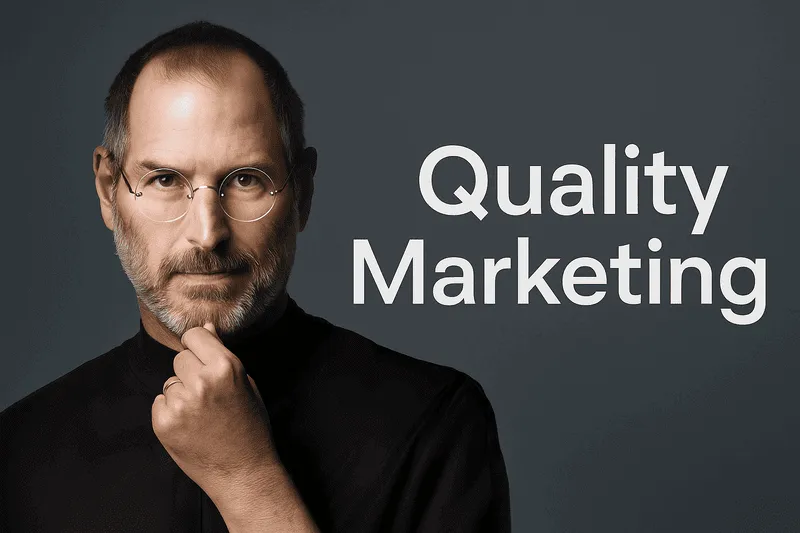
I stumbled upon a Steve Jobs interview that completely changed how I think about SaaS marketing. In it, Jobs made an observation that hit me like a lightning bolt—and it explains why so many SaaS companies are burning through marketing budgets while their competitors quietly steal market share.
Here's what Jobs said that stopped me in my tracks: He noticed that American companies "spend enormous amounts of money on quality" marketing, constantly talking about how great their products are. Meanwhile, "Japanese companies... never see them using quality in their marketing... and yet if you ask people on the street which products have the best reputation for quality they will tell you the Japanese products."
The insight was devastating in its simplicity: While American companies were busy marketing quality, Japanese companies were busy building it.
And that's when it hit me—99% of SaaS founders are making the exact same mistake.
The SaaS Quality Marketing Trap (That I Fell Into Too)
Looking back, I realize I was guilty of this exact mistake in my early SaaS marketing days. We'd spend weeks crafting the perfect messaging about our "enterprise-grade quality" and "industry-leading platform." We'd chase awards, create elaborate comparison charts, and plaster testimonials everywhere claiming how superior we were.
But here's the uncomfortable truth Jobs revealed: Customers "don't form their opinions on quality from marketing... they form their opinions on quality from their own experience with the products or the services."
Every dollar we spent convincing prospects about our quality while delivering mediocre user experiences wasn't just wasted—it was actively damaging our reputation. We were essentially paying to disappoint people faster.
The companies that were quietly eating our lunch? They barely mentioned quality in their marketing. Instead, they obsessed over user experience, constantly improved their product, and let satisfied users do the talking for them.
What Real Quality Marketing Actually Looks Like
After that Steve Jobs revelation, I completely reimagined what quality marketing should be. It's not about claiming quality—it's about strategically building and showcasing quality user experiences that make your product irresistible.
Here's what I learned: True quality marketing means putting the actual quality of your SaaS user experience front and center, and letting those experiences do the talking. Not claims, not awards, not industry recognitions—real user experiences.
Think about it: When someone uses your SaaS and has an amazing experience—when it just works beautifully, solves their problem effortlessly, and makes their day better—they become your most powerful marketing asset. That's quality marketing in action.
The Expensive Trap: Why "Quality Marketing" Backfires for SaaS
Let's examine what happens when companies prioritize quality marketing over quality delivery—what Jobs called "The American Trap," though it's now a global phenomenon affecting SaaS companies everywhere.
Picture the typical scenario: Your company "spends enormous amounts of money on quality" marketing campaigns and "win every quality award there is"—maybe you've got advertising recognition, industry accolades, and a wall full of certificates. Your marketing team creates increasingly sophisticated campaigns about your platform's superiority. But here's Jobs's brutal truth: if "your products don't live up to it customers will not keep that opinion for long in their minds."
Think about it: Your marketing team celebrates winning a "Deming award" or "Baldridge award." You blast it across every channel, add badges to your website, and maybe even throw it in your email signatures. But here's the uncomfortable truth—if your users encounter bugs, experience slow loading times, or struggle with confusing interfaces, those accolades become meaningless noise.
For SaaS companies, this problem gets amplified exponentially. Unlike a one-time physical product purchase, your SaaS is a continuous service relationship. Every login, every feature interaction, every support ticket is a moment of truth that's constantly building or eroding trust. A single frustrating user experience can completely negate months of marketing investment and awards momentum.
I've seen companies spend six figures on marketing campaigns highlighting their "Premium Quality Platform" while their users are simultaneously complaining about downtime on social media. That's not just ineffective marketing—it's reputation damage in real time.
Phase 1: Building Quality Marketing Through Quality Experiences
This is where quality marketing gets strategic. Your job isn't to create better claims about quality—it's to create better experiences that naturally generate authentic quality perceptions.
Define "Quality Experience" for Your Users
First, you need to get crystal clear on what quality actually means in your users' daily reality:
- Reliability & Performance: Your platform loads quickly, operates smoothly, and delivers consistent uptime that users can depend on
- Intuitive Design: Workflows feel natural and efficient, with interfaces that anticipate user needs rather than creating friction
- Value Delivery: Your product consistently solves real problems and helps users achieve meaningful goals
- Responsive Support: When issues arise, your support experience reinforces rather than undermines confidence in your platform
Empower Product Teams with User-Centric Insights
Your unique position as a marketer gives you incredible access to user sentiment and market feedback.
Use this strategically:
- Channel authentic user voices directly to your product teams. Don't just share the complaints—highlight the specific moments when users express genuine delight. Show your product colleagues how these experiences directly impact retention, expansion, and organic growth.
- Champion continuous usability testing and beta programs. As a marketer, you understand that preventing a bad experience is infinitely more valuable than trying to overcome it with messaging later.
- Collaborate with product leadership on metrics that matter. Instead of just tracking vanity metrics, focus on KPIs that reflect genuine user experience: task completion rates, feature adoption curves, support ticket trends, and authentic user satisfaction scores.
Phase 2: Quality Marketing in Action – Letting Experiences Do the Talking
This is where quality marketing becomes powerful. Instead of telling prospects about your quality, you strategically create opportunities for them to experience it firsthand.
Let the Product Do the Talking (Product-Led Marketing)
Remember Jobs's insight: customers form quality opinions "from their own experience with the products or the services." Your job is to create strategic opportunities for this to happen:
Design your freemium model or trial experience to showcase core value immediately. Don't make prospects jump through hoops—let them experience the quality firsthand. I've seen companies transform their conversion rates by restructuring trials around actual user success rather than arbitrary time limits.
Create interactive demos and sandbox environments that let prospects explore key features hands-on. The goal isn't just to show functionality—it's to let them feel the quality of the experience themselves.
Showcase Outcomes & Evidence (The Result of Quality)
This is where your marketing storytelling becomes powerful:
Develop case studies that go far beyond testimonials. Tell detailed stories of how users experienced success and achieved specific, measurable results. Focus on the journey and the moments where your product's quality made the difference.
Encourage and amplify user-generated content organically. When users share genuine success stories, positive reviews, or social media shout-outs, these carry infinitely more weight than any marketing claim. Create systems to identify and thoughtfully highlight these authentic experiences.
Frame your features around improved experiences and delivered value. Instead of listing technical capabilities, tell stories about how these capabilities transform daily workflows and create better outcomes for real users.
Educate and Solve (Thought Leadership with Substance)
Create resource hubs that demonstrate your deep understanding of user challenges. When your educational content consistently delivers value, it reinforces confidence in your product's quality without you ever having to claim it explicitly.
Phase 3: Sustaining Quality Marketing – The Long-Term Strategy
Quality marketing isn't a one-time strategy—it's a continuous commitment to putting user experience quality at the center of everything you do.
Maintain a Robust Feedback Loop
Implement regular in-app surveys and Net Promoter Score measurements—not as vanity metrics, but as early warning systems for experience degradation. When scores dip, dig deeper to understand the specific experiences causing the shift.
Establish Customer Advisory Boards with your most engaged users. These relationships give you direct access to honest feedback and help validate future product directions before they impact your broader user base.
Transparent Communication
Share your product roadmap openly, demonstrating ongoing commitment to enhancing user experiences. When users can see your long-term vision for improving their daily workflows, it reinforces confidence in your platform's future.
Communicate proactively and transparently during service issues or significant updates. How you handle problems often matters more for reputation than avoiding problems entirely. Users respect companies that acknowledge issues quickly and communicate clearly about resolution steps.
Foster a Thriving Community
Build spaces where users can help each other, share best practices, and collectively reinforce positive experiences with your product. Communities become powerful amplification systems for quality experiences—users sharing genuine success stories carry more weight than any marketing campaign.
The Quality Marketing Transformation That Changed Everything
Steve Jobs's insight about American companies versus Japanese companies completely transformed how I approach SaaS marketing. The lesson was simple but profound: Stop marketing quality. Start building it.
Quality marketing isn't about having better claims, shinier awards, or more impressive industry recognitions. It's about creating SaaS experiences so consistently excellent that your users become your marketing department.
When you shift from claiming quality to building quality user experiences, something magical happens. Your users start doing your marketing for you—authentically, powerfully, and more effectively than any campaign you could ever create.
The companies winning in today's SaaS market aren't the ones shouting loudest about their quality. They're the ones whose users can't stop talking about their exceptional experiences.
That's the quality marketing strategy Steve Jobs taught me. And once you start building it into your SaaS, you'll wonder why you ever spent a single dollar trying to convince people you were great instead of just being great.
Your users will do the rest.
Ready to transform your approach to quality marketing? Start by auditing every user touchpoint in your SaaS, identify where quality experiences shine, and build your marketing strategy around showcasing those authentic moments. Your users will become your most powerful marketing asset.
TL;DR
Steve Jobs observed that American companies spend enormous money marketing quality while Japanese companies never mention quality in marketing—yet people recognize Japanese products as higher quality. The lesson for SaaS founders:
- Stop marketing quality, start building it: Focus resources on creating exceptional user experiences rather than claims about quality
- Quality marketing = quality experiences: Let satisfied users do your marketing through authentic testimonials and organic advocacy
- Experience beats claims: Use trials, demos, and user stories to let prospects experience quality firsthand rather than just hearing about it
- Sustainable advantage: When your SaaS consistently delivers exceptional experiences, you build reputation and loyalty that no marketing campaign can match
True quality marketing isn't about convincing people you're great—it's about being so great that your users can't stop telling others.
Frequently Asked Questions
Q: Doesn't this mean I should never mention quality in my marketing?
A: Not exactly. The key is shifting from claiming quality to demonstrating it. Instead of saying "We're the highest quality platform," show case studies of exceptional results, offer hands-on trials, and let user testimonials speak to their actual experience.
Q: How do I measure if our "quality marketing" approach is working?
A: Look beyond vanity metrics to experience indicators: Net Promoter Scores, organic user-generated content, trial-to-paid conversion rates, customer retention, and unsolicited positive reviews. When quality truly speaks for itself, these metrics improve naturally.
Q: What if our product isn't perfect yet? Should we wait to implement this strategy?
A: No product is perfect, and that's not the goal. Focus on identifying and showcasing the areas where you do excel, while being transparent about your improvement roadmap. Users respect honesty and continuous improvement over false perfection claims.
Q: How do I convince leadership to invest in product experience over marketing campaigns?
A: Present the ROI of experience: retention rates from satisfied users, lower customer acquisition costs through referrals, and reduced churn from quality experiences. Show how companies with strong product experiences (like Apple, which Jobs exemplified) achieve premium pricing and loyal customer bases.
Q: Can this approach work for B2B SaaS, or is it mainly for consumer products?
A: It's especially powerful for B2B SaaS. Business buyers are more sophisticated and skeptical of marketing claims. They rely heavily on trials, demos, and peer recommendations. When your product delivers genuine value in their daily workflows, B2B users become vocal advocates within their professional networks.
Q: How long does it take to build a "quality marketing" reputation?
A: It varies, but expect 6-18 months to see significant momentum. Unlike advertising campaigns with immediate visibility, reputation building is gradual but more sustainable. However, you can accelerate the process by strategically encouraging satisfied users to share their experiences and creating more opportunities for prospects to experience your product firsthand.

Written by Sudheer Kiran
Full Stack Growth Marketing Professional & Fractional CMOHey, I'm Sudheer. I've spent nearly two decades working in growth marketing—mostly with B2B SaaS companies, agencies, and startups. I help businesses find smart, scalable ways to grow through digital transformation, brand strategy, and marketing that actually converts.