For three years, the AI industry has been sitting on a genuinely awkward contradiction. Record valuations. Hundreds of millions of users. And almost no one making money.
The fastest-growing consumer technology in history was running on one of the least sustainable business models in modern tech. Sam Altman himself once said he disliked traditional internet advertising. That position, it turns out, has a price tag.
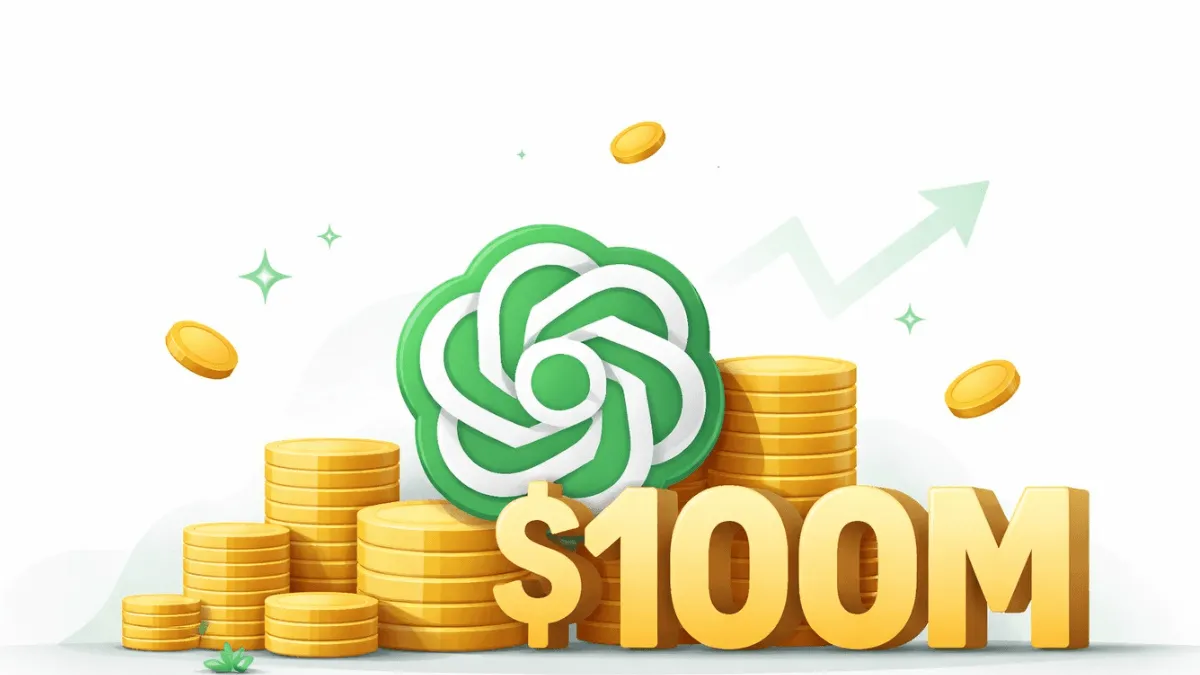
Just six weeks after OpenAI launched its advertising pilot on January 16, 2026, ChatGPT crossed $100 million in annualized ad revenue.
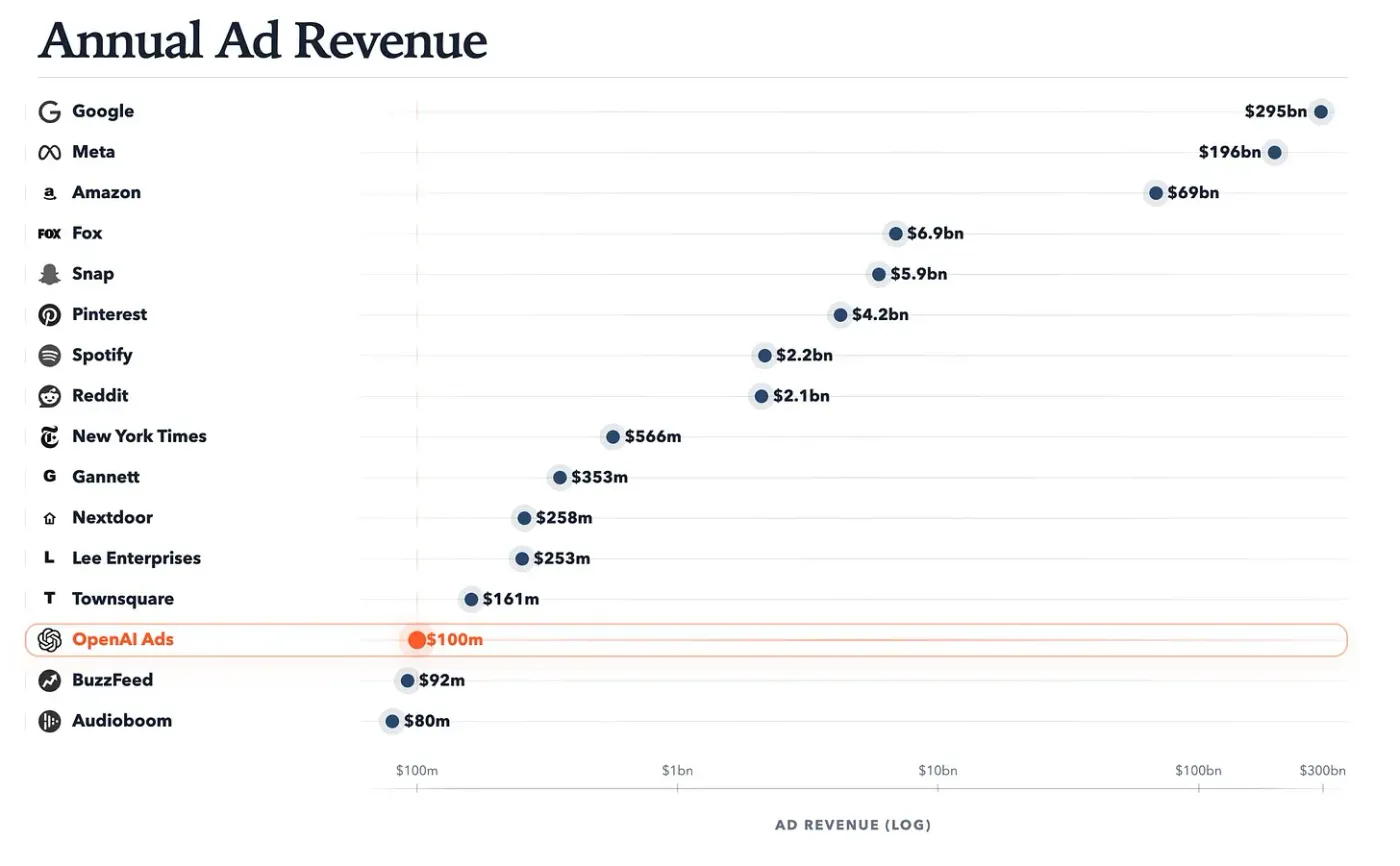
And here's the part that should make every marketer pay attention: ads are currently showing to less than 20% of eligible users, only in the United States, and only on the Free and $8/month "Go" tiers. This isn't a fully deployed monetization engine. It's barely been switched on.
The Financial Reality Behind the Milestone
To understand why this matters, you need to sit with the actual economics of running a frontier AI company.
ChatGPT has 800 million weekly active users. Less than 5% pay for a subscription. That means more than 95% of users are consuming expensive compute infrastructure without generating any direct revenue. On the cost side: OpenAI burned through $2.5 billion in the first half of 2025 alone, with industry projections pointing toward $115 billion in cumulative cash burn through 2029.
Anthropic faces the same math. So does every other major AI lab. The industry has proved it can build technology people love. It has not yet proved it can build businesses that sustain themselves.
Advertising is now the most credible answer to that problem, and OpenAI is betting on it in a serious way. They've hired Dave Dugan, a former Meta ad executive, to lead ad sales. Self-serve advertiser access is scheduled to open in April 2026. Geographic expansion into Canada, Australia, and New Zealand is actively being explored.
The $25 billion annual ad revenue projection for 2029 is starting to look less like analyst optimism and more like a roadmap.
Why 20% Rollout Generating $100M Is the Real Story
Around 85% of Free and Go tier users are eligible to see ads. The current $100M ARR is coming from a fraction of that inventory being activated. When you run the math forward, the scale of what's coming is striking.
The early format is straightforward: clearly labeled "Sponsored Recommendations" appearing in lightly tinted boxes at the bottom of relevant answers. No cookie-based tracking. No ads next to health, mental health, or political topics. No ads shown to users under 18.
Early relevance data supports the approach. Less than 7% of users rate the ads as "low relevance." For a brand new ad product with limited targeting history, that's a strong signal the contextual model is working.
The Go Tier Is Smarter Than It Looks
The $8/month Go tier sits between Free and $20/month Plus. Plus, Pro, and Enterprise subscribers see no ads at all. Go users, like Free users, do see ads, but the audience profile is meaningfully different.
Because Go users are paying a monthly subscription, they signal commercial intent that free users simply don't. They're actively investing in an AI tool to solve real problems, which makes them a genuinely premium audience for advertisers.
That shows up in pricing. Advertising on the Go tier costs 2x to 3x more in CPM and CPC compared to the Free tier. And despite those higher upfront costs, early data shows the Go tier often delivers a lower cost-per-acquisition for B2B and professional services categories. The audience quality justifies the premium.
It's clean segmentation: subscription revenue from users who want more features, and premium ad inventory for advertisers who want higher-intent audiences. Both sides of the equation improve at the same time.
Search Economy vs. Answer Economy: Why This Is Structurally Different
This is the part that most marketers are underestimating.
The Answer Economy is no longer a theory. Google Search catches people early. Someone types a query, they're in discovery mode, comparing options, figuring out what they want. A ChatGPT conversation is much further along. By the time a user sees an ad, they've already explained their situation, received relevant information, and narrowed down what they need. They're not exploring. They're deciding.
That structural difference shows up directly in conversion data. AI search traffic converts at 14.2% compared to Google's 2.8%, roughly a 5x gap. ChatGPT's cost-per-click runs 30% to 60% higher than comparable Google keywords, with some category estimates running 2x to 3x higher. But because conversion rates are dramatically better, the final cost-per-acquisition is often competitive with or better than Google.
This is also why budget minimums are higher. Google lets you test with $5/day. Experts are recommending $3,000 to $5,000/month minimum for ChatGPT campaigns, because the conversational targeting system needs sufficient volume to identify optimal contexts for your ads. Thin budgets produce data too noisy to optimize from.
The Ad Formats Coming Down the Pipe
Right now, users see Sponsored Recommendations at the bottom of answers. That's the starting point. Based on internal mockups and leaked code from the ChatGPT Android beta, here's what's in development:
- Search Ads and Product Carousels for high-intent commercial queries, similar to Google Shopping grids but triggered by conversational context rather than keywords.
- Sidebar Placements with sponsored information panels adjacent to the chat window, including images, pricing, and call-to-action buttons, without interrupting the conversation flow.
- Generative Ads where the AI writes the actual ad copy in real time, customized to the specific details of the user's query. Every ad is effectively a custom creative built for one person in one moment.
- Sponsored Responses positioned at the top of the AI's answers rather than the bottom, for higher-visibility placements.
- Sponsored Tool and App Integrations giving third-party plugins preferred placement when users ask for help with specific tasks.
- In-Chat E-Commerce Links with contextual affiliate integrations letting users purchase items directly within the conversation, like buying ingredients for a recipe the AI just generated.
The Format That Will Actually Change How Advertising Works
All of the above are evolutions of familiar formats. The Interactive Ad is something different.
Instead of clicking out to a landing page, users can interrogate the ad directly within the chat. A CRM software recommendation appears, and the user types: "Does this integrate with Salesforce?" or "What does onboarding actually look like?" or frankly, "What's the catch?" The AI responds and keeps the user on the platform.
Each follow-up question constitutes a billable interaction. Advertisers are not paying for a click to a static page. They're paying for extended, high-intent sales conversation time with a prospect who has already been contextually qualified.
This changes what "good ad creative" means. You're no longer writing for a click. You're writing for a conversation. Effective interactive ads require anticipating follow-up questions, addressing likely objections, and maintaining a helpful dialogue that keeps the user engaged. Brands that figure out conversational copywriting early will have a real advantage.
What This Means for Marketers Right Now
A few practical implications worth thinking through before this channel scales further:
- Budget planning needs to adjust. The $500/month test budget mindset that works on Google won't give ChatGPT's targeting system enough data to generate usable signal. If you're serious about testing this channel, plan for $3,000 to $5,000/month minimum.
- Your landing pages may be the weak link. Someone arriving from a ChatGPT ad has already had a detailed, contextual conversation about their problem before they clicked. They're arriving with a different level of qualification than a typical search visitor. A generic landing page built for early-stage discovery will underperform for this audience.
- Conversational copywriting is now a real skill gap. Static taglines and benefit bullets don't translate well to a format where users can push back, ask questions, and drill into specifics in real time. Teams that develop conversational creative capabilities now will be ahead when interactive ad formats roll out widely.
- ChatGPT is a complement to Google, not a replacement. Google processes billions of queries daily at a scale ChatGPT can't currently match on the ad-eligible user base. The smarter play right now is treating ChatGPT as a high-quality, high-intent supplementary channel rather than a direct swap.
The Bigger Picture
Advertising has historically been the bridge between "people love this thing" and "this thing can sustain itself financially." It happened with broadcast television. It happened with the early web. It happened with mobile. The pattern is consistent.
What's different this time is the quality of the intent signal. Keyword targeting was always a proxy for what someone actually wanted. A conversational ad system captures intent directly, stated in full context by the user, before they've ever seen a sponsored result. That's a qualitatively better input than anything the search economy was ever built on.
OpenAI crossing $100M in six weeks with a fraction of its inventory activated isn't just a revenue milestone. It's the AI industry demonstrating, for the first time, that it has a financially sustainable path forward. The companies that build for this shift now, structuring campaigns around conversation logic rather than keyword logic, will look very smart in about 18 months.
FAQs
How are ChatGPT ads different from Google Search ads?
Google Search targets keywords at an early discovery stage when users are still exploring options. ChatGPT ads reach users after they've already explained their situation, received relevant information, and narrowed their decision. That context gap is why AI search traffic converts at 14.2% compared to Google's 2.8%. Higher cost-per-click, but dramatically better conversion, which often makes the final cost-per-acquisition competitive or better.
Which ChatGPT subscription tiers show ads?
Ads run on the Free tier and the $8/month Go tier only. The $20/month Plus plan, Pro, and Enterprise subscriptions are completely ad-free.
What exactly is the Go tier?
An $8/month plan that sits between Free and Plus. It offers faster response times and enhanced features, and like the Free tier, it includes ads. Because Go users pay a subscription, they signal stronger commercial intent, which is why ad rates on this tier run 2x to 3x higher in CPM and CPC than the Free tier. Early data shows this premium often pays off through lower cost-per-acquisition, particularly for B2B categories.
Are ChatGPT ads tracking users with cookies?
No. The targeting is entirely contextual, based on the active conversation rather than third-party tracking data. Ads are also blocked from appearing next to sensitive topics including health, mental health, and politics, and are not shown to users under 18.
What ad formats are currently live versus in development?
The only confirmed live format is Sponsored Recommendations: context-aware, clearly labeled boxes appearing at the bottom of relevant answers. In development based on leaked app code and internal mockups: search ads and product carousels, sidebar placements, generative ads with real-time AI-written copy, sponsored tool integrations, interactive ads where users can ask follow-up questions within the chat, and in-chat e-commerce links.
What are interactive ads and how do they work?
Instead of clicking out to a landing page, users can ask questions directly to the ad within the chat. A CRM software recommendation appears, and the user can ask "Does this integrate with Salesforce?" or "What's the onboarding like?" The AI responds and keeps the conversation going on the platform. Each follow-up interaction is billable, meaning advertisers are effectively paying for extended sales conversation time with an already-qualified prospect.
How much does advertising on ChatGPT cost?
CPCs currently run 30% to 60% higher than comparable Google keywords, with some estimates at 2x to 3x depending on the category. Experts recommend minimum monthly budgets of $3,000 to $5,000 for initial testing, because the conversational targeting system needs enough volume to identify optimal ad contexts. Thin budgets produce data that's too noisy to optimize from.
How many advertisers are on the platform right now?
More than 600 advertisers are currently active. Self-serve access opens in April 2026, which is expected to significantly expand that number.
When will ChatGPT ads expand beyond the US?
Geographic expansion into Canada, Australia, and New Zealand is actively being explored. No confirmed launch dates yet.
Is ChatGPT a replacement for Google Ads?
Not right now. Google processes billions of searches daily at a scale ChatGPT's ad-eligible user base can't currently match. The smarter approach is treating ChatGPT as a high-intent supplementary channel alongside Google, not a direct replacement. That calculus may shift as the platform scales.
Get the monthly briefing
One high-signal edition a month on B2B growth, AI search, and agentic marketing. No noise, unsubscribe anytime.