TLDR
- UNBOUND 2026 was less about new AI features and more about HubSpot's bet that the CRM becomes the context layer AI uses to make marketing and sales decisions.
- Three announcements matter most for marketers: a self-updating Smart CRM built on "Growth Context," AI that runs workflows through Breeze Assistant and Marketing Studio, and the first CRM integration with ChatGPT Ads.
- As a HubSpot user, I've watched Breeze go from answering my questions about reports, contacts and pipelines to being positioned as something that plans and executes work.
- The research underneath the announcements is the part worth keeping. Organic traffic for HubSpot customers is down 27% year over year, 58% of marketers say AI referral traffic has much higher intent, and 42% of CRM buyers used AI search to evaluate vendors.
- My advice: don't buy another AI tool yet. Fix your CRM data, add AI visibility to your measurement model, and build evidence instead of more content.
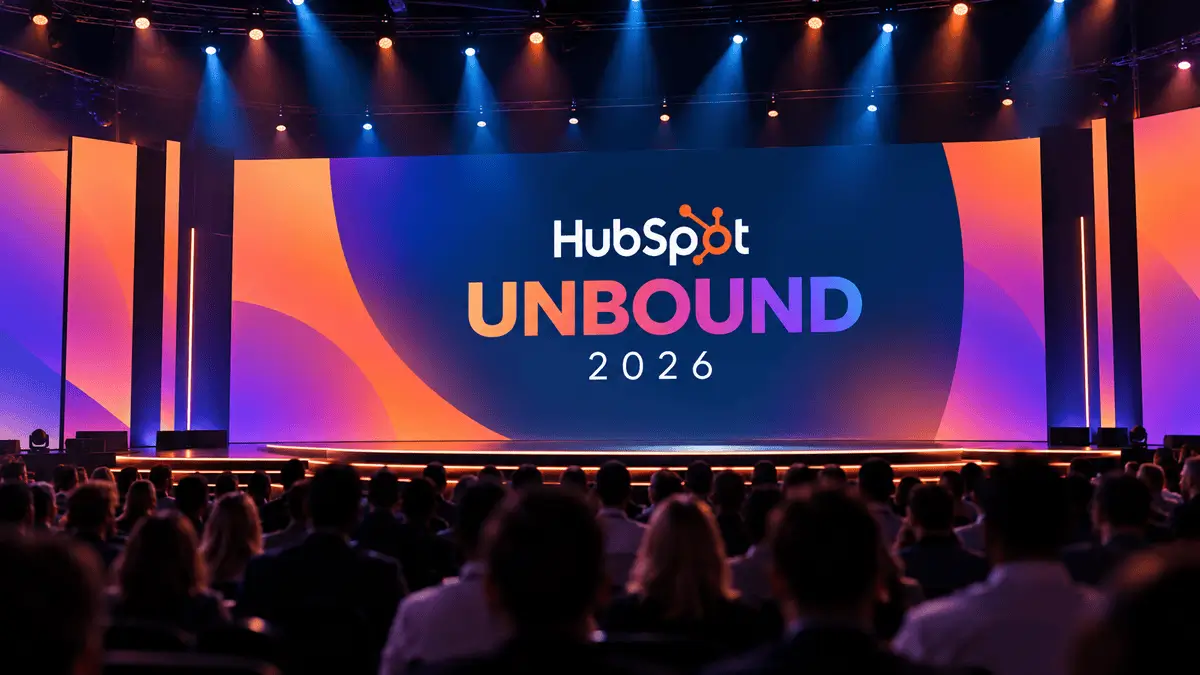
I've been to enough marketing conferences to know the difference between a feature launch and a change in direction. At HubSpot UNBOUND 2026, I think we got the second one.
This was the first year under the new name. The event that spent 15 years as INBOUND is now UNBOUND, which HubSpot says better reflects how growth works today, with go-to-market teams rather than marketing alone owning the buyer relationship. Over ten thousand leaders were in Boston to hear from more than 200 speakers (Salted Stone ).
There were plenty of AI announcements, of course. Agents, a smarter assistant, new marketing workflows, a ChatGPT Ads integration. But the thing I kept coming back to afterwards wasn't the AI. It was context.
I've spent about 15 years in this industry, across SEO, PPC, content, demand gen, product marketing and GTM. In that time I've watched a few generations of martech arrive with big promises. Most of them saved us time. Very few changed how marketing teams actually make decisions.
I'm also a HubSpot user, and that shapes how I read these announcements. I've used Breeze the way a lot of marketers probably have so far, asking it about reports, finding contacts, checking what's happening in a pipeline. It's been genuinely useful, but it's always been me asking and the AI answering. What HubSpot showed this week goes well past that.
Three announcements carry the story
HubSpot shipped a lot, but if you strip it back, three things matter for marketers. The CRM is turning into a business memory, AI is starting to run workflows instead of just assisting with them, and AI conversations are becoming a paid demand channel. Everything else sits underneath those.
1. The CRM is becoming the business memory
I've worked with CRMs long enough to know the biggest CRM problem was never the software. It's us.
Sales doesn't log the call. Nobody trusts the lead source field. Lifecycle stages drift. And data hygiene becomes everyone's priority for about a week, right when attribution falls apart at quarter end.
HubSpot's answer is a Smart CRM that updates itself, plus a Context Home that shows how complete your data actually is (SiliconANGLE ). It pulls in information from calls, emails and meetings, so the record keeps building without depending on someone's discipline at 7pm.
HubSpot calls the result Growth Context, and it's making big claims about it. According to its own data, businesses whose AI runs on high-quality context generate 3.6x more MQLs, win 3.2x more deals and close more than twice as many support tickets (iTWire ). I wouldn't put those numbers in a board deck, because it's HubSpot measuring HubSpot customers and we don't know how the comparison was built. They're handy if you've been trying to get budget for CRM cleanup, which is probably their real job anyway.
Here's where I think HubSpot gets it right, though.
When I've asked Breeze about a pipeline or a contact segment, the answer was only ever as good as what was in the CRM. If a deal stage hadn't been updated or a contact was missing key properties, the AI had no way of knowing. That was fine when I was the one reviewing the answer before doing anything with it.
Now agents are going to score leads, route them, pick nurture tracks and draft outreach based on that same data. Bad data used to give us bad reports, which was annoying but survivable. Bad data now turns into bad actions, and that's a lot more expensive.
Even TechTarget's coverage pointed out that humans still need to stay in the loop when AI is writing to the system of record, which seems right to me. A CRM that updates itself can still update itself wrong.
2. Breeze moves from answering questions to running workflows
This is the shift I've felt most directly as a user.
My use of Breeze so far has been mostly question and answer. Pull up a report. Find contacts that fit a certain profile. Show me where deals are sitting in a pipeline. It saved me time building filters and clicking through views, and for day-to-day CRM work that alone was worth it.
But I was still doing the thinking. I decided what to look at, figured out what the numbers meant, and decided what to do next. Breeze made the CRM faster to work with without changing who was running the work.
The new Breeze Assistant is designed to change that. It takes a goal, works out which agents it needs, and comes back with things like a campaign plan, a proposal or a performance report built from your CRM data. That's a big jump in a short time, from AI that helps you find information inside the CRM to AI that's expected to take a business objective and turn it into work.
HubSpot also introduced Agent Hub, a command center for managing agents across the customer journey. When a vendor ships a console for managing your agents, it's assuming you'll end up with more than one.
Marketing Studio is the piece that pushes this furthest for marketers. It flags things like your AEO visibility, underperforming campaign segments and leads nobody followed up on, then lets AI act on them. If you've ever found a batch of MQLs sitting untouched in a queue for a week, you know exactly why that matters.
Our dashboards were never short on data. What broke was the chain after the data, where someone had to spot the problem, figure out what it meant, decide on a fix and find time to do it. That chain broke constantly, especially across marketing and sales handoffs.
But there's a catch.
If your ICP is fuzzy or your positioning is inconsistent, an agent running your campaigns won't fix that. It'll just push the wrong message to the wrong segment faster than your team ever could. AI execution makes strategy more important, not less.
3. ChatGPT Ads, and the part of the funnel we can't see
This is the announcement I think demand gen teams will feel first.
HubSpot customers can now connect a ChatGPT Ads account, set targeting, budgets and schedules, and track performance next to their other paid channels (Social Samosa ). It launched in beta. In its own announcement , OpenAI named HubSpot its first CRM partner and Shopify its first ecommerce partner for ChatGPT Ads.
There's some history behind it. HubSpot built the first CRM connector for ChatGPT back in 2025 and says weekly active users of that connector have grown 250%, although it hasn't disclosed the base that growth started from (PPC Land ).
The targeting angle is interesting for B2B. HubSpot's Angela De Franco made the point that audience lists come from CRM data, so you can target with your own customer context instead of relying only on the ad platform's signals (B&T ). That's a meaningful step up from keyword and demographic targeting if your CRM data is in decent shape.
But the part I really want marketers to think about goes beyond the ad product.
For most of my career, the funnel was something we could at least partly see. Impressions, clicks, sessions, form fills. Attribution was always messy, but there was a trail to follow, and that trail is getting shorter.
A buyer now asks an AI assistant which platforms to consider. They get a shortlist, read a few summaries, maybe forward the answer to someone on the buying committee. The first time we see them in our data is a demo request, if we're lucky. We've talked about the dark funnel for years with word of mouth, communities and private Slack groups, and AI conversations are making that dark funnel a lot bigger.
Your first touchpoint with a buyer might be a recommendation you never saw, rather than a click you can track.
That changes a few things for how we run demand gen. First-party data becomes the main way to connect ad spend to pipeline. Self-reported attribution ("how did you hear about us?") matters again. And being included in the AI's answer becomes a top-of-funnel goal in its own right.
The numbers behind the announcements
Product news gets the headlines, but the research HubSpot has published this year is what actually makes the case, so these are the figures I'd take into a planning meeting.
Start with the traffic picture, because HubSpot has put a number on something most of us have been watching nervously in our own analytics. Organic traffic for HubSpot customers is down 27% year over year, while AEO beta users who prioritized answer engines saw AI referral traffic grow 20% compared to customers not using the tool (HubSpot investor relations ).
The traffic that does arrive looks different from what we're used to. In HubSpot's State of Marketing 2026 , a survey of more than 1,500 marketers, 49% agree that web traffic from search has fallen because of AI answers, while 58% say AI referral traffic has much higher intent, meaning those visitors show up further along in their buying journey. Another 61% say brand point of view matters more than ever now that humans and AI are working alongside each other, which I read as a reaction to how much undifferentiated content the last two years have produced.
For anyone selling software, the evaluation data is the part that should get attention. HubSpot's State of AEO 2026 surveyed over 4,000 global marketers and analyzed brand citations across several answer engines. It found that 42% of CRM software buyers used AI search to evaluate vendors, and that AI search was the strongest predictor of purchase intent of all the evaluation activities it tracked. If an answer engine names your competitor during that stage, the shortlist can be settled before your sales team knows the buyer exists. The same report found that nearly half of surveyed marketers have personally made a business purchase decision based mainly on brand information they first came across in AI answers, and 29% have done it more than once.
HubSpot's own results are the loudest number in all of this and the one I'd handle most carefully. The company reports 3x better conversion from AI-sourced leads than other channels in 2025, and says it now ranks first in AI visibility for its search category. That's a company with a large content team, two decades of domain authority and a product built for the exact thing it's measuring, so I'd read it as evidence that the mechanism works rather than as a benchmark for what your team should expect.
There's a reality check worth keeping next to all of this. AI-referred sessions still account for roughly 1% of traffic even after a 527% year-over-year increase (CMSWire ). Anyone telling you to defund SEO this quarter is reading the growth rate and ignoring the base it's growing from. For an outside view on quality, Similarweb data cited in HubSpot's AEO research puts ecommerce AI referral conversion at 11.4% globally against 5.3% from organic search, which is a different vertical pointing in the same direction.
What the main stage actually said
The Spotlight keynote was led by CEO Yamini Rangan, Chief Product and Technology Officer Duncan Lennox and Chief Customer Officer Jon Dick, with the session framed around AI grounded in your business context (HubSpot ).
Lennox gave the clearest statement of intent in the release, saying customers don't want to think about which AI tools to use, they just want outcomes. That lines up with what I hear from marketing leaders at the moment. Nobody is asking for a fourteenth AI subscription. They want the pipeline number to move, and they're tired of evaluating tools to get there.
Dharmesh Shah's solo keynote was the one I'd point a marketing team toward. His question was why some people get dramatically more out of AI than others using exactly the same tools, and his answer had to do with adopting a builder mindset rather than finding better prompts. That matches what I see in practice. The teams getting real leverage from AI tend to be the ones who have broken their work into pieces clear enough to hand off, which is a thinking problem long before it becomes a technology problem.
The wider speaker list included Tom Brady, Cynthia Erivo, Mel Robbins, astronaut Suni Williams and the TBPN team. Good sessions, and clearly built for the room rather than for your roadmap.
AEO isn't SEO with a new acronym
Which brings me to AEO.
HubSpot now lets teams manage paid and organic AI search in one place (Mumbrella ). When a platform this size builds AEO into the core product, it's moving out of the experimental budget line and into everyday marketing operations.
I don't think most marketing teams are ready for it, though, because they're still treating it like SEO.
SEO asks whether we can rank for a query. AEO asks something harder. When an AI answers a question about our category, does our company become part of the answer? And if it does, what evidence made the AI trust us enough to mention us?
That second question is where it gets uncomfortable. AI systems can draw on signals from your website, reviews, case studies, documentation, analyst coverage and public discussions about your company. If your homepage messaging doesn't match your sales deck, or your reviews describe a different product than your positioning does, that inconsistency can show up in how you're represented.
So the metrics shift too. Rankings still matter, but we also need to track share of voice in AI answers, how accurately we're described and which competitors keep appearing next to us. With 42% of CRM buyers already using AI search during evaluation, this stops being a nice-to-have for anyone selling software.
After 15 years, this is the part I find hardest to dismiss
Most B2B marketing stacks I've worked with look the same. A CRM, a marketing automation platform, analytics, a few ad platforms, a CMS, and a reporting layer nobody fully trusts. Each tool holds a slice of the customer, and marketing ops spends half its week stitching those slices together.
HubSpot's bet is that AI can finally do that stitching, as long as it can see across everything.
I've already seen the first version of this in my own work. Asking Breeze for a report or a contact list was the CRM becoming easier to question. What UNBOUND points to is the CRM becoming something that acts on what it knows.
The CRM may be becoming less of a system marketers update and more of a system that understands how the business works. I'm not sure HubSpot will be the only one who gets there, but I'd be surprised if the direction is wrong.
How I'd act on this
These are the principles I'd follow if I were running a marketing team through this shift.
Don't buy another AI tool yet. Fix your data first.
Audit lifecycle stages, lead source, contact completeness and deal data. AI will amplify whatever state your CRM is in.
Use the questions you already ask your CRM as your agent roadmap.
If you're asking AI for the same pipeline report or contact list every week, that's a repeatable decision waiting to be automated. Start there before handing agents anything bigger.
Don't throw away SEO. Add AI visibility to your measurement model.
Keep tracking rankings and organic pipeline. Then start checking how AI assistants describe your brand and who they recommend alongside you.
Segment AI referrals before you argue about them.
Get AI-sourced traffic into its own channel in your analytics and compare conversion against organic yourself. Industry averages are directional, but your own numbers are what will win the budget conversation.
Don't produce more content just because AI makes it cheap. Build more evidence.
Customer stories with real numbers, original research, clear product documentation and consistent positioning across every channel. That's what earns mentions.
Don't automate everything. Automate repeatable decisions and keep consequential ones human.
Lead routing and follow-up reminders can go to agents. Positioning, pricing and messaging for a key account should stay with people.
Don't run marketing as a string of campaigns. Build continuous GTM systems.
Campaigns still matter, but they should come out of an always-on loop of signals, decisions and feedback, rather than a calendar that resets every quarter.
What I took away
I've watched marketing move from reach to traffic, from traffic to leads, from leads to data, and from data to automation. We're heading into another transition.
This time, the scarce resource isn't content. It isn't software. AI models are becoming increasingly accessible, so it probably won't be the models either. What your competitors can't easily copy is the context surrounding your business.
The companies that build the richest understanding of their customers, markets and business will give their AI something competitors can't simply buy.
That's what I took away from UNBOUND. The advantage may not go to whoever has the fanciest AI. It may go to whoever gives their AI the best context.
Salesforce made a related argument at Dreamforce the same week, and took it a step further. I wrote about that separately in what Dreamforce 2026 means for marketing and growth teams.
Related questions
What is HubSpot Growth Context?
It's HubSpot's term for the understanding of your business, customers and team that its AI works from. In practice, it's your CRM data combined with signals from calls, emails and meetings.
How is the new Breeze Assistant different from earlier versions?
Earlier use was largely conversational, like asking for reports, contacts or pipeline details. The new Breeze Assistant is built to take a goal, pick the agents it needs and produce outputs such as campaign plans, proposals and reports.
Should marketers trust the 3.6x MQL and 3.2x deal figures?
Treat them as directional. They come from HubSpot's own customer data rather than an independent study, so they work better for building a case for CRM investment than for forecasting pipeline.
Who spoke at HubSpot UNBOUND 2026?
The Spotlight keynote was led by CEO Yamini Rangan, CPTO Duncan Lennox and CCO Jon Dick, with a separate solo keynote from co-founder and CTO Dharmesh Shah. Main stage guests included Tom Brady, Cynthia Erivo, Mel Robbins, Suni Williams and TBPN, across more than 200 speakers.
Why did INBOUND change its name to UNBOUND?
HubSpot says the new name better reflects how growth works today, with sales, service and marketing teams all building buyer relationships on one agentic platform rather than marketing owning it alone.
Is the ChatGPT Ads integration available now?
It launched in beta, and you need an active ChatGPT Ads account plus the right HubSpot permissions to connect and launch campaigns.
How is AEO different from SEO?
SEO focuses on ranking for queries. AEO focuses on whether AI assistants include your brand in their answers, how they describe you and which sources they rely on. HubSpot's State of AEO 2026 found that 42% of CRM software buyers use AI search during vendor evaluation.
Is AI search actually sending meaningful traffic yet?
Not in volume for most teams. AI-referred sessions are still around 1% of traffic, though growing quickly, and 49% of marketers say search traffic has fallen because of AI answers. The case for AEO rests on intent quality rather than volume.
Where should a small marketing team start?
With CRM data quality. Fix the biggest gaps in lifecycle stages, lead source and contact data, then test AI on one measurable workflow like lead follow-up before expanding.

Written by Sudheer Kiran
Full Stack Growth Marketing Professional & Fractional CMOHey, I'm Sudheer. I've spent nearly two decades working in growth marketing—mostly with B2B SaaS companies, agencies, and startups. I help businesses find smart, scalable ways to grow through digital transformation, brand strategy, and marketing that actually converts.