TL;DR:
- Execution has never been cheaper or easier thanks to AI, but that's exactly why it stopped being a differentiator.
- Most companies aren't struggling to do marketing. They're struggling to make marketing, product, sales, and customer experience reinforce each other.
- Growth that compounds comes from alignment, not more output. Built to Compound is the framework for building that alignment.
- B2B buyers now complete roughly 80% of their journey before they ever talk to sales, and generative AI is shaping their shortlist before your team knows the deal exists. Coherence across every touchpoint is no longer optional.
Sixteen years of watching algorithms change, tactics multiply, and execution get cheaper taught me something simple: sustainable growth isn't an execution problem anymore. It's an alignment problem.
If you've worked in B2B marketing for more than a few years, you've probably felt this. Your team is sharper than it was three years ago. Your stack is better. You have more data, more automation, and now AI that can research, write, personalize, and test at a speed we couldn't have imagined a decade ago.
On paper, execution has never been stronger.
Yet most of the marketing leaders I talk to say growth is getting harder, not easier. Acquisition is more expensive: the median New Customer CAC Ratio rose 14% in 2024, meaning the typical SaaS company now spends two dollars in sales and marketing to bring in one dollar of new revenue (Benchmarkit, 2025 SaaS Performance Metrics). Buyers are also doing far more homework before they ever reach out. And when teams pause campaigns for a couple of weeks, momentum often disappears with them.
We keep having versions of the same conversation. It usually starts tactical: demand gen isn't converting, content isn't performing, the website isn't converting, AI search is changing discovery. But underneath, it's the same root issue every time.
We're getting better at doing marketing without getting better at building something that compounds.
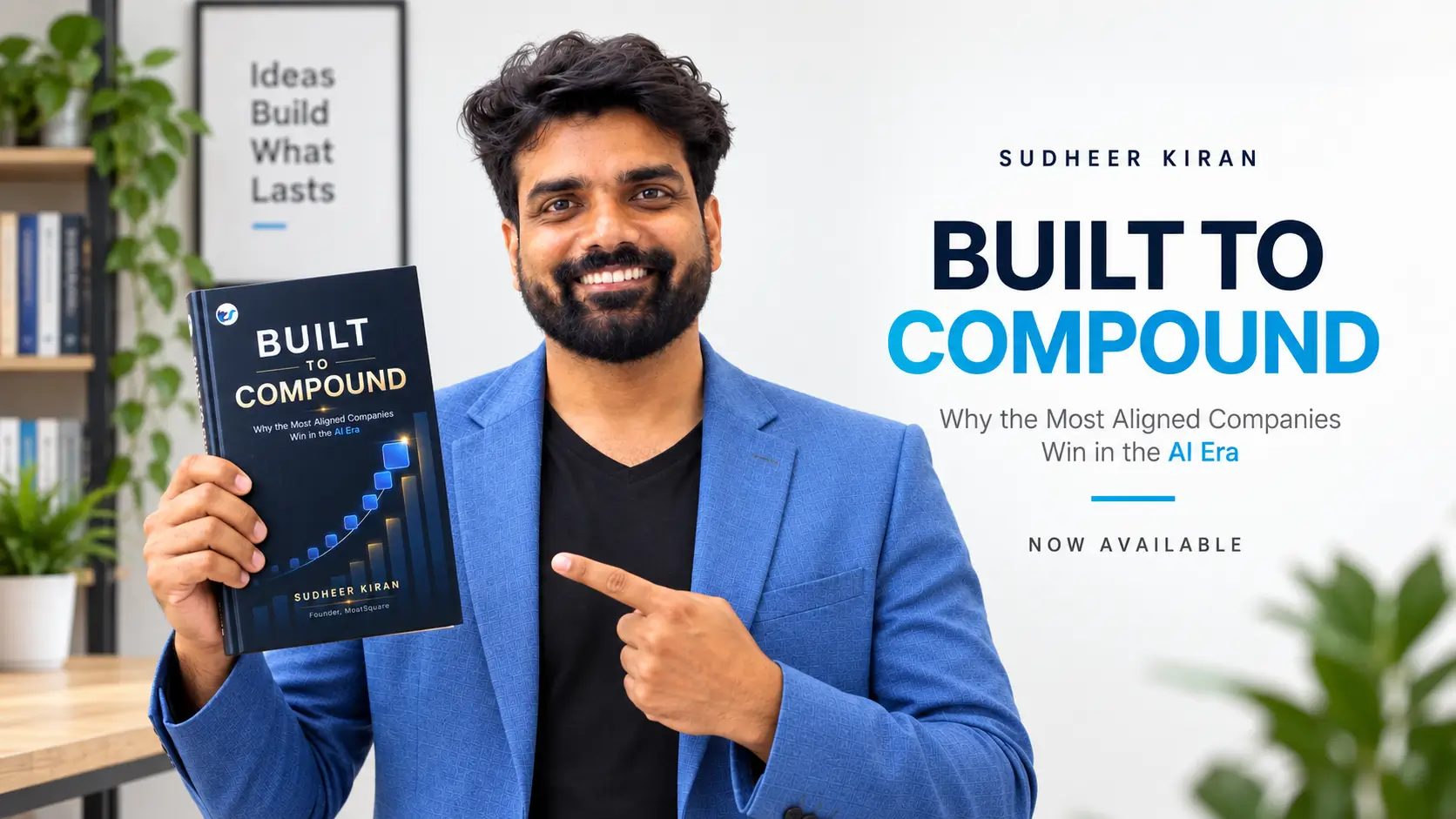
That's what eventually became Built to Compound: Why the Most Aligned Companies Win in the AI Era.
The Lesson I Learned the Hard Way
I came into marketing from computer science, so my instinct was always to treat it as a system: learn the rules, find the patterns, optimize the output. That worked well early in my SEO career, until Panda, Penguin, and every update after them wiped out companies that had built growth around satisfying an algorithm instead of the reason the algorithm existed.
That was the turning point. I stopped asking "how do we make Google reward us" and started asking "what is Google actually trying to recognize." The answer was relevance, authority, and usefulness, not a clever workaround.
Years later, I watched the exact same pattern play out inside companies, just at a bigger scale.
Random Acts of Marketing
Across agencies, in-house leadership roles, RevOps, and consulting with founders, one thing became obvious: the problem was never effort. Everyone was working hard. Marketing ran campaigns. Demand gen chased pipeline. Product shipped features. Sales ran outbound. Customer success handled retention. Every function made sense on its own.
The problem showed up when we stepped back and looked at the whole system. Did the website use the same language as sales? Did customer success reinforce what marketing promised? Did customers describe the company the way the company described itself?
Usually, no. I started calling this pattern Random Acts of Marketing, not as a knock on the people doing the work, but because the work wasn't connected into a system. There's a real difference between a company that's busy with marketing and one that's building assets that accumulate value over time.
Why AI Makes This Worse, Not Better
AI has collapsed the cost of execution. We can research faster, generate content at scale, build software quicker, and personalize experiences that used to take a team weeks. That's a genuine opportunity.
It's also a trap. When everyone has access to dramatically better execution, execution stops being a moat. If every competitor can publish ten articles instead of two, publishing ten articles isn't an advantage anymore. If everyone can produce a hundred ad variations, volume stops meaning anything.
I think of this as competent-looking sameness. The internet doesn't have a content shortage. It has a growing shortage of things that are distinctive, credible, consistent, and backed by real customer proof.
What Actually Compounds
This is the question the book is built around: what makes growth accumulate instead of resetting every quarter?
The answer, in short, is reinforcement. Positioning gets stronger because customers actually experience what you promise. That experience creates evidence, which strengthens trust with the next buyer. Content becomes more useful because it's grounded in real customer problems. The website converts better because the language matches what buyers actually care about.
None of the individual activities are new. What changes is the relationship between them:
- Customer experience creates evidence.
- Evidence strengthens trust.
- Trust improves conversion.
- Better conversion attracts better customers.
- Better customers create stronger evidence.
That loop is what compounding looks like in practice.
Why This Matters More in the AI Era
Buyers aren't discovering companies through a single search box anymore. They're piecing together an impression across AI tools, communities, reviews, analysts, and peer networks, often before your team has any idea a deal is in motion.
Gartner's own research shows B2B buyers typically spend only about 17% of their total purchase time meeting with potential suppliers, leaving roughly 80% of the journey to happen without a seller in the room (Gartner). It gets sharper with AI in the mix: 6sense's 2025 Buyer Experience Report found buyers are now picking a preliminary vendor winner earlier than ever, often while evaluating AI capabilities, before the vendor even knows it's being considered, and the split between independent research and seller engagement has shifted from roughly 70/30 to 60/40 in a single year (6sense, 2025 Buyer Experience Report).
That changes what trust means. A company can't just claim to be innovative, secure, or a category leader. There are now far more signals, on the web, in customer reviews, across ecosystems, and inside the data AI systems use to summarize a company, that either back up that claim or contradict it.
That makes coherence the job. Not just brand coherence. Operational coherence. What you say has to line up with what you build. What you build has to line up with what customers actually experience. The more those signals reinforce each other, the easier it becomes for both humans and AI systems to understand what you actually stand for.
Who This Book Is For
I wrote this for the CMO who's watched every new channel arrive promising to be the answer. For the growth leader tired of measuring activity without seeing it accumulate into anything. For the founder who knows the company is better than the market perceives it to be. For the marketing team doing genuinely good work that still feels disconnected from the function next to it.
I don't think the fix is another channel or another 90-day playbook. And I don't think the answer to AI is producing ten times more content. The opportunity is building something much harder to copy: a company where every function reinforces the next one.
That's why the book is called Built to Compound. Positioning reinforces product. Product reinforces customer experience. Customer experience reinforces trust. Trust reinforces discoverability. Discoverability creates qualified attention. Attention creates customers. Customers create evidence. And that evidence makes the next customer easier to win.
That's a fundamentally different growth model than turning up the volume every quarter, and it matters even more as AI makes execution abundant for everyone.
The Six Frameworks Inside the Book
I didn't want this to be another stack of tactics, so the book is built around six frameworks that map the whole system:
- The Coherence Gap: The distance between what a company says, what it delivers, and how the market actually perceives it. The wider the gap, the harder every campaign has to work.
- Trust Infrastructure: Trust isn't a testimonials section. It's built across reviews, partnerships, security posture, leadership presence, and every other signal a buyer, or an AI system, can check.
- Commercial Control Points: The assets you own that get stronger with use instead of disappearing when the ad budget stops: documentation, communities, proprietary data, tools.
- Semantic Authority & Entity Trust: Beyond keywords and rankings: how clearly the web, and increasingly AI systems, understand who you are and why you're credible.
- Designed Growth: Positioning, product, onboarding, and sales stop operating as separate functions and start reinforcing each other on purpose.
- Strategic Gravity: The point where the system does some of the work your marketing team used to do manually. Customers arrive with more context. Trust forms earlier. Discovery gets easier.
The Audience in Detail
Founders and CEOs who feel their marketing activity isn't turning into durable enterprise value. CMOs and heads of growth watching returns shrink on the usual demand-gen playbook. Product and GTM leaders who know positioning, onboarding, and customer success can't stay separate conversations. RevOps leaders who see what fragmented messaging costs before a buyer ever reaches sales. And marketing and agency leaders who want to build assets that compound instead of campaigns that reset.
If your team is busy but your market position doesn't feel proportionally stronger, this book is for you.
Explore Built to Compound
Built to Compound: Why the Most Aligned Companies Win in the AI Era is available now in Hardcover, Paperback, and Digital editions.
Get Your Copy & Connect
Available in Hardcover, Paperback, and Digital editions worldwide.
Follow my ongoing research through SignalShift, explore enterprise advisory at MoatSquare, or connect on LinkedIn.
Frequently Asked Questions
What is Built to Compound about?
It's a framework for building B2B growth that accumulates over time instead of resetting every quarter, by aligning marketing, product, sales, and customer experience around the same promise.
Who should read it?
CMOs, growth leaders, founders, and product marketers who feel like they're producing more marketing than ever but not seeing it compound into stronger positioning or easier deals.
How is this different from other marketing books?
Most marketing books focus on tactics and channels. This one is built around six frameworks, including the Coherence Gap, Trust Infrastructure, and Strategic Gravity, that map how different parts of a company reinforce or undercut each other, and why execution alone stopped being a competitive advantage once AI made it cheap for everyone.
Does the book address AI and its impact on marketing?
Yes. A core argument is that AI-driven discovery and evaluation make coherence across every customer touchpoint more important, not less, since buyers and AI systems alike are piecing together an impression of your company from scattered signals.
Where can I buy the book?
It's available now in Hardcover, Paperback, and Digital editions on Amazon, Flipkart, and Ziffybees, linked above.
Get the monthly briefing
One high-signal edition a month on B2B growth, AI search, and agentic marketing. No noise, unsubscribe anytime.