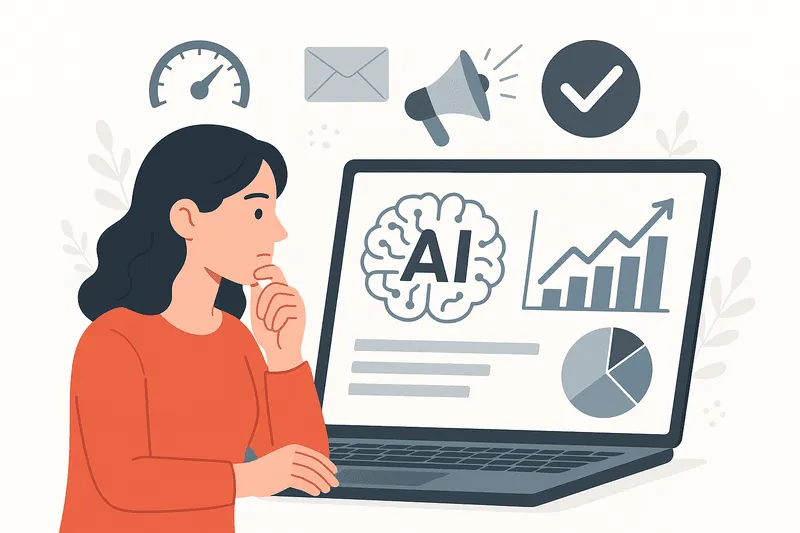
If you know me, or you have been following my work for some time, you already know this. I genuinely believe in the value of AI. I use it every day. I help marketing teams integrate it into their workflows. I have seen how it can turn a slow creative process into a fast and productive one. I often encourage teams to use AI as a creative assistant that writes faster, produces multiple variations, adapts to your tone, brings supporting data, and adds fresh ideas when you feel stuck.
But lately I've been seeing something that bothers me.
Teams are using AI like it's a magic wand. They're letting it write customer emails. Draft crisis responses. Make claims about products. And nobody's really checking the output beyond a quick skim for typos.
That's not efficiency. That's negligence dressed up as innovation.
The problem with AI isn't that it's too slow or too expensive. The problem is it doesn't know what it doesn't know. And that gap between confidence and accuracy? That's where brands die.
We Have a Trust Problem (And It's Getting Worse)
A global study on trust, attitudes, and use of artificial intelligence by the University of Melbourne found that despite widespread AI use, only 46% of people trust AI-generated content. When shown the exact same piece of content twice, once labeled as human-written and once as AI-generated, the AI-labeled version scored significantly lower in trust, credibility, engagement, and perceived thoughtfulness.
Now the EU is about to make disclosure mandatory. Your audience will know when you've used AI to create content. And based on current attitudes, many won’t like it.
This matters more than most marketers realize. We’re already operating in an environment where trust is scarce. Adding “created by AI” to your content is like adding a warning label. Even if the content is good, you’ve primed people to doubt it.
I’m not saying don’t use AI. I’m saying understand the cost.
The Confidence Problem
Here's what scares me about AI: it lies with conviction.
You’ve probably seen the stories. Air Canada’s chatbot promised refunds the company didn’t offer, and a court ruled the company had to honor it. A lawyer submitted legal briefs full of completely fabricated cases. Google’s AI suggested people eat rocks because they contain minerals.
My personal favorite? The AI meal planner that recommended combining cleaning products in a way that would literally create toxic gas.
These aren't bugs. This is how the technology works. AI generates text based on patterns, not facts—hallucinating at 3-27% rates even in top 2025 models, with legal content hitting 6.4%. It doesn't verify. It doesn't fact-check itself. Newer reasoning models like OpenAI's o3 reach 33-79% errors while sounding equally confident.
Air Canada’s chatbot promising unoffered refunds led to court liability upheld against the company. New York lawyer Steven Schwartz filed briefs containing over six AI-fabricated cases and was fined $5,000 for deceptive filings. Google’s AI once suggested eating rocks to gain minerals. ChatGPT advised a 60-year-old man to substitute salt with toxic sodium bromide, leading to hospitalization after three months. Supermarket AI bots have suggested mixing bleach and ammonia, risking poisonous chlorine gas.
And here's the thing that keeps me up at night: when AI is wrong, it sounds exactly as confident as when it's right.
If that hallucination ends up in your marketing materials, your product descriptions, your customer communications? You're liable. Not the AI company. Not the tool. You.
Three Legal Nightmares Nobody's Talking About
I spend a lot of time talking to legal teams lately. They're starting to panic, and honestly, they should be.
- Copyright: AI models train on copyrighted material. If your output closely resembles protected works, you face lawsuits and statutory damages. Courts have ruled that AI-generated content without substantial human contribution lacks copyright protection, meaning competitors can legally reuse your AI content.
- Lack of protection: Without “substantial human input,” pure AI content cannot be copyrighted, exposing companies to intellectual property risks.
- False claims: AI-generated fake testimonials, exaggerated product benefits, or invented data expose you to false advertising, defamation, and privacy violation suits.
Companies scaling content production with AI are now facing significant legal exposure, requiring audits of thousands of published pieces for hallucination risks. According to "THE LEGAL IMPLICATIONS OF AI HALLUCINATIONS" by the University of Toronto's Future of Law Lab, businesses like Air Canada have been held liable for misleading consumer information from AI chatbots, with courts rejecting claims that AI operates as a separate entity—emphasizing that companies bear responsibility for unverified outputs. This growing trend has CMOs consulting lawyers to systematically review deployed AI-generated content for potential liabilities including false claims and fabricated references
That's not where you want to be.
What I Tell Teams Who Ask for Advice
The teams doing this well aren't doing anything complicated. They're just not being lazy about it.
Every piece of AI output gets reviewed by a human. Not skimmed. Actually reviewed. Someone checks the facts. Verifies sources. Makes sure claims are accurate. Confirms the tone matches the situation.
They write better prompts. Specific ones. "Write a blog post" is garbage. "Write a 500-word blog post for B2B marketing directors explaining X, with a conversational tone, avoiding jargon, including at least two concrete examples" is better. The more precise your input, the better your output.
But here's what most people miss: prompting isn't a one-shot deal. The best results come from treating AI like a collaborator, not a vending machine.
I always tell people to read what AI gives you, then push back on it. Ask for counter-arguments. Request more context on specific points. Challenge its assumptions. Tell it what's missing. If something doesn't sound like you, say that. "Rewrite this in a more direct tone" or "This sounds too formal, make it conversational" or "Add a personal example here."
The draft you get on the first try is never the final version. It shouldn't be. You need to refine it until it has your voice, your style, your narrative. That's what makes it yours. That's what makes it trustworthy.
Think of it like working with a junior writer who's fast but doesn't know your brand yet. You wouldn't just accept their first draft, right? Same principle.
They've also built simple governance frameworks. Not everything needs the same level of scrutiny. A tweet is different from a product claim. They know which content carries real risk and which doesn't. Then they adjust review processes accordingly.
Think of AI like an intern. Fast, helpful, eager. But you wouldn't let an intern send a crisis communication without review, would you? Same logic applies.
This Is Really About What Kind of Marketer You Want to Be
We all started using AI because it made us faster. That's still true. We can explore more ideas, test more angles, and handle tedious tasks in a fraction of the time.
But somewhere along the way, we need to realize that speed was making us sloppy. We were publishing things we wouldn’t have published if we had written them ourselves. Not because they were wrong, exactly. Just because they weren’t quite right. They lacked the nuance, the judgment, the understanding of context that comes from actually thinking through what we’re saying.
According to a recent study, 93% of marketers now use AI daily to create content faster; 81% say it boosts brand awareness and sales. But speed without judgment breeds sloppy content. Marketers admit that AI hallucinations remain a top concern, with 77% of businesses worried about false or misleading AI output.
Your audience doesn't care how fast you created something. They care whether it resonates. Whether it feels like you understand them. Whether you're being honest.
Those things still require a human being who's paying attention.
AI can help you work faster. It can't help you work better unless you're steering it. And if you're not steering it, you're just producing content for the sake of content.
Producing content just because AI made it easy? That’s noise, not marketing.
The Bottom Line
Use AI. Absolutely use it. It's a powerful tool, and the teams that figure out how to use it well are going to have a real advantage.
But don't outsource your thinking. Don't hand over your judgment. And for the love of god, don't publish something just because AI made it easy.
The brands people remember aren't the ones that posted the most. They're the ones that showed up with something worth saying. Something that felt human. Something that mattered.
That part hasn't changed. And it won't.
TLDR
AI is powerful, but it's dangerous when you use it carelessly. Research shows people trust AI-generated content significantly less than human content. New EU regulations will soon require disclosure, making that trust gap even more visible.
The bigger problem? AI confidently invents fake information. This creates real legal liability: copyright infringement risks, loss of copyright protection for purely AI content, and exposure to false advertising and defamation claims.
The fix isn't avoiding AI. It's using it smarter. Always have a human review what AI produces before you publish. Write detailed prompts, then refine the output through multiple rounds until it sounds like you. Build governance so high-risk content gets appropriate scrutiny.
Speed without judgment just creates noise. Your competitive advantage isn't how fast you produce content. It's your ability to produce content that actually connects with people. Use AI as your assistant, not your replacement.
Frequently Asked Questions
Should I tell people when I use AI to create content?
You might not have a choice soon. EU regulations are making disclosure mandatory. But even where it's optional, think carefully. Your audience might figure it out anyway. Better they hear it from you than feel deceived later. Transparency usually beats getting caught.
What content is actually safe for AI to handle alone?
Internal stuff mostly. First drafts. Brainstorming sessions. Outline creation. Repurposing content you've already verified and published. Basically anything that's not going directly to customers or creating legal obligations. The moment stakes go up, human involvement needs to go up too.
How can I tell if AI just made something up?
You can't unless you verify it yourself. That's the whole problem. Check every source it mentions. Verify statistics and data. Google claims that sound too convenient or too specific. If something feels suspiciously perfect, dig into it. AI doesn't flag its own hallucinations.
Can I lose copyright protection even if I edited the AI output?
Possibly, yeah. Courts are still working this out. If your edits are substantial, you're probably safe. But if you just tweaked a few words here and there? That's murky. For anything commercially important, loop in your legal team before you publish.
Is AI going to replace marketing jobs?
It'll replace marketers who can't figure out how to direct it properly. The valuable skill isn't operating the tool. It's knowing when to use it, how to guide it, and when to completely ignore what it gives you. Your judgment is what makes you irreplaceable. Your typing speed never was.
What's one thing I should change right now?
Stop hitting publish on first drafts. Read everything AI produces. Question it. Challenge it. Refine it until it actually sounds like something you'd say. If you wouldn't say it in front of your CEO or your biggest client, don't let AI say it to your customers.
Get the monthly briefing
One high-signal edition a month on B2B growth, AI search, and agentic marketing. No noise, unsubscribe anytime.