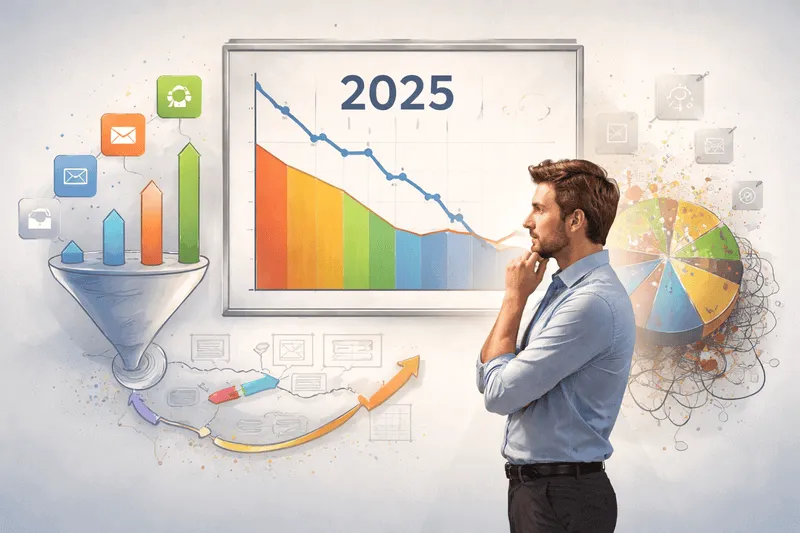
If I had to describe 2025 in one sentence, it would be this:
Marketing didn’t evolve quietly in 2025. It was forced to grow up.
This was not a year of incremental improvements. It was a year where long-standing assumptions broke, often without warning. Systems we trusted started behaving differently. Platforms changed incentives. AI stopped being a tool and became an environment. And growth teams were pushed into decisions they could no longer postpone.
This is a comprehensive SignalShift for all of 2025.
What changed. How it changed. Why it mattered.
And most importantly, what to do differently in 2026.
1. Discovery fundamentally changed shape in 2025
At the start of the year, most teams still treated discovery as a familiar mix of search, social feeds, and paid distribution.
By the end of 2025, that model was no longer accurate.
Search results were increasingly blended with AI-generated answers. Social platforms became search engines in their own right. Communities, creators, AI assistants, and private channels played a larger role in influencing decisions than traditional SERPs ever showed.
Discovery became multi-surface and fragmented.
What mattered was no longer where you ranked, but where you showed up when a real question was asked.
What changed during 2025
- AI answers became a primary discovery layer
- Social platforms expanded searchable, decision-oriented content
- Community and creator recommendations gained more weight than brand claims
Action for 2026
- Map all discovery surfaces that influence your buyers, not just search
- Track visibility beyond rankings, including mentions and recommendations
- Design content to answer questions clearly, not just attract clicks
What to watch
- AI assistants becoming default starting points for research
- Search engines reducing visible organic real estate even further
2. SEO stopped being predictable and became evaluative
2025 saw multiple Google core updates, with the December update acting as a final enforcement point rather than a surprise.
SEO stopped behaving like a mechanical system where inputs reliably produced outputs. Instead, it started acting like a quality audit that never turns off.
Pages built to capture demand struggled. Pages built to genuinely help survived. Authority without depth stopped protecting large sites. Experience and specificity mattered more than volume.
What changed during 2025
- Core updates increased volatility across content-heavy sites
- Discover traffic became less reliable for publishers
- Topical depth outperformed broad coverage
Action for 2026
- Consolidate content around fewer, stronger topics
- Remove pages that exist only to rank, not to help
- Treat SEO as a product-quality signal, not a traffic hack
What to watch
- More frequent quality recalibrations
- Stronger weighting of experience and outcome-based signals
3. AI moved from acceleration to accountability
Early in the year, AI was mostly used to speed things up. Faster drafts. More variations. Higher output.
By mid-2025, cracks started showing.
AI-generated sameness became visible. Messaging drifted. Positioning weakened. And platforms became better at detecting shallow synthesis.
AI did not replace marketers in 2025.
It exposed who was thinking and who was not.
What changed during 2025
- AI-assisted content scaled faster than judgment
- Platforms filtered generic output more aggressively
- Teams realised AI needs direction, not delegation
Action for 2026
- Use AI for exploration, not final decisions
- Add human judgment checkpoints before publishing
- Prioritise clarity and perspective over volume
What to watch
- AI systems rewarding original frameworks and lived experience
- Increasing penalties for templated, undifferentiated content
4. Paid media became more powerful and less transparent
Throughout 2025, paid platforms improved performance while reducing visibility into how results were achieved.
AI-driven targeting, creative optimisation, and delivery decisions moved deeper into black boxes. Results often improved. Explanations did not.
This forced teams to shift focus away from control and toward creative quality and intent alignment.
What changed during 2025
- AI-inferred intent replaced explicit targeting signals
- Creative quality mattered more than audience definitions
- Platform fluency outperformed budget increases
Action for 2026
- Design paid journeys, not single ads
- Invest in creative testing and sequencing
- Evaluate performance trends, not just settings
What to watch
- Ads embedded deeper inside AI and discovery interfaces
- Further reduction in manual targeting controls
5. Social platforms collapsed the funnel
In 2025, social platforms stopped pretending they were just distribution channels.
Discovery, evaluation, and purchase increasingly happened inside the same app. This shifted success metrics away from clicks and toward decision signals.
Creators became educators. Content became explanation. Social became a place to decide, not just discover.
What changed during 2025
- In-app commerce expanded across platforms
- Search behaviour inside social apps increased
- Creator trust often outweighed brand messaging
Action for 2026
- Redefine social KPIs beyond outbound traffic
- Build creator partnerships focused on explanation and proof
- Treat social as a full-funnel environment
What to watch
- Social platforms formalising creator-led commerce models
- Deeper integration of AI summaries and recommendations
6. Measurement stopped keeping up with reality
This was one of the most uncomfortable shifts of 2025.
Revenue moved. Pipelines grew or shrank. But dashboards increasingly failed to tell a clean story.
Multi-surface discovery, dark social, AI answers, and product-led growth broke linear attribution models.
What changed during 2025
- Attribution models lagged real behaviour
- Clean funnels became rare
- Directional insight became more valuable than precision
Action for 2026
- Shift from attribution to contribution models
- Track intent, engagement depth, and return behaviour
- Align leadership around uncertainty, not false certainty
What to watch
- More probabilistic and blended measurement approaches
- Growing acceptance that not everything can be tracked
7. Product experience reasserted itself as a growth driver
As acquisition became noisier and less predictable, teams rediscovered something old but powerful.
Retention. Activation. Onboarding.
The fastest-growing teams in 2025 were not always the ones acquiring the most users. They were the ones helping users reach value faster.
What changed during 2025
- Onboarding outperformed acquisition in efficiency
- Marketing and product boundaries blurred
- Activation became a core growth metric
Action for 2026
- Align marketing promises with product reality
- Treat onboarding as a growth surface
- Measure time-to-value aggressively
What to watch
- More product-led growth hybrids
- Marketing teams owning post-signup experience design
The big SignalShift of 2025
Looking back, 2025 was not about tools, platforms, or tactics.
It was about truth.
Truth about what your product does.
Truth about how buyers decide.
Truth about what actually drives growth.
Marketing moved away from persuasion and closer to clarity.
What to prioritise in 2026
If 2025 was the year of disruption, 2026 will be the year of discipline.
Here is what matters going forward:
- Build connected growth systems, not isolated wins
- Optimise for trust across discovery surfaces
- Use AI to think better, not just faster
- Accept measurement uncertainty and design for it
- Treat product experience as part of marketing
Final thought
2025 did not reward the loudest brands.
It rewarded the clearest ones.
The next phase of marketing will not be won by those who chase every new surface. It will be won by teams who understand where they truly add value and show up consistently when it matters.
That is the SignalShift of 2025.
And it sets the tone for everything that comes next.
Get the monthly briefing
One high-signal edition a month on B2B growth, AI search, and agentic marketing. No noise, unsubscribe anytime.