A recent industry report caught my attention because it confirms something many of us in marketing have been feeling for the past year.
AI discovery is already operating at massive scale.
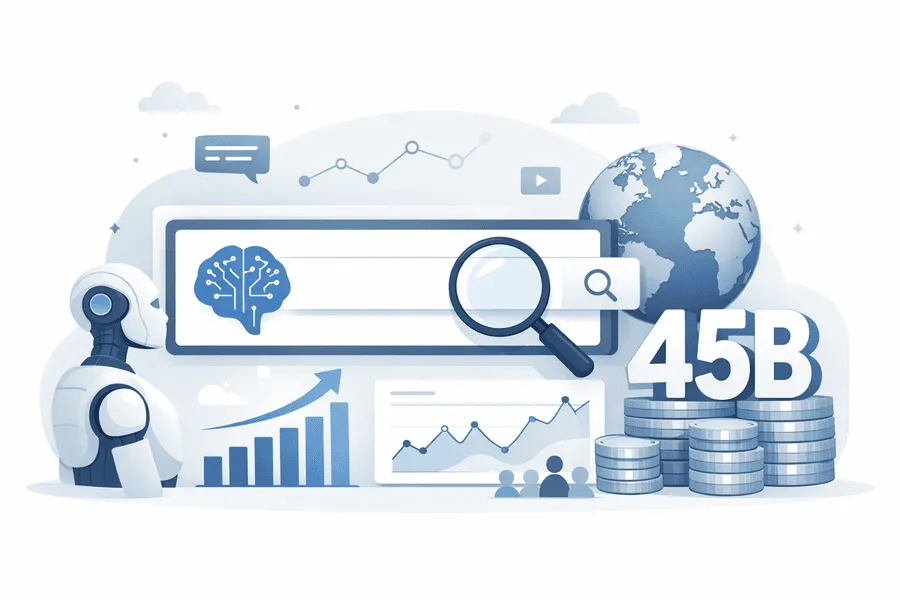
According to a report from Graphite titled “AI Is Much Bigger Than You Think,” AI assistants now generate roughly 45 billion sessions every month worldwide. When the researchers compared that number with global search engine activity, they found that AI sessions equal about 56 percent of total search engine volume.
A big reason for this scale is where the usage is happening.
Most of it is inside mobile apps such as:
- ChatGPT
- Gemini
- Perplexity
- Grok
- Claude
This matters because many comparisons between AI and search engines only look at website traffic. People compare visits to Google.com with visits to ChatGPT.com and conclude that AI usage is still small.
But that comparison misses the real picture.
The report estimates that 83 percent of global AI usage happens inside mobile apps. In the United States the number is around 75 percent.
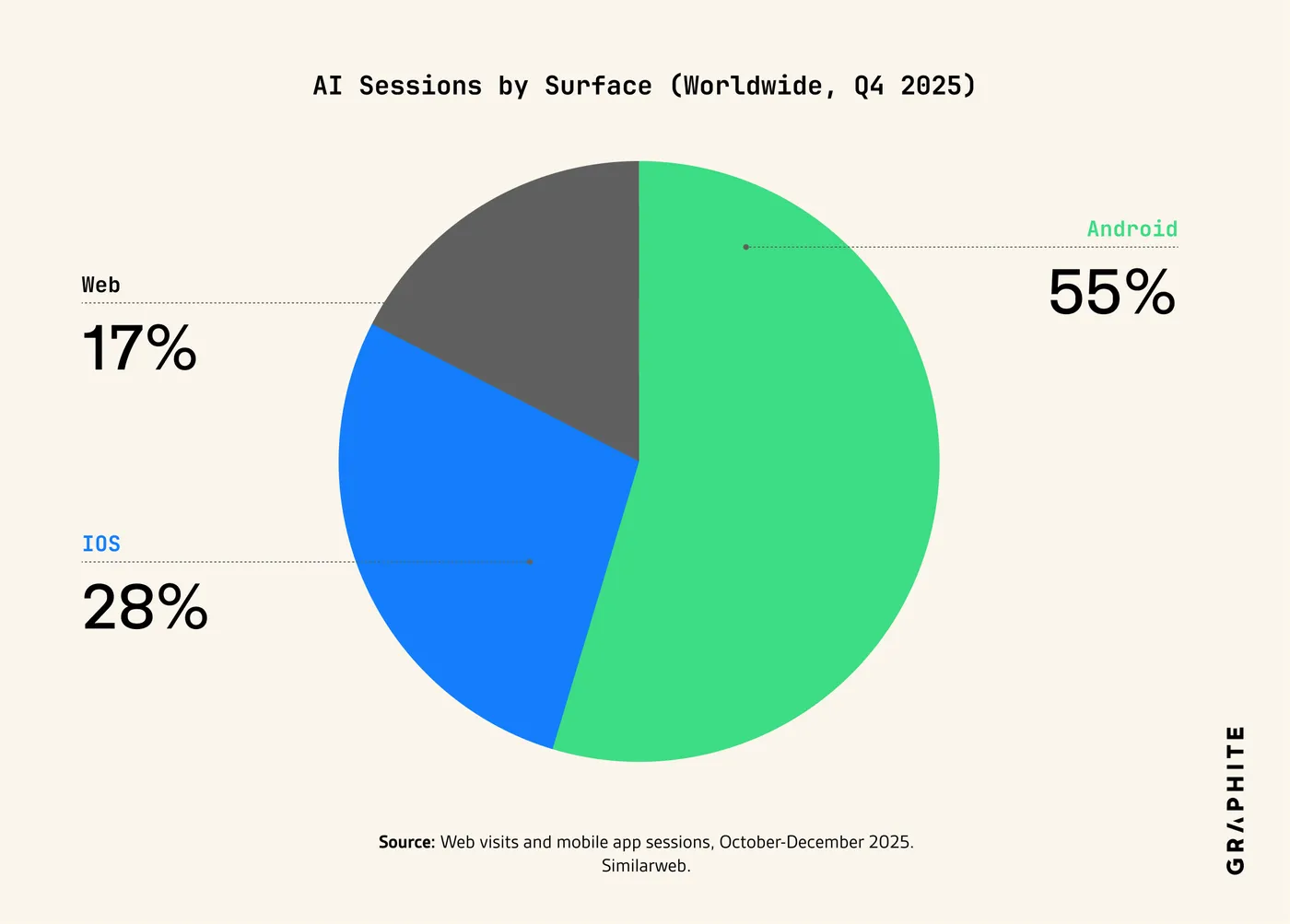
(Source: AI Sessions by Surface, Worldwide, Q4 2025)
If you only measure website visits you underestimate AI usage by four or five times.
However, this does not mean AI is replacing search.
The data actually shows something more interesting.
AI Is Expanding Discovery
One of the most important insights in the report is that total discovery activity is increasing.
When the researchers combined search engines and AI assistants together, global usage has grown about 26 percent since 2023.
So we are not seeing a situation where AI replaces Google and people stop searching.
What we are seeing is people discovering information in more places.
Think about how people research software today.
A typical workflow might look like this:
- First they ask an AI assistant a question.
- Then they open Google to verify what they learned.
- Then they check reviews on G2 or Reddit.
- Then they watch a demo video on YouTube.
This is not a single channel journey anymore.
Discovery has become a multi-surface process.
For marketers that means one thing.
You cannot treat AI and search as separate strategies.
You need both.
Not Every AI Prompt Is a Search Query
Another detail from the report is worth understanding.
Not every interaction with AI tools is equivalent to a search query.
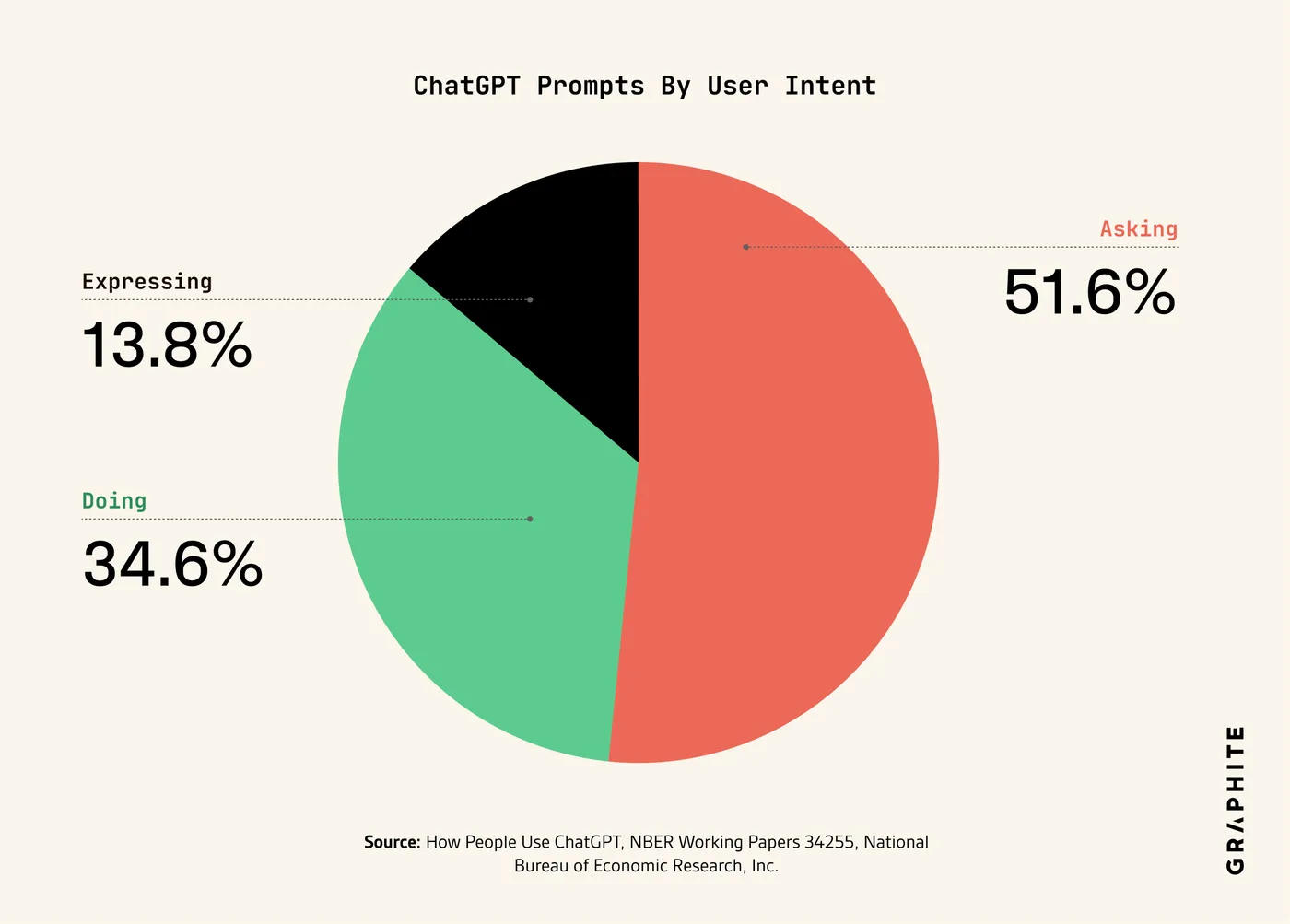
The researchers grouped prompts into three categories:
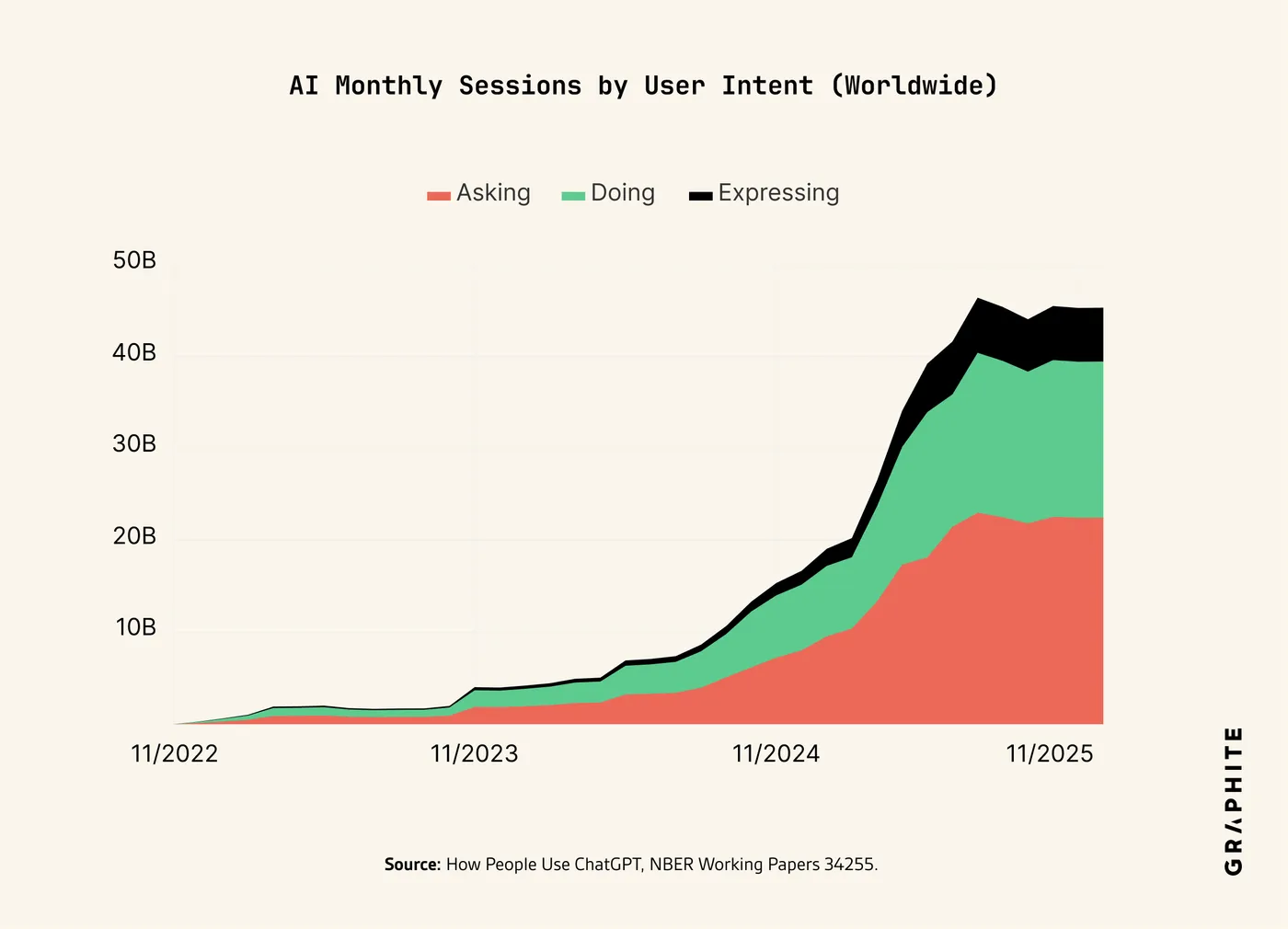
(Source: AI Monthly Sessions by User Intent, Worldwide)
- Asking: Information seeking prompts similar to search queries.
- Doing: Requests such as writing text, generating code, or summarizing documents.
- Expressing: Conversational prompts like brainstorming ideas or chatting.
When they isolated only the asking category, AI activity equals about:
- 28 percent of global search volume
- 17 percent of U.S. search volume
Research from OpenAI also suggests that roughly half of AI prompts are information seeking.
That means AI is already handling a meaningful share of the research queries that traditionally belonged to search engines.
Why People Are Moving Toward AI Answers
The growth of AI discovery makes a lot more sense when you look at user behavior.
I wrote about this in detail in my earlier article “From Search and Click to Synthesis and Curation.”
For years search required people to assemble answers themselves.
You typed a query.
You scanned ten blue links.
You opened multiple tabs.
You compared sources.
AI changes that.
Instead of doing the research yourself, you ask a question and receive a synthesized answer.
Let me give a simple example.
A marketer researching CRM tools in the past might search:
“CRM software for startups”
Then open five websites.
Then compare pricing pages.
Then read reviews.
Today that same marketer might open ChatGPT and ask:
“Which CRM tools work best for a small outbound sales team with automated email sequences and pipeline tracking?”
Within seconds they receive a summarized answer.
That change in effort is why adoption is happening so quickly.
The Rise of the AI Dark Funnel
Another side effect of AI discovery is something many marketers are starting to notice in their analytics.
Traffic patterns are changing.
Some teams report that rankings look stable but traffic growth has slowed.
This happens because discovery is moving upstream.
Users often research inside AI tools first, narrow their options, and only visit websites later to verify details.
I explored this in more detail in my article “From Search and Click to Synthesis and Curation,” where I first described what I call the AI dark funnel.
The decision process happens before someone lands on your site.
For example, a founder might ask an AI assistant:
“What are the best email marketing platforms for SaaS startups?”
The AI may summarize five tools.
The founder then searches Google for reviews of those tools.
By the time they visit a website they already know which vendors are on the shortlist.
In that world the question changes.
It is no longer just about ranking on Google.
It is about whether AI systems mention your brand at all.
AI Discovery Is Mobile First
One insight from the Graphite report that many marketers overlook is the role of mobile apps.
Most AI discovery does not happen in a browser.
It happens inside mobile applications.
The report estimates that:
- 83 percent of global AI sessions happen in mobile apps
- 75 percent of U.S. sessions happen in mobile apps
Think about how different that is from traditional search behavior.
With search engines we usually open a browser.
With AI tools people often open an app and ask a question like they would message a colleague.
That change in interface is important.
It means the content we publish needs to be easy for AI systems to retrieve and summarize, not just easy for humans to read on a web page.
ChatGPT Still Dominates AI Usage
Another interesting finding from the report is how concentrated AI usage is right now.
According to the analysis, ChatGPT accounts for roughly 89 percent of global AI sessions.
(Source: ChatGPT Prompts by User Intent)
Other tools like Gemini, Claude, and Perplexity are growing quickly, but ChatGPT is still the main interface people use.
For marketers this means that understanding how ChatGPT retrieves information gives you a strong starting point for improving AI visibility.
Why Keywords Are Losing Their Dominance
Another shift that AI introduces is how people phrase their queries.
I covered this in another article titled “Long-Form Intent and Conversational Queries Killed Short-Tail Keywords.”
Research cited there found that ChatGPT search queries average about 5.48 words, which is significantly longer than typical Google searches.
More importantly, over 77 percent of AI queries contain five or more words.
Users are no longer typing quick fragments like:
“CRM software”
They are asking questions that sound more like this:
“Which CRM works best for a B2B sales team that sends cold emails and tracks deal pipelines?”
From a marketing perspective this changes how we write content.
We are no longer optimizing for isolated keywords.
We are writing answers to specific problems and use cases.
Turning Visibility Into Strategy
Understanding the scale of AI discovery is useful, but marketers naturally ask the next question.
How do we actually appear in those AI answers?
I explored that topic in my article “How to Rank on LLMs: The Five-Part GEO Framework for Marketing Teams.”
The framework breaks AI visibility into several practical areas.
- First, your website needs to be technically accessible so AI crawlers can retrieve your content.
- Second, your content needs structure that makes it easy to extract. Clear headings, FAQ sections, and comparison tables help AI systems understand your content.
- Third, credibility signals matter more than ever. AI models prefer sources that demonstrate expertise through author profiles, research, case studies, and verified data.
- Fourth, third party validation is critical. Reviews on platforms like G2 or Capterra often appear in AI summaries because they provide independent credibility.
- Finally, marketers need to monitor how AI tools actually talk about their brand. Testing prompts in ChatGPT or Gemini can reveal where your visibility is strong and where gaps exist.
The New Discovery Strategy
Putting all of this together, discovery today works across several layers.
- Traditional SEO: Ranking in search engines still matters because it establishes authority.
- AI optimization: Content must be structured so AI tools can extract and cite it.
- Community presence: Discussions on platforms like Reddit or industry forums often influence AI responses.
- Social authority: Thought leadership on networks like LinkedIn reinforces expertise signals across the ecosystem.
These channels reinforce each other.
When your brand appears across multiple sources, AI systems are more likely to treat it as a trusted reference.
What This Means for Marketers
The report “AI Is Much Bigger Than You Think” confirms something many marketing teams are already seeing.
AI discovery is not a future trend. It is already happening at scale.
But the real story is not just the growth of AI tools. The real story is how discovery itself is changing.
People are asking questions instead of typing keywords. They are receiving synthesized answers instead of scanning ten links. They are forming opinions before they ever visit your website.
For marketers the goal is no longer just ranking.
The goal is becoming the source that AI systems trust enough to reference when they generate answers.
And the teams that understand this shift early will have a major advantage as AI continues to reshape how people discover information online.
Get the monthly briefing
One high-signal edition a month on B2B growth, AI search, and agentic marketing. No noise, unsubscribe anytime.