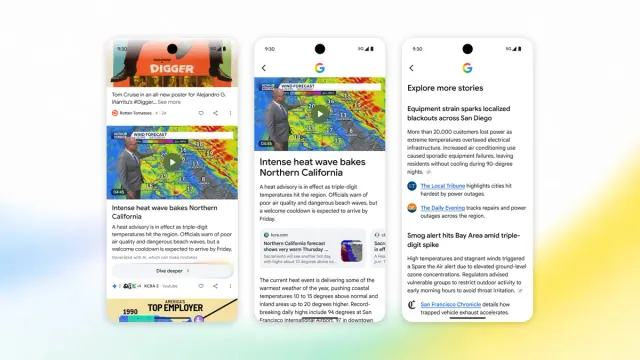
At Google Marketing Live 2025, Google signaled that ads would soon appear within its conversational AI search results, powered by Performance Max campaigns. This plan felt futuristic, but by November, ads were already visible in the middle of Google’s AI Overview answers. Instead of being pushed to the side or marked as separate, these ads appeared as part of the conversational flow, reaching users directly while they read AI-generated responses.
Ads like these now appear for a broad range of queries, no matter the device. Many marketers expected they would have years to prepare. Instead, the shift happened in just a few months. Google’s rollout outpaced previous upgrades such as the years-long adoption of responsive search ads. This time, there was barely a warning.
Search Pages Are Becoming Conversations
Google uses information from active Search, Shopping, and Performance Max campaigns and simply weaves those existing assets into conversational answers. Advertisers didn’t have to change anything; participation was automatic. This approach sounds simple, but it introduces new problems.
Marketers are struggling to see which queries trigger their ads. Critical data points like specific click-through rates for these AI placements are missing. Tracking user journeys is tough because people may engage with several AI-generated answers before clicking an ad. Some advertisers reported that while their impressions stayed steady, click-through rates dropped over 20 percent in six weeks. The reason? Users often find what they need in the AI’s answer, so they click less.
Performance Max Takes Center Stage
Performance Max is now the main driver for these new placements. Brands that treated PMax as a side project quickly discovered it is essential. Early results show that well-structured PMax setups can boost efficiency. Some case studies saw cost per acquisition drop from $42 to $31 within two months, assuming they invested in broader asset libraries and accurate tracking. However, one-size-fits-all creative no longer works. Advertisers must build deep libraries of images, headlines, and themed variations because the AI system relies on variety to match each conversation.
Google has added more manual controls for cautious advertisers. Negative keywords, customer data integrations, and device exclusions are all available now—features that weren’t there in the early PMax pitch. These changes reflect the ongoing push and pull between automated ease and advertiser control.
Unanswered Questions About Data and Compliance
Compliance isn’t just a background concern. Laws like GDPR and CCPA require companies to know exactly how AI uses customer data. Yet, most marketing teams can’t fully explain why an algorithm chooses one user over another. CivicScience recently found that over a third of U.S. adults feel less likely to buy from brands using AI-driven ads, highlighting the need for both transparency and trust.
What Comes Next
Classic search results won’t vanish completely, especially for simple buying or local queries. For research or discovery topics, conversational answers are taking over. As ads become integral to those answers, the lines between marketing and unbiased information blur.
Winning in this environment depends on high-quality data, robust system design, and constant human oversight. Marketers who rely only on automation may see quick wins but risk losing the strategic edge needed for long-term growth.
If you’re running search campaigns today, you’re already part of this transformation. The speed of change suggests that everyone needs to adapt quicker than planned.
Get the monthly briefing
One high-signal edition a month on B2B growth, AI search, and agentic marketing. No noise, unsubscribe anytime.