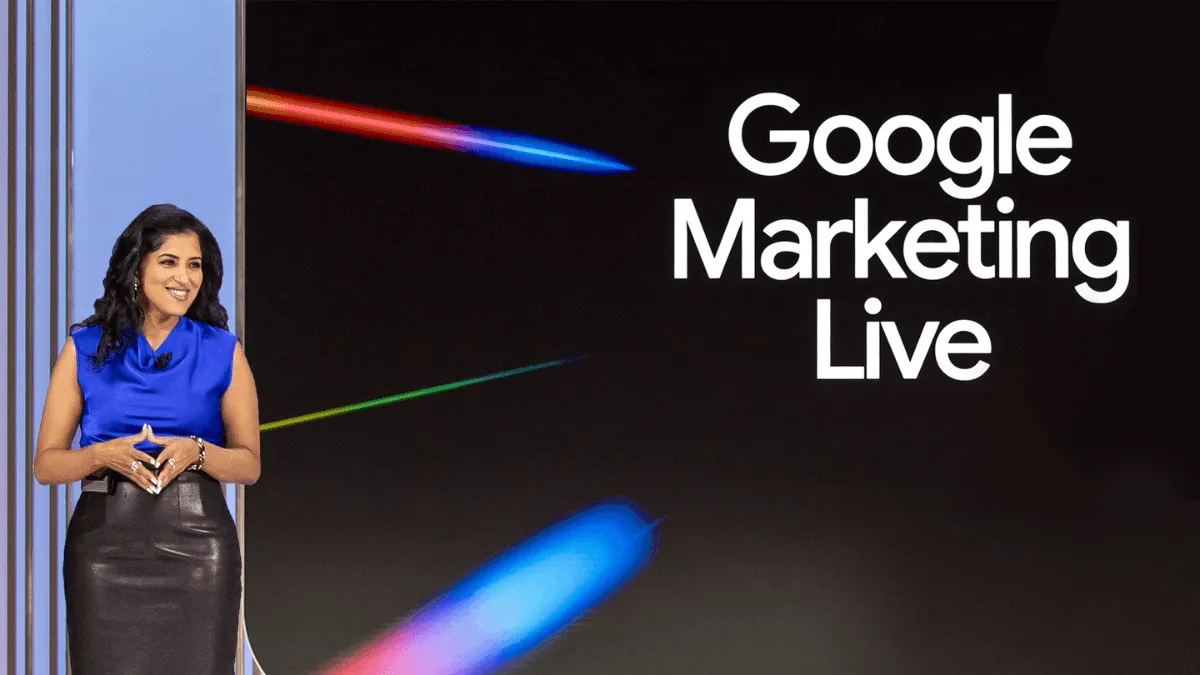
Last night Google Marketing Live 2026 had a lot of announcements.
Some of them were expected. Some were much bigger than expected.
And honestly, if you’ve been watching where search, advertising, and AI are heading over the last two years, this feels like the moment where all the pieces finally connected.
I’ve been talking for a while about how:
- search is becoming conversational,
- static ads will slowly lose relevance,
- AI will move from assisting campaigns to actually running large parts of campaigns,
- and marketers will spend less time operating ad platforms and more time guiding AI systems.
Now all of that is here.
And not just inside Search.
Google is rebuilding advertising across:
- Search,
- YouTube,
- Google Maps,
- Shopping,
- Merchant Center,
- and Gemini itself.
What happened yesterday was not simply a product update.
Google basically showed us how advertising works in an AI-first internet.
And the biggest takeaway is this: Marketing is moving from manual execution to AI-guided orchestration.
Here Are the 8 Most Important Announcements You Need to Pay Attention To:
1. Search Ads Are Becoming Conversations
This was the clearest message from the event.
Google Search is no longer just a place where users type keywords and see static ads.
It’s becoming an AI conversation layer powered by Gemini.
Google introduced:
- Conversational Discovery Ads
- AI-generated Direct Offers
- Business Agent for Leads
- Conversational shopping recommendations
- AI-native search placements
This changes advertising completely.
For years, search advertising worked like this:
User enters keyword → advertiser bids → ad appears.
Now the experience looks more like this:
User asks a complex question → Gemini understands intent → AI generates recommendations, comparisons, answers, and ads contextually.
That is a massive shift.
Because users are increasingly searching in natural language now.
Instead of:
- “best CRM software”
they ask:
- “What’s the best CRM for a telecom sales team with long enterprise cycles?”
Instead of:
- “running shoes”
they ask:
- “What’s the best running shoe for flat feet and marathon training?”
These are conversations, not keywords.
And Google clearly understands that the future of advertising sits inside those conversations.
2. AI Max Is Quietly Becoming Mandatory
Another major announcement:
Google is pushing advertisers deeper into AI-driven campaign ecosystems like AI Max and Performance Max.
Dynamic Search Ads are being phased out.
And honestly, this tells us where Google wants advertising to go.
The platform increasingly wants marketers to provide:
- business goals,
- audience signals,
- first-party data,
- creative assets,
- margin goals,
- and brand guardrails,
while Gemini handles:
- targeting,
- bidding,
- optimization,
- creative matching,
- placements,
- and conversion prediction.
A lot of marketers will feel uncomfortable with this because it reduces manual control.
But the reality is:
manual optimization is becoming less valuable compared to strategic inputs.
The advantage is shifting toward:
- better customer understanding,
- stronger positioning,
- cleaner data,
- and better creative direction.
The marketers who adapt fastest will stop behaving like campaign operators.
They’ll behave more like AI strategists.
3. Google Is Turning Ads Into Interactive Shopping Experiences
This was another huge theme across the announcements.
Google is trying to remove friction between discovery and purchase.
And it’s doing this by connecting AI across:
- Search
- Shopping
- YouTube
- Maps
- Gmail
- Gemini
The new Universal Cart and commerce integrations show exactly where this is heading.
Google wants users to:
- discover products,
- compare products,
- ask questions,
- watch reviews,
- check pricing,
- and complete purchases
without leaving Google-powered environments.
That changes ecommerce advertising significantly.
Because product visibility is no longer only about:
- bidding aggressively,
- ranking for keywords,
- or writing better ad copy.
Now products must also be understandable by AI systems.
That means:
- stronger product feeds,
- richer metadata,
- conversational product descriptions,
- customer reviews,
- inventory accuracy,
- and structured product information
become increasingly important.
Your product now needs to sell not only to humans…
…but also to AI recommendation engines deciding what humans should see.
4. Google Maps Is Becoming Conversational Too
One of the most overlooked announcements from the event was the evolution of Google Maps.
Maps is moving beyond location search into contextual recommendations.
Instead of users typing:
- “restaurants near me”
they can ask:
- “Best quiet café nearby to work from”
- “Good family-friendly Italian restaurant open late”
- “Best business lunch place with parking”
This matters because local advertising and local SEO are changing fundamentally.
AI is now evaluating:
- reviews,
- sentiment,
- context,
- relevance,
- reputation,
- and customer experience signals
far more deeply than traditional keyword-based systems.
For local businesses, this means visibility will increasingly depend on:
- trust,
- experience quality,
- structured data,
- and reputation consistency.
Not just local keyword optimization.
5. YouTube Is Becoming a Full-Funnel Commerce Platform
For years, many marketers treated YouTube mainly as a reach and awareness platform.
That’s changing fast.
Google announced major expansions around:
- Demand Gen
- Creator partnerships
- Shopping integrations
- Product feeds
- Performance attribution
One of the smartest moves was allowing brands to identify creator videos organically featuring their products and amplify them directly into ads.
That’s important because consumer behavior itself has changed.
People trust creators more than polished corporate advertising.
And Google understands that creator-driven discovery is now a core part of the buying journey.
Especially for:
- younger audiences,
- ecommerce,
- software recommendations,
- lifestyle products,
- and even B2B education.
This also signals something bigger: Advertising is becoming personality-driven.
Not just keyword-driven.
And marketers who ignore creator ecosystems are going to struggle in AI-driven discovery environments.
6. Creative Production Is About to Change Completely
Google also deeply integrated Gemini into creative workflows through Asset Studio.
This means marketers can generate:
- videos,
- images,
- ad copy,
- creative variations,
- product creatives,
- and placement-specific assets
using prompts and brand guidelines.
This is going to dramatically increase the amount of advertising content online.
Every brand will soon be able to generate thousands of creative variations almost instantly.
But there’s an important reality many companies will learn very quickly:
AI can scale content production.
It cannot automatically create strong positioning.
And that matters because the internet is about to become flooded with AI-generated ads that all start sounding and looking similar.
So the brands that win will not necessarily be the brands creating the most content.
They’ll be the brands with:
- stronger messaging,
- better storytelling,
- clearer positioning,
- stronger brand identity,
- and deeper customer understanding.
The strategic layer becomes even more important now.
Not less.
7. Measurement Is Becoming Predictive Instead of Reactive
Another important shift from GML 2026:
Google introduced Qualified Future Conversions.
This is Google using AI to predict long-term business outcomes earlier in the customer journey.
And honestly, this makes sense because modern customer journeys are fragmented now.
Someone might:
- discover a product on YouTube,
- research in Search,
- compare options through Gemini,
- check Maps reviews,
- revisit through retargeting,
- and purchase weeks later.
Traditional attribution models struggle to connect all these touchpoints.
Google is now using AI prediction models to fill those gaps.
This also explains why Google emphasized:
- first-party data,
- server-side tracking,
- Tag Gateway,
- and data infrastructure improvements.
Because AI systems are only as good as the signals they receive.
The brands with stronger data ecosystems will have a major advantage over the next few years.
8. Ask Advisor Shows Where Marketing Operations Are Heading
Google also launched Ask Advisor.
And I honestly think this may become one of the most important long-term announcements.
Ask Advisor connects:
- Google Ads
- Analytics
- Merchant Center
- Google Marketing Platform
through one conversational AI assistant.
Instead of manually pulling reports and navigating dashboards, marketers can ask:
- “Why did ROAS drop last week?”
- “Which audience segment has the highest future value?”
- “Where is creative fatigue happening?”
- “What campaigns deserve more budget?”
- “What products are seeing stronger assisted conversions?”
This signals a major operational shift.
Marketing platforms themselves are becoming conversational.
The future marketer will spend less time clicking through dashboards…
…and more time directing intelligence systems.
What Actually Changes for Marketers After This?
This is the real story behind all the announcements.
The biggest shift is not the tools themselves.
It’s the role of the marketer.
For years, digital marketing rewarded operational expertise:
- bid management,
- campaign setup,
- keyword sculpting,
- audience layering,
- platform navigation.
Now AI is increasingly handling those mechanics.
Which means human value shifts toward:
- strategy,
- positioning,
- customer psychology,
- creative direction,
- first-party data,
- messaging,
- and decision-making.
The marketers who adapt fastest will stop thinking like platform operators.
They’ll think more like:
- strategists,
- systems thinkers,
- behavioral analysts,
- and AI orchestrators.
My Biggest Takeaway From Google Marketing Live 2026
Google is rebuilding advertising around AI-driven discovery.
Not just AI-generated ads.
AI-driven customer journeys themselves.
That changes:
- how people search,
- how products are discovered,
- how ads appear,
- how campaigns run,
- how attribution works,
- and how brands compete for attention.
We’re entering a phase where:
- search becomes conversational,
- advertising becomes adaptive,
- campaigns become autonomous,
- creative becomes generative,
- commerce becomes integrated,
- and optimization becomes continuous.
And honestly, I still think we’re early.
Most companies are still operating with workflows built for the previous era of digital marketing.
Yesterday made it very clear where the next era is heading.
TL;DR
Google Marketing Live 2026 made one thing very clear:
Google is rebuilding advertising around AI-driven discovery and conversational experiences.
The biggest shifts announced:
- Search ads are becoming conversational through Gemini-powered AI experiences.
- AI Max and Performance Max are becoming central to future ad inventory.
- Static keyword-based advertising is slowly giving way to intent-driven AI recommendations.
- YouTube is becoming a much stronger commerce and performance channel.
- Google Maps is evolving into a conversational local discovery engine.
- AI-generated creative production is becoming mainstream through Asset Studio.
- Measurement is becoming predictive with AI-driven attribution and Qualified Future Conversions.
- Ask Advisor signals the rise of conversational marketing operations.
The biggest takeaway for marketers:
The competitive advantage is shifting away from manual campaign management and toward:
- strategy,
- first-party data,
- positioning,
- customer understanding,
- creative direction,
- and AI orchestration.
FAQs About Google Marketing Live 2026
Is SEO dead after Google Marketing Live 2026?
No. But SEO is definitely changing.
Traditional keyword-focused SEO alone will become less effective over time as search becomes more conversational and AI-assisted.
Visibility will increasingly depend on:
- authority,
- trust,
- structured information,
- brand reputation,
- topical depth,
- and content that AI systems can confidently reference and recommend.
The goal is no longer just ranking.
The goal is becoming part of AI-generated discovery.
Are keywords becoming irrelevant now?
Not immediately.
Keywords still matter because they help AI systems understand intent and context.
But marketers should understand that Google is moving beyond simple keyword matching toward conversational intent understanding.
Over time, audience signals, behavioral data, context, and AI interpretation will become more important than exact keyword structures.
What happens to traditional Google Ads specialists?
Their role evolves.
The value of manual optimization skills alone will decrease over time as AI handles more campaign execution.
Future advertising teams will focus more on:
- strategy,
- AI briefing,
- customer psychology,
- creative systems,
- first-party data,
- positioning,
- and performance interpretation.
The marketer is becoming more of an AI strategist than a platform operator.
Is Performance Max becoming unavoidable?
Google is clearly pushing advertisers toward AI-driven campaign ecosystems like AI Max and Performance Max.
Many future AI-powered placements and conversational ad experiences will likely depend on these systems.
That does not mean manual campaigns disappear overnight.
But Google’s long-term direction is becoming increasingly obvious.
What does this mean for ecommerce brands?
Ecommerce is about to become far more AI-driven.
Product visibility will increasingly depend on:
- strong product feeds,
- metadata quality,
- reviews,
- inventory accuracy,
- conversational descriptions,
- creator influence,
- and structured product intelligence.
Your products now need to be understandable not only by shoppers…
…but by AI systems recommending products to shoppers.
Why is YouTube becoming more important now?
Because discovery behavior is changing.
People increasingly discover products through:
- creators,
- reviews,
- explainers,
- demos,
- and video-led recommendations.
Google is integrating commerce, AI recommendations, and creator content directly into YouTube advertising ecosystems.
That makes YouTube much more than an awareness channel now.
It’s increasingly becoming a full-funnel commerce platform.
What is Ask Advisor and why does it matter?
Ask Advisor is Google’s conversational AI assistant across:
- Ads,
- Analytics,
- Merchant Center,
- and Google Marketing Platform.
Instead of manually navigating dashboards, marketers can ask questions conversationally and receive insights, recommendations, and analysis.
This signals where marketing operations are heading:
toward conversational intelligence systems instead of manual dashboard management.
What should marketers focus on right now?
The biggest priorities now are:
- Building strong first-party data systems
- Improving positioning and messaging
- Developing AI-assisted creative workflows
- Creating stronger brand differentiation
- Understanding customer intent deeply
- Learning how to guide AI systems strategically
Because as execution becomes automated…
Strategic thinking becomes even more valuable.
Get the monthly briefing
One high-signal edition a month on B2B growth, AI search, and agentic marketing. No noise, unsubscribe anytime.