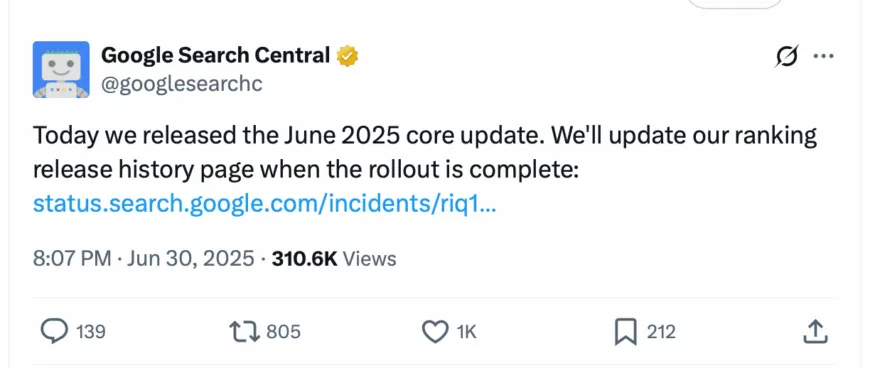
Google officially began rolling out its June 2025 Core Algorithm Update, announcing it via their X account on June 30, 2025, and stated that it may take up to three weeks to complete.
Like every broad core update, this one isn’t targeting a specific violation or spam technique. It’s a recalibration of what Google considers high-quality, helpful content.
But there’s a clear message underneath this update: People-first content, real expertise, and seamless user experience are no longer competitive edges—they’re minimum requirements.
Let’s break down what’s changing, what we’re observing in real time, and how your SEO strategy needs to evolve.
Core Themes of the June 2025 Update
Google reiterated in their Search Central documentation that core updates are about improving how systems assess content overall—not penalizing specific pages.
But this update comes with sharper signals:
1. Helpful Content and E-E-A-T Overlap
Google continues emphasizing the importance of creating content that directly meets user intent and is written by people with real experience and expertise.
Sites that align with E-E-A-T—Experience, Expertise, Authoritativeness, Trustworthiness—are showing resilience or gains post-update. Learn more at Google’s Quality Rater Guidelines
2. AI-Generated Content Without Value Is Losing Ground
The SEO community, including reports from Search Engine Journal, is observing that thin or AI-generated content without added human value is being demoted. This lines up with Google’s consistent messaging:
“Using AI doesn’t violate guidelines—but content must be helpful, original, and written with people in mind.” — Google Search Central
3. UX and Performance Matter More Than Ever
Fast-loading, mobile-optimized sites are gaining traction. Tools like PageSpeed Insights and Core Web Vitals reports are essential to monitor.
Google’s update aligns with their earlier 2021 Page Experience update, which prioritized load speed, interactivity, and visual stability.
Don’t React—Observe First (Yes, Even During a Drop)
During a core update, volatility is expected. As Google advises, don’t make hasty changes during the rollout. Instead:
Monitor These Daily:
- Google Search Console (GSC)
- Track clicks, impressions, average positions.
- Watch Core Web Vitals, especially on mobile.
- Google Analytics 4 (GA4)
- Monitor organic traffic, bounce rates, and average engagement time by page.
- Rank Tracking Tools (SEMrush, Ahrefs, Moz)
- Don’t obsess over daily fluctuations—look for trends.
- Competitor Movement
- If they’re gaining where you’re losing, analyze their E-E-A-T, structure, and technical health.
Tip: Save pre-update data (June 1–29) so you can compare post-update trends after July 21.
What the SEO Community Is Seeing (As of Week 1)
Even though the update is still rolling out, insights are pouring in across industry forums and social channels:
- High Volatility: Tools like Semrush Sensor and Rank Ranger are showing extreme fluctuations across nearly all verticals.
- Content Without Depth Is Dropping: AI-written content without human insight is taking a hit.
- User-Generated Content Is Rising: Forums like Reddit, Quora, and niche communities are gaining visibility, likely due to authentic, diverse perspectives.
- Structured, In-Depth Content Wins: Pages using FAQ schema, HowTo markup, and organized formatting are seeing gains.
— Supported by recent research from Ahrefs on rich snippet optimization.
After the Rollout: It’s Time to Analyze and Act
Once Google confirms the rollout is complete, here’s how to approach your data:
1. Compare Pre/Post Performance
Use GSC and GA4 to compare:
- Clicks, impressions, and rankings by page
- Engagement and conversions from organic
- Keyword movements (top gainers and losers)
2. Review Affected Pages
Ask these tough questions:
- Is the content thin, outdated, or generic?
- Is authorship clear and credible?
- Are there original insights or research?
- Was the content lightly edited from an AI tool?
3. Technical SEO Health Check
Even if content is good, technical issues can limit performance:
- Site speed and mobile-friendliness
- Structured data and internal linking
- Broken links or redirect chains
- Secure browsing (HTTPS)
Tools like Screaming Frog, Ahrefs Site Audit, or Google Lighthouse are invaluable here.
Moving Forward: Your SEO Playbook Post-June 2025
This update reinforces what we’ve seen since 2023: SEO is no longer about “hacking the algorithm.” It’s about building real content for real people—with the technical rigor to support it.
Here's your action plan:
- Audit and update underperforming content
- Consolidate or delete outdated and low-value pages
- Invest in authorship, expertise, and original insights
- Improve page experience and technical performance
- Use structured data to enrich search appearance
As Google keeps evolving, shortcuts will backfire. What works long term? Content that teaches, solves, or inspires—rooted in credibility and built with users in mind.
Final Thought
The June 2025 Core Update isn’t a disruption. It’s a reminder. A reminder that SEO, at its core, is about serving people—not just search engines.
If your content is real, useful, well-structured, and technically sound, you’re on the right side of this shift.
Now’s the time to double down on quality. Not to recover from this update, but to build resilience for the next.
Get the monthly briefing
One high-signal edition a month on B2B growth, AI search, and agentic marketing. No noise, unsubscribe anytime.