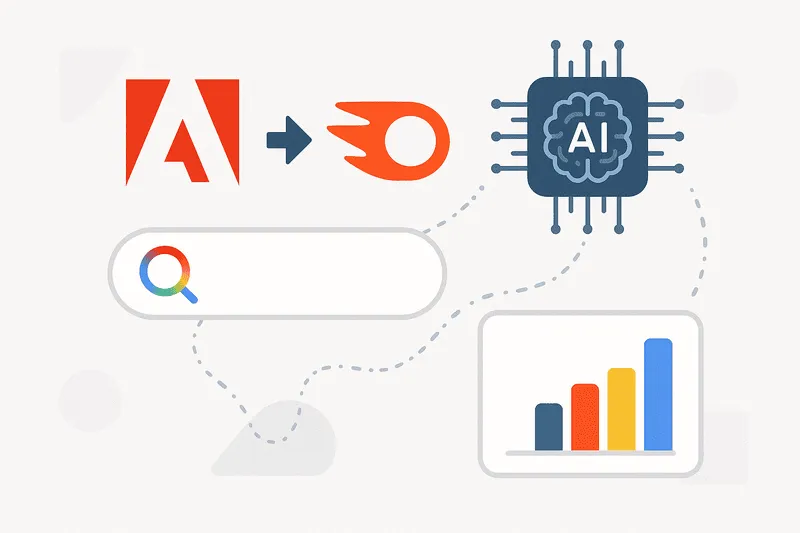
Attention my fellow SEO and AI Search Marketing folks… Adobe will acquire Semrush. Yes, one of our favourite SEO and GEO tools.
We have been talking about LLM visibility nonstop. We have been testing prompts, monitoring how ChatGPT and Gemini describe our brands, experimenting with GEO strategies, fixing hallucinated product info, influencing sources LLMs trust, and helping our clients show up inside AI answers.
Now this moment just changed the entire landscape.
Adobe has agreed to acquire Semrush in an all-cash deal valued at $1.9 billion, paying $12.00 per share, which is about a 77 percent premium over Semrush’s last closing price. The companies entered into a definitive agreement, and the deal is expected to close in the first half of 2026, pending regulatory and shareholder approvals.
For our industry, this is not a simple “big company buys a popular tool” story. This is a signal that GEO and AI Search Marketing are now official enterprise-level priorities.
Let’s break down what this actually means for us as practitioners and leaders in SEO.
Why this acquisition is a big deal for SEOs and AI search marketers
1. GEO just graduated into a mainstream enterprise discipline
Adobe’s own explanation of the acquisition is very clear. They highlight that customers are turning to LLMs such as ChatGPT and Google Gemini for information, recommendations, and purchase decisions. Adobe directly says that brand visibility is being reshaped by generative AI.
This is what we have been telling clients for the past year.
Now Adobe is telling the Fortune 100 the exact same thing.
Semrush brings ten years of SEO expertise and a strong GEO product line that helps brands stay visible across LLMs, traditional search, and the wider web. Adobe explicitly positions Semrush’s GEO tech as a new growth channel alongside SEO.
This legitimizes everything we have been building.
2. This will shape how brands track visibility in AI platforms
If you have been doing LLM audits or AI answer mapping, you already know how valuable GEO metrics are. Semrush has been giving us tools to track:
- How LLMs mention our brands
- How accurate those mentions are
- Which sources LLMs rely on
- How we compare against competitors
- Where we need to influence signals
Once this becomes part of Adobe Experience Cloud, it will sit next to Adobe Analytics, AEM, and Adobe Brand Concierge. Adobe says the combined platform will give marketers a holistic view of how their brands appear across owned channels, search engines, LLMs, and the entire web.
This is huge because it means:
- GEO and SEO will be measured together
- AI discovery will appear in enterprise attribution models
- Visibility inside LLMs will become a standard performance indicator
We have been preparing for this moment. Now it is arriving.
How this affects us day-to-day as SEO professionals
1. Expect more questions from leadership
Once Adobe starts talking about GEO as an official part of brand visibility, your CMO, VP of Growth, or client’s CEO will start asking:
- How visible are we inside ChatGPT?
- Why does Gemini describe our competitors differently?
- How much AI search traffic are we getting?
- How do we improve our standing in LLM answers?
This trend was already building. Adobe just mainstreamed it.
2. AI search marketing will be part of every roadmap
The moment Semrush sits inside Adobe, GEO becomes a line item in:
- SEO roadmaps
- Content calendars
- Brand guidelines
- Performance dashboards
- Acquisition strategies
This is good news for us. It pushes the industry to mature and adopt LLM visibility as a formal responsibility.
3. Agencies and consultants will need an AI visibility offering
If you run an agency or consult independently, you will need to expand your service menu with:
- LLM visibility audits
- GEO playbooks
- AI-driven brand sentiment monitoring
- Prompt-based visibility tracking
- AI search share-of-voice reporting
This acquisition forces the entire SEO industry to evolve.
The elephant in the room: pricing and accessibility
Let us talk honestly.
Adobe tends to bundle and push enterprise pricing.
Semrush has already been adding more add-ons and higher-tier features.
When the deal closes, it is reasonable to expect:
- Higher pricing for advanced GEO features
- More bundling into Adobe Experience Cloud
- A stronger enterprise and mid-market focus
- Fewer aggressively-priced SMB or freelancer plans
This will not disrupt enterprise teams.
But it will impact smaller agencies, solo SEOs, and early-stage startups.
Many in the community will start comparing:
- Ahrefs
- SE Ranking
- Similarweb
- Smaller GEO-focused tools
This was already happening. The acquisition will accelerate it.
Why Adobe really wants Semrush
Here is the strategic picture, backed by the press release:
Content supply chain + customer experience + brand visibility
Adobe says it is leading customer experience orchestration in the agentic AI era and Semrush perfectly fills the visibility gap.
Enterprise marketers need unified visibility
Adobe says brands want a full view of how they appear across LLMs, search, and owned channels. Semrush provides that.
GEO solves a growing problem
Semrush helps brands remain discoverable in AI search, which Adobe directly names as an essential need.
Consumer behavior is shifting fast
Adobe cites a 1,200 percent increase in traffic from generative AI sources to U.S. retail sites.
This is not a defensive acquisition. It is an offensive one.
What SEOs should do next
Here is the practical part.
1. Start reporting GEO alongside SEO
Make it a section in every monthly update.
2. Track AI answer accuracy for branded queries
Map the prompts and monitor how LLMs describe your clients.
3. Identify sources LLMs trust in your industry
Google is not the only visibility channel anymore.
4. Build a simple LLM visibility scorecard
It will become a standard dashboard item once the acquisition closes.
5. Prepare for tool stack changes
Export your data. Note your dependencies. Keep an alternative ready.
This is not fear. It is professionalism.
A simple analogy for our industry
This acquisition feels like Semrush built an advanced AI visibility radar and Adobe is about to mount it on the deck of one of the largest enterprise ships on the ocean.
- Enterprise teams will see farther.
- Their visibility pipelines will be automated.
- Their attribution models will include LLM search.
Smaller teams will still navigate the same waters, but the radar might no longer be priced for all of us.
This is the new era. And we get to help shape it.
Get the monthly briefing
One high-signal edition a month on B2B growth, AI search, and agentic marketing. No noise, unsubscribe anytime.